
- Get in Touch with Us

Last Updated: Aug 13, 2026 | Study Period: 2026-2032
Built from installed-capacity battery gigafactory tracking, teardown cost modelling, public capital-expenditure disclosures across EV OEMs & ESS integrators, official production statistics, and cell chemistry yield documentation. The analysis addresses three critical buyer decisions: optimal cathode/anode formulation selection, supply security via multi-sourcing, and strategic localization of cell-to-pack (CTP) assembly assets.
Calibrated estimate. Scope covers global production and shipment values of 2170 (21mm x 70mm) cylindrical lithium-ion cells across high-nickel NMC, NCA, LFP/LMFP, and silicon-anode formulations. Includes primary cell manufacturing, cell-to-module/pack integration components, and direct B2B supply contracts for Electric Vehicles (EVs), Energy Storage Systems (ESS), power tools, and micromobility. It excludes solid-state pouch cells, 4680 large-format cylindrical cells, legacy 18650 cells, raw mineral extraction, and standalone BMS software licensing.
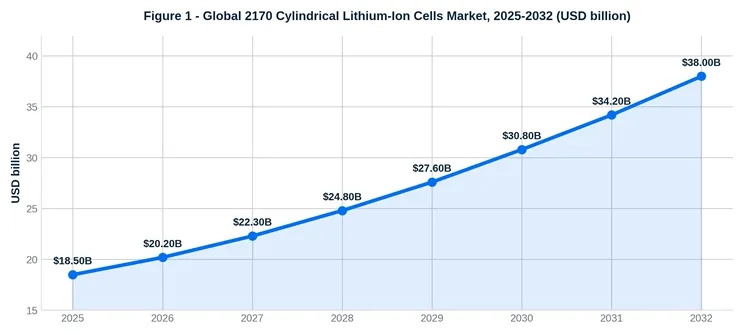
The 2025 baseline estimate of $18.50 billion is derived from an estimated 142-158 GWh global shipment volume of 2170 cylindrical cells across automotive, industrial, and energy storage end-markets. An average cell-level selling price (ASP) of $0.115-$0.130 per Wh is applied depending on cathode chemistry (High-Nickel vs. LFP) and volume tier, then adjusted for yield loss, warranty reserves, and long-term B2B take-or-pay agreement discounts. This yields a base-year valuation range of $16.80-$20.10 billion.
Growth to 2032 is underpinned by systemic structural demand rather than simple volumetric expansion. Electric vehicle platforms continue to adopt optimized 2170 module designs due to their mature manufacturing yield and thermal isolation capabilities.
The 2170 cylindrical lithium-ion cell (21mm diameter, 70mm height) represents a sweet spot in battery engineering, offering approximately 50% higher energy capacity per cell compared to legacy 18650 formats while maintaining superior structural rigidity and heat dissipation relative to large-format prismatic or pouch cells. Covered chemistries span Nickel Manganese Cobalt (NMC 811, 622), Nickel Cobalt Aluminum (NCA), Lithium Iron Phosphate (LFP/LMFP), and next-generation Silicon-Graphite composite anodes.
The market structure differs significantly from standard commodity components. Producing high-density 2170 cells requires extreme precision, ultra-clean dry room conditions (dew point below -40°C), micro-meter electrode coating tolerances, and automated high-speed tab-welding systems.
By 2032, 2170 cell manufacturing will be defined by localized regional supply ecosystems and advanced tabless internal architecture. While Asia-Pacific will maintain substantial cell production, North American and European gigafactories will claim an increased share of global volume to satisfy regional content rules and reduce transatlantic freight costs.
Cell-level technology content is set to surge. Leading manufacturers are deploying tabless cathode/anode designs within the 2170 form factor to cut internal ohmic resistance by up to 60%, drastically reducing heat generation during 15-minute ultra-fast charging.
| Technology / Chemistry | Adoption Level | 2025-2032 Direction |
|---|---|---|
| High-Nickel NMC (811) | Very High | Mandatory standard for long-range EV packs, high energy density, and performance vehicles. |
| NCA Formulations | High | Established in premium EV platforms; expanding into high-drain power tools and aviation. |
| Cylindrical LFP / LMFP | Medium-High | Scaling in utility ESS and budget mobility where thermal safety and lower cost trump energy density. |
| Dry Electrode Coating | Medium | Emerging process technology aimed at lowering gigafactory energy consumption and capital expenditure. |
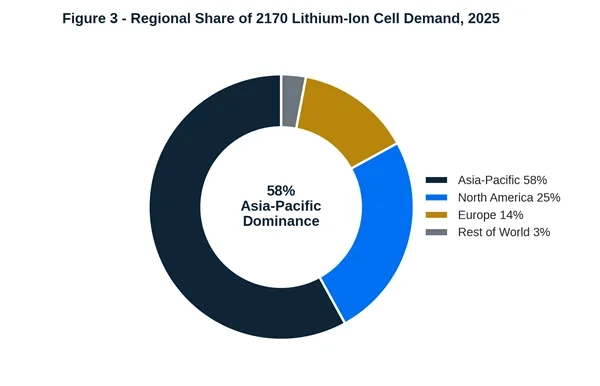
| Region | 2025 Share | CAGR | Demand and Service Position |
|---|---|---|---|
| China | 38% | 8.5% | Largest production hub; deeply integrated cathode/anode supply chain and massive domestic ESS demand. |
| North America | 25% | 13.8% | Fastest-growing market led by US gigafactories, IRA tax incentives, and robust EV pack assembly. |
| Europe | 14% | 12.2% | Rapid expansion of localized cell capacity driven by EU carbon mandates and regional EV manufacturing hubs. |
| Rest of World | 3% | 9.0% | Emerging assembly footprints in India and Southeast Asia focusing on 2-wheeler/3-wheeler electrification. |
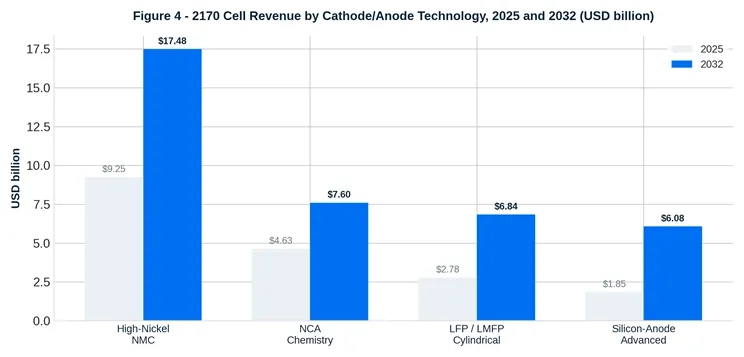
| Chemistry Family | 2025 | 2032 | CAGR | Market Demand & Application |
|---|---|---|---|---|
| High-Nickel NMC | $9.25B | $17.48B | 9.5% | Dominant in premium & long-range EV platforms; high energy density requirements. |
| NCA Chemistry | $4.63B | $7.60B | 7.3% | High power output; established in flagship electric vehicles and high-end power tools. |
| LFP / LMFP Cylindrical | $2.78B | $6.84B | 13.7% | Surging in commercial energy storage, residential backup, and low-cost mobility. |
| Provider Group | Representative Participants | Primary Market Position |
|---|---|---|
| Tier-1 Cell Giants | Panasonic Energy, LG Energy Solution, Samsung SDI, CATL | Proprietary cell chemistry, multi-GWh automated lines, direct OEM long-term contracts. |
| Emerging Cylindrical Specialists | EVE Energy, BAK Battery, SVOLT, Gotion High-Tech | High-flexibility lines, competitive LFP/LMFP 2170 pricing, rapid capacity scaling. |
| Component & Anode Innovators | Sila Nanotechnologies, Group14, Enovix, Hitachi Chemical | Advanced silicon anodes, dry coating technology, custom electrolyte additives. |
| Pack Integrators & MRO | Hubbell, Custom Cells, Cleantron, OEM internal pack teams | Module/pack assembly, thermal management integration, lifetime battery servicing. |
| Segmentation | Coverage |
|---|---|
| By Cathode Chemistry | High-Nickel NMC (NMC 811, 622); Nickel Cobalt Aluminum (NCA); Lithium Iron Phosphate (LFP/LMFP); Silicon-Anode Advanced. |
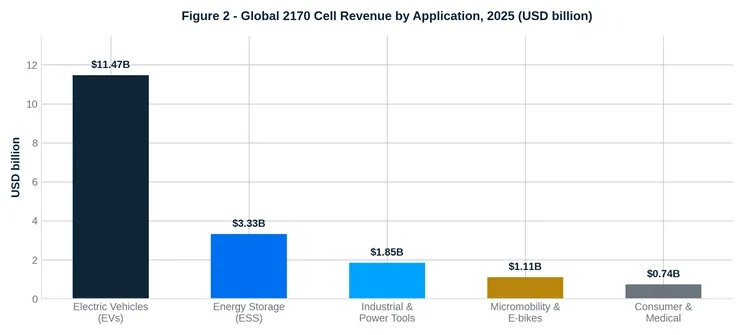
| By End-Use Application | Electric Vehicles (EV Pass-Car & Commercial); Energy Storage Systems (Utility, C&I, Residential); Industrial & Power Tools; Micromobility & E-bikes; Consumer Electronics & Medical. |
| By Cell Component / Value Layer | Active Cathode Materials; Anode & Silicon Additives; Separators & Electrolyte; Cell Casing & CID Assembly; Pack Integration. |
| By Sales Channel | Direct Automotive OEM Off-Take; Tier-1 Battery Pack Integrators; Industrial B2B Distribution; Aftermarket Replacement. |
| By Geography | North America (US, Canada); Europe (Germany, France, UK, Nordics); Asia-Pacific (China, S. Korea, Japan, India, SE Asia); Rest of World. |
The market estimation utilizes a rigorous bottom-up capacity and vehicle-production modeling approach. Global battery manufacturing plants, Gigafactory operational statuses, and line expansion plans were mapped against EV model production statistics, energy storage project deployments, and industrial power tool shipment volumes. Average cell capacities (Ah) and energy content (Wh) were calculated by chemistry to derive total Gigawatt-hour (GWh) demand.
Cell pricing models incorporate multi-year raw material spot/futures prices (lithium carbonate/hydroxide, nickel sulphate, synthetic graphite) alongside processing cost overlays, yielding accurate B2B average selling prices (ASPs). Provider shares and segment proportions reflect analyst adjustments based on off-take agreements, public filings, and primary market interviews.
The global 2170 cylindrical lithium-ion cells market is undergoing a structural evolution from commodity manufacturing toward high-performance, regionally localized energy storage solutions. While Asia-Pacific maintains cell production leadership, rapid gigafactory expansions in North America and Europe will redefine global supply dynamics. Cell producers that master tabless manufacturing, integrate silicon anodes, and secure localized raw material supply chains will capture outsized market share through 2032.
| Sr No | Topic |
|---|---|
| 1 | Market Segmentation |
| 2 | Scope of the report |
| 3 | Research Methodology |
| 4 | Executive summary |
| 5 | Key Predictions of 2170 Cylindrical Lithium-Ion Cells Market |
| 6 | Avg B2B price of 2170 Cylindrical Lithium-Ion Cells Market |
| 7 | Major Drivers For 2170 Cylindrical Lithium-Ion Cells Market |
| 8 | Global 2170 Cylindrical Lithium-Ion Cells Market Production Footprint - 2025 |
| 9 | Technology Developments In 2170 Cylindrical Lithium-Ion Cells Market |
| 10 | New Product Development In 2170 Cylindrical Lithium-Ion Cells Market |
| 11 | Research focuses on new 2170 Cylindrical Lithium-Ion Cells |
| 12 | Key Trends in the 2170 Cylindrical Lithium-Ion Cells Market |
| 13 | Major changes expected in 2170 Cylindrical Lithium-Ion Cells Market |
| 14 | Incentives by the government for 2170 Cylindrical Lithium-Ion Cells Market |
| 15 | Private investments and their impact on 2170 Cylindrical Lithium-Ion Cells Market |
| 16 | Market Size, Dynamics, And Forecast, By Type, 2026-2032 |
| 17 | Market Size, Dynamics And Forecast, By Output, 2026-2032 |
| 18 | Market Size, Dynamics, And Forecast, By End User, 2026-2032 |
| 19 | Competitive Landscape Of 2170 Cylindrical Lithium-Ion Cells Market |
| 20 | Mergers and Acquisitions |
| 21 | Competitive Landscape |
| 22 | Growth strategy of leading players |
| 23 | Market share of vendors, 2025 |
| 24 | Company Profiles |
| 25 | Unmet needs and opportunities for new suppliers |
| 26 | Conclusion |
© 2017-2026 Mobility Foresights Pvt Ltd. All rights reserved.
Developed with by ClousTech