
- Get in Touch with Us

Last Updated: Aug 13, 2026 | Study Period: 2026-2032
Built from installed-capacity teardown modeling across EV gigafactories, public capital-expenditure disclosures, official battery production data and equipment-OEM technical documentation. The analysis addresses three strategic decisions: which cell chemistries scale fastest, where tabless dry-coating bottlenecks occur, and which manufacturing regions lead global commercial supply.
Calibrated estimate. Scope covers cell manufacturing, supply chain, dry-electrode technology adoption, tabless design integration, cathode chemistries (high-nickel NMC, NCA, LFP, LMFP), structural battery pack integration, and end-use applications across passenger electric vehicles, commercial trucks, stationary energy storage, and high-power industrial equipment. It excludes legacy 18650 and 21700 cylindrical formats, pouch cells, and raw material mining operations.
The 2025 base-year midpoint of $3.85 billion is derived from an estimated 38 GWh to 44 GWh of global effective 4680 cell shipments across automotive and energy storage channels. Applying an average cell-level factory price range of $88-$102/kWh across high-nickel and LFP variants, then adjusting for initial manufacturing scrap rates and captive OEM internal transfer pricing, yields a base-year calibrated market range of $3.20-$4.40 billion.
Growth through 2032 is propelled by scaling cell manufacturing yields, rapid commercial adoption beyond early adopters, and localized supply chain mandates. High-volume integration into structural pack designs (cell-to-pack and cell-to-chassis) eliminates module hardware, offsetting raw material cost pressures. Increased yield stability in continuous dry-electrode coating and high-speed tabless laser welding reduces scrap rates from historical highs of 30%+ down to benchmark cell industry standards below 5%. Inflation and higher energy-density material blends support value retention over the forecast period.
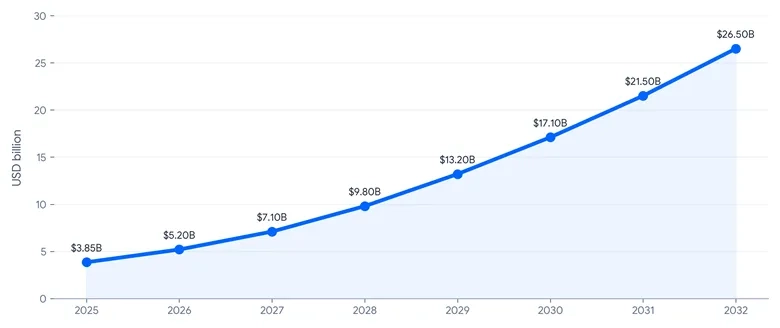
The 4680 cylindrical lithium-ion cell (46mm diameter by 80mm height) represents a paradigm shift in energy storage architecture for electric mobility and large-scale energy systems. Offering five times the volume and up to six times the power output of legacy 21700 cells, the 4680 form factor optimizes pack-level volumetric efficiency while reducing the total number of individual cells, electrical connections, and structural support components required in modern battery packs.
Unlike traditional small-format cylindrical batteries, scaling to a 46mm diameter creates severe thermal and electrical resistance challenges if manufactured using conventional single-tab or double-tab designs. The commercial viability of the 4680 format relies on three core technological innovations: tabless current collection geometry, continuous dry battery electrode (DBE) coating, and structural integration into vehicle chassis assemblies.
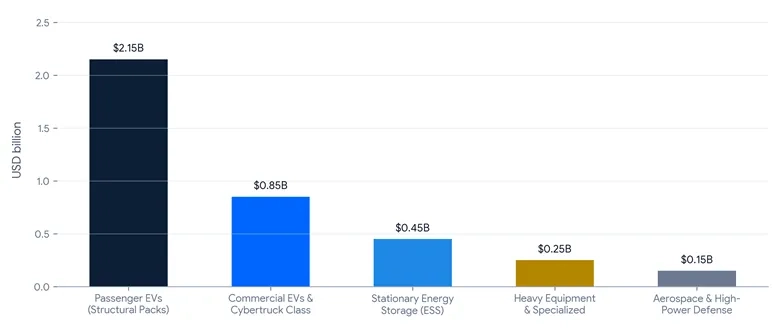
By 2032, 4680 cylindrical cell manufacturing will transition from concentrated pilot plants into standardized, high-yield gigafactory architectures distributed across North America, Europe, and Asia. While initial deployments focused heavily on premium electric light trucks and structural passenger cars, scaling production volumes will push 4680 cells into mass-market EV platforms, commercial delivery fleets, and stationary energy storage systems (ESS).
Technology roadmaps indicate that dry electrode manufacturing will achieve universal commercialization by 2028, enabling lower energy consumption and solvent-free production lines. Furthermore, silicon-synthetic graphite composite anodes and manganese-rich LMFP cathodes will gain substantial market share, widening the performance window and dramatically reducing dependency on expensive cobalt and high-purity nickel feedstocks.
| Application / Feature | Adoption Level | 2025-2032 Direction |
|---|---|---|
| Structural Passenger EVs | Very High | Standardizing across high-volume EV platforms and cell-to-chassis architectures. |
| Tabless Laser Welding | Very High | Mandatory process requirement for thermal management and low internal resistance. |
| Dry Battery Electrode (DBE) | High | Rapidly scaling as web-handling and calender roll pressing yields stabilize. |
| LFP / LMFP 4680 Chemistries | High | Expanding rapidly in entry-level EVs and stationary energy storage applications. |
| Silicon-Composite Anodes | Medium-High | Growing adoption to achieve target energy densities exceeding 300 Wh/kg. |
| Solid-State 4680 Integration | Medium | Emerging pilot lines targeting ultra-high performance and defense applications. |
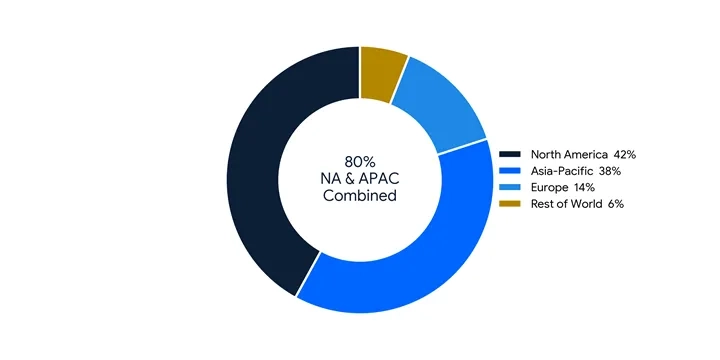
| Region | 2025 Share | CAGR | Demand and Production Position |
|---|---|---|---|
| North America | 42% | 33.5% | Largest market demand driven by structural EV integration and IRA localized production mandates. |
| Asia-Pacific | 38% | 30.8% | Dominant cell manufacturing cluster lead by Japanese, South Korean, and Chinese gigafactories. |
| Europe | 14% | 29.5% | Expanding automotive manufacturing base adoption driven by BMW Neue Klasse and regional battery hubs. |
| Rest of World | 3% | 22.1% | Niche high-power industrial, defense, and specialized energy storage installations. |
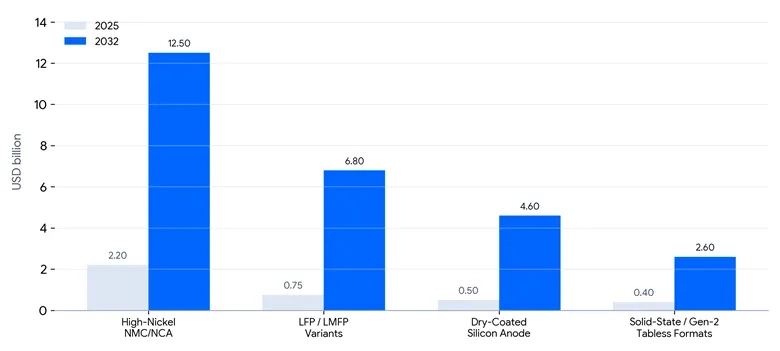
| Cathode Chemistry / Format | 2025 | 2032 | CAGR | Market Demand & Integration |
|---|---|---|---|---|
| High-Nickel NMC/NCA | $2.20B | $12.50B | 28.2% | Primary chemistry for long-range EVs and high-payload vehicle platforms. |
| LFP / LMFP Variants | $0.75B | $6.80B | 37.0% | Fastest growing segment targeting cost-sensitive EVs and stationary ESS. |
| Dry-Coated Silicon Anode | $0.50B | $4.60B | 37.3% | High energy-density segment utilizing solvent-free electrode processing. |
| Solid-State / Gen-2 Formats | $0.40B | $2.60B | 30.6% | Next-generation tabless formats engineered for extreme thermal stability. |
| Provider Group | Representative Participants | Primary Market Position |
|---|---|---|
| Tier-1 Cell Manufacturers | Panasonic, LG Energy Solution, CATL, EVE Energy, Samsung SDI | High-volume mass production, global logistics, long-term OEM supply contracts. |
| Captive Automotive OEMs | Tesla Giga Texas / Berlin, OEM Joint Ventures | In-house structural cell line development, direct vehicle platform integration. |
| Equipment & Automation OEMs | Wuxi Lead, Schuler, GROB, Trumpf, Keyence | Turnkey tabless winding, high-speed laser welding, vision inspection machinery. |
| Advanced Material Developers | Sila Nanotechnologies, Group14, Superior Graphite, Ningbo Shanshan | High-capacity silicon anodes, dry-processable binders, high-nickel precursors. |
Competitive advantage in the 4680 cell market is determined by manufacturing yield stability, dry-electrode coating proficiency, laser-welding precision, and low-cost feedstock sourcing. Tier-1 cell producers lead high-volume merchant supply, while captive automotive facilities push structural vehicle integration boundary limits.
| Segmentation Dimension | Coverage and Categories |
|---|---|
| By Cathode Chemistry | High-Nickel NMC (NMC 811 / 9.5.5); High-Nickel NCA; LFP (Lithium Iron Phosphate); LMFP; Advanced Solid-State Formats. |
| By Process Technology | Dry Battery Electrode (DBE) Coating; Wet Slurry Coating; Tabless Laser Edge-Welding; Standard Multi-Tab Design. |
| By Vehicle / End-Use Class | Passenger Electric Vehicles (Sedans, SUVs); Light & Commercial EVs (Cybertruck, Vans); Heavy Equipment & Mining; Stationary ESS. |
| By Integration Architecture | Structural Cell-to-Chassis (CTC); Cell-to-Pack (CTP); Conventional Module-Based Battery Packs. |
| By Geography | North America (US, Canada); Asia-Pacific (China, Japan, South Korea, India); Europe (Germany, UK, France, Sweden); Rest of World. |
The market estimation utilizes a rigorous bottom-up installed-capacity and volume-build model. Cell manufacturing throughput is mapped across operational and planned 4680 gigafactories worldwide. Cell revenue is calculated from public EV production volumes, battery pack capacity specifications (kWh/vehicle), equipment supply contracts, and localized cell unit pricing ($/kWh). Manufacturing scrap rates, dry-electrode yield curves, and captive internal transfer discounts are factored in to isolate true merchant market value.
Regional allocations reflect regional automotive manufacturing investment, localized supply chain mandates, and operating cell plant locations. Forecast CAGRs incorporate projected battery cost declines, chemistry mix shifts, EV adoption rates, and grid storage deployment trajectories.
The global 4680 cylindrical lithium-ion cells market is entering a rapid commercial expansion phase, evolving from pilot experimentation into the primary architecture for next-generation electric mobility and stationary storage. North America and Asia-Pacific lead industrial adoption, while dry electrode processing and tabless design serve as the core technological catalysts. Market winners will combine high dry-coating manufacturing yields, secure localized supply chains, and ultra-precise tabless laser assembly disciplines.
| Sr No | Topic |
|---|---|
| 1 | Market Segmentation |
| 2 | Scope of the report |
| 3 | Research Methodology |
| 4 | Executive summary |
| 5 | Key Predictions of 4680 Cylindrical Lithium-Ion Cells Market |
| 6 | Avg B2B price of 4680 Cylindrical Lithium-Ion Cells Market |
| 7 | Major Drivers For 4680 Cylindrical Lithium-Ion Cells Market |
| 8 | Global 4680 Cylindrical Lithium-Ion Cells Market Production Footprint - 2025 |
| 9 | Technology Developments In 4680 Cylindrical Lithium-Ion Cells Market |
| 10 | New Product Development In 4680 Cylindrical Lithium-Ion Cells Market |
| 11 | Research focuses on new 4680 Cylindrical Lithium-Ion Cells |
| 12 | Key Trends in the 4680 Cylindrical Lithium-Ion Cells Market |
| 13 | Major changes expected in 4680 Cylindrical Lithium-Ion Cells Market |
| 14 | Incentives by the government for 4680 Cylindrical Lithium-Ion Cells Market |
| 15 | Private investments and their impact on 4680 Cylindrical Lithium-Ion Cells Market |
| 16 | Market Size, Dynamics, And Forecast, By Type, 2026-2032 |
| 17 | Market Size, Dynamics And Forecast, By Output, 2026-2032 |
| 18 | Market Size, Dynamics, And Forecast, By End User, 2026-2032 |
| 19 | Competitive Landscape Of 4680 Cylindrical Lithium-Ion Cells Market |
| 20 | Mergers and Acquisitions |
| 21 | Competitive Landscape |
| 22 | Growth strategy of leading players |
| 23 | Market share of vendors, 2025 |
| 24 | Company Profiles |
| 25 | Unmet needs and opportunities for new suppliers |
| 26 | Conclusion |
© 2017-2026 Mobility Foresights Pvt Ltd. All rights reserved.
Developed with by ClousTech