- Get in Touch with Us

Last Updated: Aug 13, 2026 | Study Period: 2026-2032
Built from installed-equipment replacement-value modelling across AI server clusters, supercomputing node assembly, hyper-scaler capital expenditure disclosures, public foundry investment data, and connector-OEM technical service documentation.
Calibrated estimate. Scope covers high-speed board-to-board, mezzanine, optical transceivers, co-packaged optics (CPO) sockets, power delivery connectors, backplane interconnects, and custom qualification services for AI accelerator chips (GPUs, TPUs, NPUs) in data centers and edge nodes. It excludes consumer electronics, automotive standard wiring harnesses, commodity cables, building infrastructure, and internal power grid utilities.
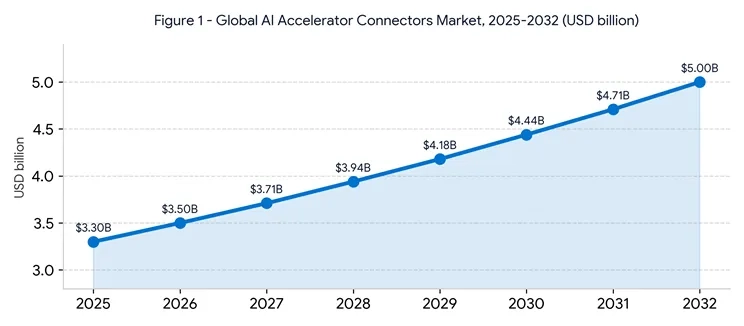
The 2025 midpoint is derived from an estimated $66-$74 billion replacement value for installed AI server racks, accelerator modules, and high-performance interconnect hardware. A specialized high-reliability component factor of roughly 4.3%-5.0% is applied across accelerator chip families, adjusted for OEM warranty bundles and custom cluster topologies. This yields a base-year range of $3.0-$3.7 billion.
Growth to 2032 is fueled by extreme interconnect density requirements rather than raw server box volumes. Migration to PCIe Gen 6/7, CXL (Compute Express Link), 1.6T optical engines, and Co-Packaged Optics (CPO) dramatically increases socket complexity and pin density. High thermal dissipation requirements in 1000W+ GPUs also drive demand for specialized high-power connector interfaces.
AI Accelerator Connectors form the critical physical backbone of modern artificial intelligence infrastructure, linking GPUs, TPUs, and custom ASICs to high-speed memory, switches, and power distribution units. Scope covers high-bandwidth backplane systems, mezzanine card sockets, optical transceiver interfaces, co-packaged optics (CPO) mountings, liquid-cooling power feed connectors, and diagnostic signal integrity test sockets.
The market differs fundamentally from standard server interconnects. AI clusters operate under extreme signaling speeds (112G/224G PAM4), dense thermal environments, and rigorous mechanical tolerances. A single connector contact degradation or impedance imbalance can trigger packet loss, network throttling, or catastrophic system downtime across thousand-node clusters. Consequently, hyperscalers enforce stringent validation standards and high-reliability specifications.
By 2032, the AI accelerator connector architecture will undergo a massive transition toward hybrid optical-electrical platforms and co-packaged optics. North America and East Asia will retain structural leadership, but rapid edge-AI node buildouts in Europe and Southeast Asia will require decentralized, modular connector maintenance and quick-swap field support protocols.
Pin density and thermal resilience per socket will scale dramatically. Modern connectors are evolving from passive mechanical parts into active monitored interfaces equipped with embedded thermal sensors and wear-detection circuits, allowing hyper-scalers to predict connection degradation before cluster training failures occur.
| Service / Technology | Adoption Level | 2025-2032 Direction |
|---|---|---|
| High-Speed PCIe Gen 6/7 | Very High | Mandatory for next-gen GPU-to-GPU and fabric interconnects. |
| Co-Packaged Optics (CPO) | High | Rapid acceleration in hyperscale data centers to curb power/attenuation. |
| Direct Liquid Cooling Power Connects | High | Essential for 1000W+ accelerator boards to ensure leak-free power delivery. |
| Signal Integrity (SI) Diagnostics | High | Critical during initial rack integration and live cluster maintenance. |
| Predictive Wear Sensing | Medium-High | Scaling via smart sockets that track signal degradation and pin stress. |
| Refill & Socket Retrofits | Medium | Increasingly popular for extending life of expensive board substrates. |
| Region | 2025 Share | CAGR | Demand and Service Position |
|---|---|---|---|
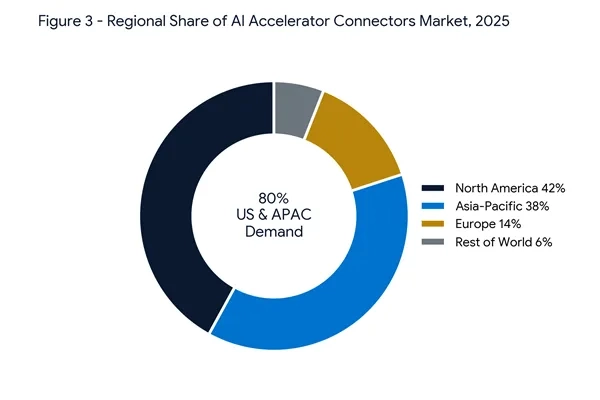
| North America | 42% | 6.5% | Largest buyer base; concentrated hyperscale clusters (AWS, Azure, GCP, Meta). |
| Asia-Pacific | 38% | 6.8% | Primary manufacturing & packaging hub; rapid cluster expansion in China & SEA. |
| Europe | 14% | 4.5% | Driven by sovereign AI initiatives, enterprise clusters, and strict power efficiency laws. |
| Latin America | 3% | 5.2% | Emerging edge nodes and localized cloud cache facilities. |
| Middle East & Africa | 3% | 7.0% | Fast-growing state-backed AI infrastructure investments (UAE, KSA). |
| Equipment Family | 2025 | 2032 | CAGR | Service / Component Demand |
|---|---|---|---|---|
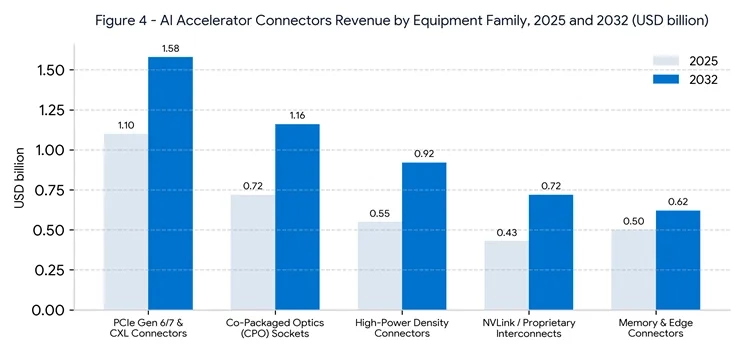
| PCIe Gen 6/7 & CXL | $1.10B | $1.58B | 5.3% | High volume; demands precise pin alignment and signal shielding. |
| Co-Packaged Optics Sockets | $0.72B | $1.16B | 7.1% | Fastest growth; ultra-clean optical alignment and socket replacement. |
| High-Power Connectors | $0.55B | $0.92B | 7.6% | Liquid-cooled power rails; thermal resistance and high-amp reliability. |
| NVLink / Custom Interconnects | $0.43B | $0.72B | 7.7% | Proprietary GPU fabric connectors with mandatory OEM validation. |
| Memory & Edge Sockets | $0.50B | $0.62B | 3.1% | Standardized HBM/CAMM interfaces for modular server expansion. |
| Provider Group | Representative Participants | Primary Service Position |
|---|---|---|
| Interconnect OEMs | Amphenol, TE Connectivity, Molex, Foxconn Interconnect | Proprietary design-ins, high-density backplanes, custom tooling. |
| Optics Specialists | Broadcom, Lumentum, Coherent, Cisco/Acacia | Optical engines, CPO sockets, high-speed transceivers. |
| Semiconductor Ecosystem | NVIDIA, AMD, Intel, TSMC (CouPLoS) | Specification setting, custom ASIC fabrics, substrate socketing. |
| Testing & Equipment | Keysight, Anritsu, Samtec, Teradyne | 224G SI validation, automated socket testing, lab retrofits. |
| Segmentation Basis | Coverage Scope |
|---|---|
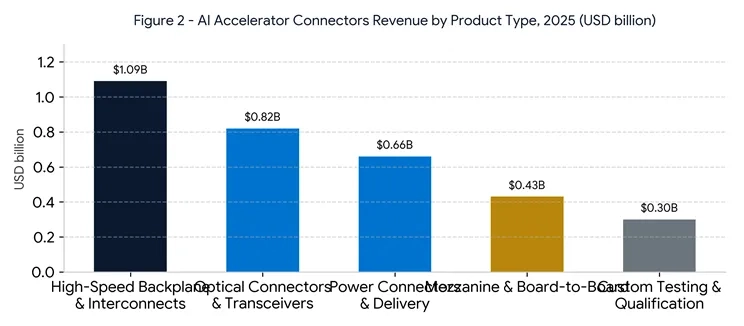
| By Product Type | High-Speed Backplane, Optical Connectors/CPO, Power Delivery, Mezzanine/B2B, Custom Sockets. |
| By Speed / Bandwidth | 56G PAM4, 112G PAM4, 224G PAM4, Optical/CPO Interfaces. |
| By Application | Hyperscale AI Data Centers, Enterprise AI Servers, Edge AI Nodes, Supercomputing Clusters. |
| By Provider | Tier-1 Interconnect OEMs, Optics Partners, Component Manufacturers, Specialist Testing Firms. |
| By Geography | North America, Europe, China, Japan/Korea, Southeast Asia, Rest of World. |
The estimate uses a bottom-up installed-equipment and capital-expenditure modeling method. Interconnect families are mapped to AI accelerator board topologies, server backplanes, and data center switch fabrics.
Replacement and expansion values are calculated from hyper-scaler capex disclosures, server shipment volumes, foundry wafer output, and OEM service documentation. Signal integrity requirements, pin densities, thermal factors, and component replacement rates are factored into the growth algorithms. Provider market shares are analyst-modeled estimates based on product teardowns and design-win tracking.
The AI accelerator connectors market is transitioning from standard rack hardware into highly engineered, thermal-aware, high-speed active interfaces. Success for connector manufacturers hinges on deep co-design partnerships with semiconductor foundries and hyper-scalers, along with rapid adaptation to co-packaged optics and liquid cooling architectures.
| Sr No | Topic |
|---|---|
| 1 | Market Segmentation |
| 2 | Scope of the report |
| 3 | Research Methodology |
| 4 | Executive summary |
| 5 | Key Predictions of AI Accelerator Connectors Market |
| 6 | Avg B2B price of AI Accelerator Connectors Market |
| 7 | Major Drivers For AI Accelerator Connectors Market |
| 8 | Global AI Accelerator Connectors Market Production Footprint - 2025 |
| 9 | Technology Developments In AI Accelerator Connectors Market |
| 10 | New Product Development In AI Accelerator Connectors Market |
| 11 | Research focuses on new AI Accelerator Connectors |
| 12 | Key Trends in the AI Accelerator Connectors Market |
| 13 | Major changes expected in AI Accelerator Connectors Market |
| 14 | Incentives by the government for AI Accelerator Connectors Market |
| 15 | Private investments and their impact on AI Accelerator Connectors Market |
| 16 | Market Size, Dynamics, And Forecast, By Type, 2026-2032 |
| 17 | Market Size, Dynamics And Forecast, By Output, 2026-2032 |
| 18 | Market Size, Dynamics, And Forecast, By End User, 2026-2032 |
| 19 | Competitive Landscape Of AI Accelerator Connectors Market |
| 20 | Mergers and Acquisitions |
| 21 | Competitive Landscape |
| 22 | Growth strategy of leading players |
| 23 | Market share of vendors, 2025 |
| 24 | Company Profiles |
| 25 | Unmet needs and opportunities for new suppliers |
| 26 | Conclusion |
© 2017-2026 Mobility Foresights Pvt Ltd. All rights reserved.
Developed with by ClousTech