- Get in Touch with Us

Last Updated: Aug 05, 2026 | Study Period: 2026-2032
A decision-grade reference for chemical producers, green ammonia project developers, catalyst manufacturers, technology licensors and investors assessing the operational shift toward low-temperature, low-pressure, and ruthenium-based ammonia synthesis catalysts.
The market values are bottom-up estimates. The model is anchored to global ammonia production capacity (~235 million metric tons), catalyst replacement cycles (4–10 years depending on formulation), announced green/blue ammonia project additions, and key catalyst suppliers' disclosed production capacities.
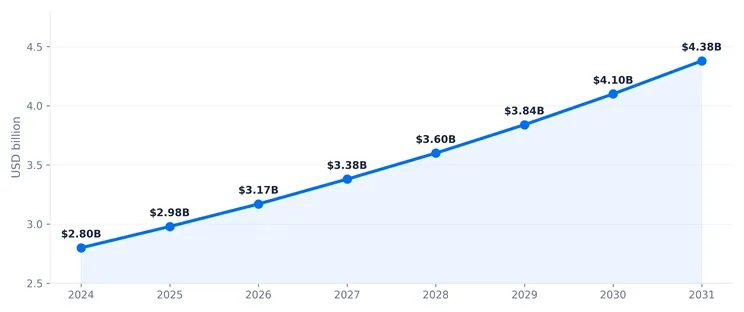
The 2024 midpoint value of $2.80 billion is derived from an estimated global active ammonia synthesis loop capacity of 235 million metric tons per annum (MTPA). With average catalyst replacement cycles ranging between 5 to 10 years depending on operating conditions, gas purity, and thermal stress, annualized catalyst turnover and new plant commissioning create a consistent recurring expenditure pool. An external catalyst charge factor of roughly $11.5–$14.2 per metric ton of installed synthesis capacity is applied across plant configurations.
Growth toward $4.38 billion by 2031 is driven by two parallel forces: the expansion of low-carbon (green/blue) ammonia infrastructure and retrofits aimed at curbing carbon intensity in fossil-based ammonia loops. Transitioning from high-pressure loop designs to lower-temperature, ruthenium and promoter-doped formulations expands value density, even where overall bulk volume requirements decrease.
Ammonia synthesis catalysts are the core chemical engines inside Haber-Bosch reactor loops, enabling the exothermic conversion of nitrogen and hydrogen into anhydrous ammonia (NH3). Modern plant configurations demand catalysts that deliver high single-pass conversion efficiency, low pressure drop, thermal tolerance, and resistance to trace poisons such as water vapor, carbon oxides, and oxygenates.
Unlike standard petrochemical catalysts, ammonia synthesis charges operate under severe temperature (380°C–520°C) and pressure conditions (80–220 bar). Plant operators increasingly balance initial catalyst acquisition cost against lifetime energy savings. The market has evolved from commodity un-reduced magnetite grains into engineered pre-reduced catalysts, wustite structures, ruthenium-on-carbon systems, and custom promoter combinations designed for intermittent renewable hydrogen feeds.
By 2031, the global ammonia synthesis catalyst landscape will shift toward decentralized, lower-pressure green ammonia synthesis loops paired with water electrolysis. While large-scale world-scale fertilizer plants in China, Russia, and the US Gulf Coast maintain base demand for magnetite and wustite catalysts, new green hydrogen projects require ultra-high-activity formulations capable of fast response to fluctuating feed conditions.
Ruthenium and specialty noble metal formulations will capture a growing portion of capital spend in modular and small-scale green ammonia facilities. Digital twin monitoring, online catalyst degradation diagnostics, and spent catalyst metal recovery services will become standard components of long-term vendor service packages.
| Catalyst / Service Type | Adoption Level | 2024–2031 Direction |
|---|---|---|
| Conventional Magnetite (Iron) | Very High | Mature baseline; gradual shift toward pre-reduced variants for shorter startup times. |
| Pre-Reduced Iron Catalysts | High | Rapid growth; saves 3–5 days of plant startup time and lowers activation energy. |
| Ruthenium-Based Systems | High | Accelerating in low-pressure loops and green ammonia plants operating under 100 bar. |
| Wustite-Based High Activity | Medium-High | Gaining traction in revamp projects seeking 10–15% capacity expansion without reactor change. |
| Cobalt & Promoter Enhancements | Medium-High | Increasingly specified to enhance low-temperature activity and poison tolerance. |
| Spent Catalyst Recovery Services | Medium | Mandatory compliance driver; noble metal recovery (Ru) creates high circular value. |
| Region | 2024 Share | CAGR | Demand and Ecosystem Position |
|---|---|---|---|
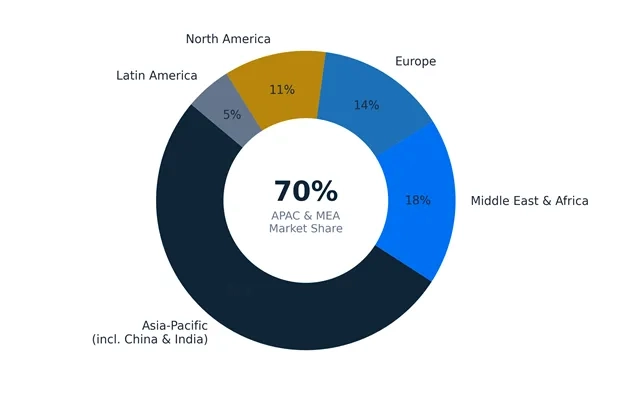
| Asia-Pacific | 52% | 6.8% | Dominant revenue pool led by China and India. Heavy demand for coal-to-ammonia revamps and new green ammonia pilots. |
| Middle East & Africa | 18% | 8.2% | Major export center. Expanding world-scale blue ammonia capacity with carbon capture integration. |
| Europe | 14% | 4.5% | High natural gas costs driving rapid shift to low-energy ruthenium catalysts and green ammonia import hubs. |
| North America | 11% | 5.9% | US Gulf Coast expansion supported by IRA incentives for clean hydrogen and low-carbon ammonia synthesis. |
| Latin America | 5% | 5.1% | Agricultural demand pushing fertilizer plant revamps in Brazil, Trinidad, and Argentina. |
| Application / Segment | 2024 | 2031 | CAGR | Catalyst & Service Demand |
|---|---|---|---|---|
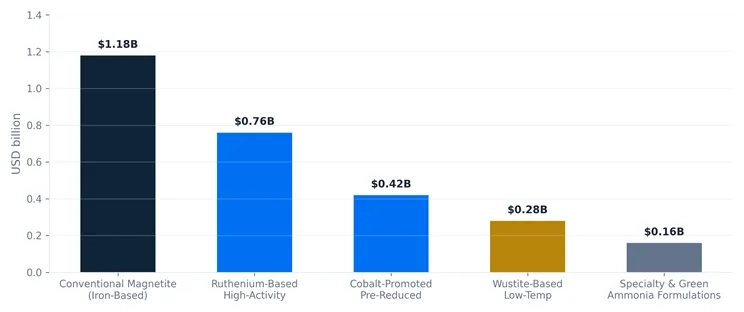
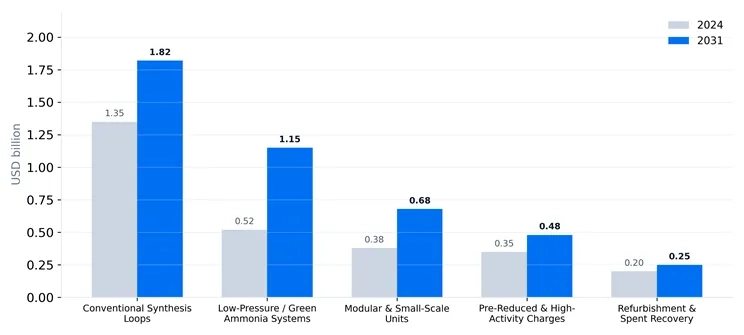
| Conventional Synthesis Loops | $1.35B | $1.82B | 4.4% | Largest demand pool; multi-bed radial reactors requiring magnetite & wustite. |
| Low-Pressure / Green Ammonia | $0.52B | $1.15B | 12.0% | Fastest-growing segment; high-activity ruthenium and promoted catalysts. |
| Modular & Small-Scale Units | $0.38B | $0.68B | 8.7% | Flexible, fast-response catalyst charges engineered for dynamic hydrogen feeds. |
| Pre-Reduced Charges & Upgrades | $0.35B | $0.48B | 4.6% | High demand in plant revamps to reduce downtime and commissioning risk. |
| Refurbishment & Spent Recovery | $0.20B | $0.25B | 3.2% | Noble metal extraction (Ru) and environmentally safe catalyst disposal. |
| Provider Group | Representative Participants | Primary Service & Catalyst Position |
|---|---|---|
| Global OEM Licensors | Topsoe, Clariant, Johnson Matthey, Casale, BASF | Integrated technology licenses, high-activity proprietary charges, performance guarantees. |
| Regional Chemical Manufacturers | Sinopec Catalyst, Unicat, Chempack | Standard magnetite charges, competitive pricing, local turnaround support. |
| Green Ammonia Specialists | KBR (K-GATM), Thyssenkrupp, Starfire Energy | Low-pressure synthesis loops, dynamic modular catalyst charges. |
| Recovery & Service Providers | Heraeus, Johnson Matthey Metal Services | Noble metal reclamation, spent catalyst handling, pyrometallurgical recycling. |
| Segmentation | Coverage |
|---|---|
| By Catalyst Type | Magnetite (Un-reduced), Pre-Reduced Iron, Wustite-Based, Ruthenium-Based, Cobalt-Promoted. |
| By Application / Technology | Conventional High-Pressure Loops, Low-Pressure Synthesis, Green/Blue Ammonia Units, Small-Scale Modular Plants. |
| By End-Use Industry | Fertilizers (Urea, Ammonium Nitrate), Chemical Intermediates, Energy Carrier & Marine Fuel, Industrial Explosives. |
| By Geography | Asia-Pacific, Middle East & Africa, Europe, North America, Latin America. |
The market estimate utilizes a bottom-up installed-capacity model across global ammonia synthesis units. Active plant capacities were cross-referenced with reactor volume requirements, catalyst density metrics, and replacement lifecycles. Price points per cubic meter / metric ton were established across un-reduced magnetite, pre-reduced iron, wustite, and ruthenium-based formulations. Regional allocations reflect underlying fertilizer and chemical production volumes, green hydrogen project pipelines, and vendor field service footprints.
The global ammonia synthesis catalyst market is transitioning from traditional commodity iron charges to advanced, energy-efficient formulations. As the global energy transition positions ammonia as a key zero-carbon fuel and hydrogen vector, catalyst suppliers capable of delivering high activity under low-pressure and dynamic operating conditions will lead market growth through 2031.
| Sr No | Topic |
|---|---|
| 1 | Market Segmentation |
| 2 | Scope of the report |
| 3 | Research Methodology |
| 4 | Executive summary |
| 5 | Key Predictions of Ammonia Synthesis Catalyst Market |
| 6 | Avg B2B price of Ammonia Synthesis Catalyst Market |
| 7 | Major Drivers For Ammonia Synthesis Catalyst Market |
| 8 | Global Ammonia Synthesis Catalyst Market Production Footprint - 2025 |
| 9 | Technology Developments In Ammonia Synthesis Catalyst Market |
| 10 | New Product Development In Ammonia Synthesis Catalyst Market |
| 11 | Research focuses on new Ammonia Synthesis Catalyst |
| 12 | Key Trends in the Ammonia Synthesis Catalyst Market |
| 13 | Major changes expected in Ammonia Synthesis Catalyst Market |
| 14 | Incentives by the government for Ammonia Synthesis Catalyst Market |
| 15 | Private investments and their impact on Ammonia Synthesis Catalyst Market |
| 16 | Market Size, Dynamics, And Forecast, By Type, 2026-2032 |
| 17 | Market Size, Dynamics And Forecast, By Output, 2026-2032 |
| 18 | Market Size, Dynamics, And Forecast, By End User, 2026-2032 |
| 19 | Competitive Landscape Of Ammonia Synthesis Catalyst Market |
| 20 | Mergers and Acquisitions |
| 21 | Competitive Landscape |
| 22 | Growth strategy of leading players |
| 23 | Market share of vendors, 2025 |
| 24 | Company Profiles |
| 25 | Unmet needs and opportunities for new suppliers |
| 26 | Conclusion |
© 2017-2026 Mobility Foresights Pvt Ltd. All rights reserved.
Developed with by ClousTech