- Get in Touch with Us

Last Updated: Aug 07, 2026 | Study Period: 2026-2032
Built from installed-capacity megawatts modelling across hyperscale, colocation, enterprise and edge data center facilities, cloud service provider capital-expenditure disclosures, NFPA fire safety compliance standards and OEM service documentation. The analysis addresses three enterprise buyer decisions: which fire suppression systems should remain under OEM maintenance contracts, where specialized multivendor integrators lower operational costs, and which global regions require new localized certified service coverage.
Calibrated estimate. Scope covers clean agent gaseous fire suppression systems (Novec 1230 / FK-5-1-12, FM-200 / HFC-227ea, Inergen, Argonite), high-pressure water mist systems, double-interlock pre-action sprinkler systems, specialized aerosol fire extinguishing units, early warning aspirating smoke detection (VESDA), sub-floor and rack-level suppression, Lithium-ion battery energy storage system (BESS) fire protection for UPS infrastructure, integrated fire alarm control panels, installation, testing, inspection and annual maintenance contracts across hyperscale, colocation, enterprise and edge facilities globally. It excludes structural building civil fireproofing, municipal water mains, and the payroll cost of in-house facility engineering teams.
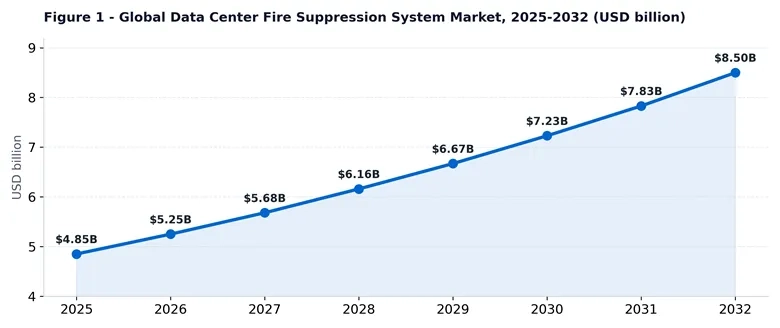
The 2025 base-year midpoint of $4.85 billion is derived from an estimated 42,000 Megawatts of active global data center white space power capacity. An external fire suppression capital and MRO factor of $110,000-$125,000 per MW is applied across facility classes, adjusted for regional safety codes, agent storage density and battery energy storage system (BESS) containment. This yields a base-year range of $4.40-$5.30 billion.
Growth to 2032 is heavily catalyzed by the AI infrastructure boom and shifting environmental regulations. Densities exceeding 40 kW to 100+ kW per rack require advanced localized fire suppression, including rack-integrated micro-environment clean agent systems and targeted BESS off-gas early detection. Simultaneously, the global phase-out of fluorinated gases (HFCs) under the Kigali Amendment and PFAS restrictions is accelerating multi-billion-dollar clean agent retrofits from FM-200 to fluoroketone (FK-5-1-12) and inert gas mixtures.
Data center fire suppression systems provide active fire detection, control and rapid extinguishment to safeguard critical mission IT assets, server halls, electrical switchgear and uninterruptible power supply (UPS) infrastructure without interrupting business continuity. System architectures encompass aspirating smoke detection (VESDA), double-interlock pre-action sprinklers, clean agent gas systems (FK-5-1-12, inert gases N2/Ar), high-pressure water mist systems and modular cabinet-level micro-suppression units.
Unlike standard commercial building fire safety, data center fire protection operates within ultra-dense, energized electronic environments. Fire suppression agents must be strictly non-conductive, leave zero chemical residue, avoid thermal shock to microprocessors, and extinguish thermal events within seconds without disrupting acoustic-sensitive hard disk drives or high-speed optical networking equipment. Consequently, enterprise operators enforce specialized maintenance protocols governed by NFPA 75 (Standard for the Fire Protection of Information Technology Equipment) and NFPA 76.
By 2032, data center fire protection will be dominated by synthetic eco-clean agents, high-pressure water mist technologies, and AI-integrated multi-sensor early warning networks. While North America and Western Europe remain major revenue sources for system upgrades and PFAS-compliant agent replacements, greenfield infrastructure investments will concentrate heavily in Southeast Asia, India, Latin America and the Middle East.
Equipment density per square foot will continue to rise rapidly as direct-to-chip liquid cooling deployments scale alongside high-voltage DC power distributions. Leading safety manufacturers like Johnson Controls (Ansul/Hygood), Carrier (Kidde-Fenwal/Marioff), Siemens (Sinorix) and Minimax Viking are embedding IoT telemetry into agent storage cylinders, continuous gas pressure monitoring systems, and off-gas lithium-ion thermal runaway detectors. Commercial service models are shifting from reactive annual inspections to continuous remote pressure/leak monitoring subscriptions tied to guaranteed 2-hour field response SLAs.
| System / Service Line | Adoption Level | 2025–2032 Market Direction |
|---|---|---|
| Clean Agent Gas Systems | Very High | Mandatory for server halls; rapid transition from HFC-227ea to FK-5-1-12 and inert gas mixtures due to environmental laws. |
| Pre-action Sprinkler Systems | Very High | Universal baseline requirement in colocation and hyperscale facilities; double-interlock systems prevent accidental discharge. |
| High-Pressure Water Mist | High | Accelerating adoption in large European and Asian hyperscale facilities due to minimal water consumption and zero GWP. |
| Aspirating Smoke Detection (VESDA) | High | Standard across high-airflow AI containment corridors for ultra-early particle detection prior to visible smoke. |
| BESS Thermal Runaway Protection | Medium-High | Fastest-growing niche; specialized off-gas detection (gas-phase detection) for Li-ion UPS battery room containment. |
| Cabinet / Rack-Level Suppression | Medium | Expanding in edge data centers and high-density AI clusters to isolate fires at the micro-environment level. |
| Region | 2025 Share | CAGR | Demand and Service Position |
|---|---|---|---|
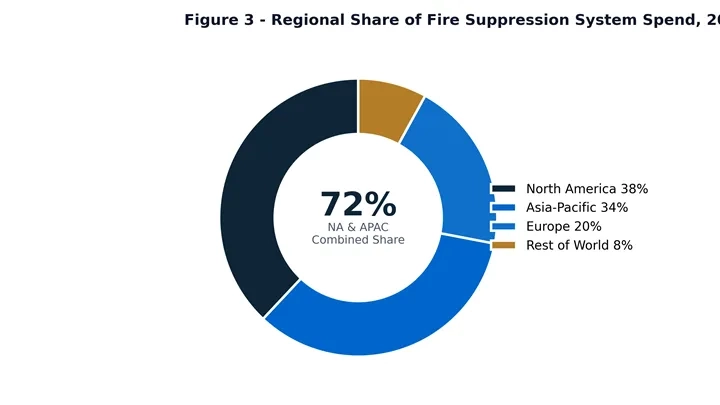
| North America | 38% | 7.5% | Largest established footprint; massive hyperscale growth in FLVA, TX, OR; accelerated phase-out retrofits of legacy fluorinated gases. |
| Asia-Pacific | 34% | 9.8% | Fastest growth corridor; India, Southeast Asia (Malaysia, Vietnam, Indonesia) and Tokyo drive mega-watt scale colocation construction. |
| Europe | 20% | 7.2% | Strict F-gas regulations and PFAS bans drive high adoption of nitrogen/argon inert gas and high-pressure water mist systems. |
| Middle East & Africa | 5% | 8.9% | Surging investments in UAE, KSA and South Africa; preference for high-end clean agent solutions with continuous monitoring. |
| Latin America | 3% | 8.1% | Expanding data center hubs in Brazil, Chile and Mexico; strong demand for cost-effective pre-action sprinkler and clean agent hybrids. |
| Facility Type | 2025 | 2032 | CAGR | Fire Protection Demand Characteristics |
|---|---|---|---|---|
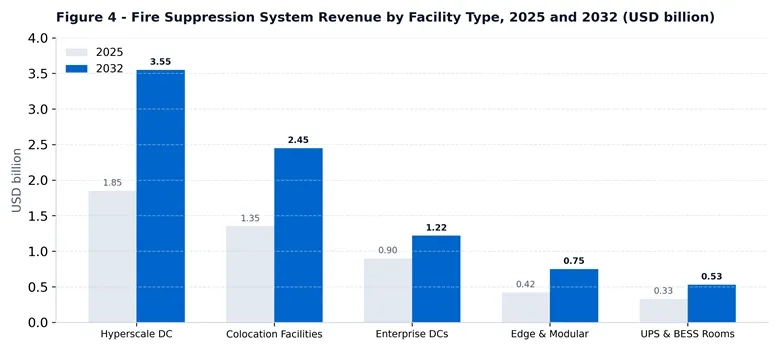
| Hyperscale DCs | $1.85B | $3.55B | 9.8% | Multi-megawatt halls requiring high-volume clean agent banking, VESDA arrays and water mist. |
| Colocation Facilities | $1.35B | $2.45B | 8.9% | Multi-tenant compartmentalized containment zone protection with double-interlock pre-action systems. |
| Enterprise DCs | $0.90B | $1.22B | 4.4% | Moderate growth; steady demand for annual agent cylinder testing, recertification and alarm panel upgrades. |
| Edge & Modular DCs | $0.42B | $0.75B | 8.6% | Compact self-contained micro-environment clean agent units with automated remote telemetry. |
| UPS & BESS Rooms | $0.33B | $0.53B | 7.0% | Specialized early gas-off detection and localized aerosol/inert gas systems for Li-ion battery racks. |
| Provider Group | Representative Participants | Primary Service & System Position |
|---|---|---|
| OEM Safety Giants | Johnson Controls (Ansul/Tyco), Carrier (Kidde-Fenwal/Marioff), Siemens AG, Minimax Viking, Fike Corp | Proprietary clean agent hardware, certified system design, turnkey OEM maintenance contracts and software control panels. |
| Early Detection & VESDA Specialists | Xtralis (Honeywell), Wagner Group, Securiton, Marioff Water Mist | High-sensitivity aspirating smoke detection, off-gas Li-ion sensors, and high-pressure water mist suppression systems. |
| Fire Protection Integrators | APi Group, ORR Protection, Cosco Fire Protection, Firetrace International | Multi-brand engineering installation, room enclosure integrity testing, annual testing and emergency agent recharge. |
| Specialized Service & Testing Labs | Regional gas distributors, localized certified hydrostatic test facilities | Agent cylinder testing, chemical purity verification, recharge services, fan door testing and compliance recertification. |
| Segmentation Axis | Sub-Segment Coverage |
|---|---|
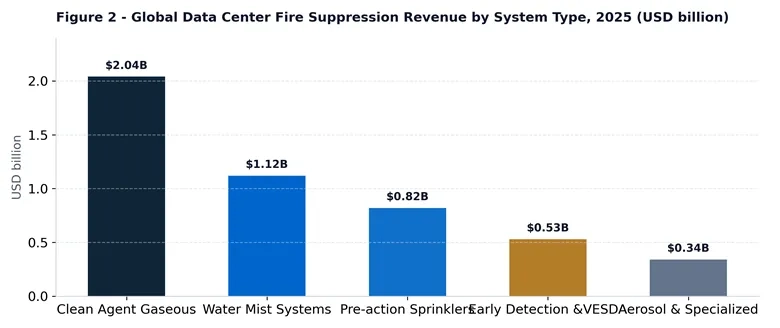
| By System Type | Clean Agent Gaseous Suppression; Water Mist Systems; Double-Interlock Pre-action Sprinklers; Aspirating Smoke Detection (VESDA); Specialized Aerosol & BESS Units. |
| By Suppression Agent | FK-5-1-12 (Fluoroketone); Inert Gas (IG-541 / IG-55 / Nitrogen / Argon); HFC-227ea (FM-200); High-Pressure Water Mist; Condensed Aerosol. |
| By Facility Type | Hyperscale Data Centers; Colocation Facilities; Enterprise Data Centers; Edge & Modular Data Centers; Dedicated UPS & Battery Rooms. |
| By Service & Component | Original Equipment & Installation; Annual Maintenance Contracts (AMC); Agent Refill & Cylinder Hydro-Testing; Enclosure Integrity Testing; Retrofits & Upgrades. |
| By Geography | North America; Europe; Asia-Pacific; Middle East & Africa; Latin America. |
The market sizing and forecast model utilizes a bottom-up installed-capacity framework. Data center white space power capacity (in Megawatts) is mapped across key facility types (hyperscale, colocation, enterprise, edge) across 45 primary country markets. Equipment capital cost factors and annual inspection/MRO service factors ($/MW) are established based on system technology (clean agent gas, water mist, pre-action sprinkler, aspirating detection).
Data inputs were calibrated using public capital expenditure filings of top cloud providers and REIT colocation operators, equipment manufacturer financial reports (JCI, Carrier, Siemens), official NFPA standards documentation, and field interviews with facility engineering directors. All company-specific fire suppression revenues represent analyst estimates derived from segment disclosures.
The global data center fire suppression market is undergoing a structural shift driven by AI rack density escalation, battery storage risks, and strict environmental chemical phase-outs. Enterprise operators must move beyond basic code compliance to adopt high-performance, eco-friendly clean agent and mist systems backed by continuous telemetry and rapid response SLAs. Equipment vendors and service integrators that establish strong regional service footprints and localized agent testing depots will capture the highest market growth through 2032.
| Sr No | Topic |
|---|---|
| 1 | Market Segmentation |
| 2 | Scope of the report |
| 3 | Research Methodology |
| 4 | Executive summary |
| 5 | Key Predictions of Data Center Fire Suppression System Market |
| 6 | Avg B2B price of Data Center Fire Suppression System Market |
| 7 | Major Drivers For Data Center Fire Suppression System Market |
| 8 | Global Data Center Fire Suppression System Market Production Footprint - 2025 |
| 9 | Technology Developments In Data Center Fire Suppression System Market |
| 10 | New Product Development In Data Center Fire Suppression System Market |
| 11 | Research focuses on new Data Center Fire Suppression System |
| 12 | Key Trends in the Data Center Fire Suppression System Market |
| 13 | Major changes expected in Data Center Fire Suppression System Market |
| 14 | Incentives by the government for Data Center Fire Suppression System Market |
| 15 | Private investments and their impact on Data Center Fire Suppression System Market |
| 16 | Market Size, Dynamics, And Forecast, By Type, 2026-2032 |
| 17 | Market Size, Dynamics And Forecast, By Output, 2026-2032 |
| 18 | Market Size, Dynamics, And Forecast, By End User, 2026-2032 |
| 19 | Competitive Landscape Of Data Center Fire Suppression System Market |
| 20 | Mergers and Acquisitions |
| 21 | Competitive Landscape |
| 22 | Growth strategy of leading players |
| 23 | Market share of vendors, 2025 |
| 24 | Company Profiles |
| 25 | Unmet needs and opportunities for new suppliers |
| 26 | Conclusion |
© 2017-2026 Mobility Foresights Pvt Ltd. All rights reserved.
Developed with by ClousTech