- Get in Touch with Us

Last Updated: Aug 05, 2026 | Study Period: 2026-2032
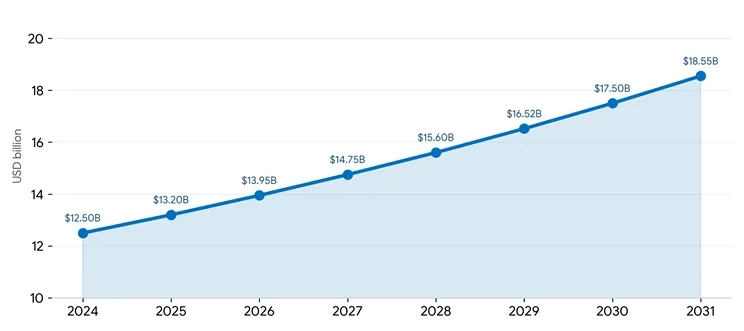
Built on chemical supplier shipment logs, formulate-level ingredient teardowns, regional automatic dishwashing (ADW) machine adoption rates, and biosurfactant commercialization pipelines, this report answers one key question: which functional ingredient categories — from eco-friendly chelating agents and cold-water active enzymes to fermentation-derived biosurfactants — will capture market share across hand dishwashing, ADW liquids, and multi-chamber pods between 2024 and 2031.
Scope note. These three figures are analyst-derived estimates, built bottom-up from primary chemical supply data, FMCG dishwashing unit shipments, and formulation teardowns, with every assumption detailed in Section 18 and graded in the Confidence Dashboard. A separate broad-scope figure (including functional polymers, packaging Solublon PVOH films, and compound masterbatches) is provided in Section 3.
The 2024 midpoint is derived from an estimated $140–$155 billion total retail market value for consumer and commercial dishwashing products globally. An active formulation ingredient intensity factor of roughly 8.2%–9.5% is applied across product formats, then adjusted for captive chemical production, localized bulk blending, and regional concentration differences. This yields a base-year range of $11.8–$13.2 billion.
Growth through 2031 is driven by structural shifts in dishwashing formats. Rapid penetration of Automatic Dishwashing (ADW) machines in Asia-Pacific and Latin America elevates demand for high-value multi-action unit-dose pods, bio-enzymes, and specialized rinse aids. Furthermore, regulatory phases against traditional phosphates and synthetic chelating agents force reformulations toward bio-based polymers and green surfactants, supporting market value expansion even in mature Western markets.
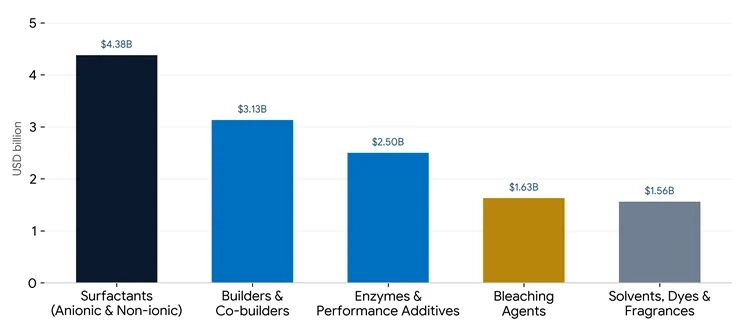
Dishwashing ingredients constitute the active functional backbone of household and commercial cleaning formulations. The scope includes primary and secondary surfactants (anionic, non-ionic, amphoteric), inorganic and organic builders (citrates, silicates, zeolites), eco-enzymes (proteases, amylases, lipases), bleaching systems (PER, TAED), water-conditioning polymers, green solvents, and specialty additives such as corrosion inhibitors and fragrances. Formulations cover automatic dishwashing (ADW) powders, tablets, gel pods, and traditional manual liquid dish soaps.
The market is structurally distinct from general home care chemicals. Dishwashing formulations must deliver fast grease emulsification, starch/protein breakdown, and spot-free drying under tight mechanical and water-temperature constraints. Formulators face strict regulatory bans on phosphates, microplastic-forming polymers, and persistent optical brighteners, requiring continuous ingredient replacement without sacrificing wash efficacy or skin mildness in manual liquids.
By 2031, dishwashing ingredient innovation will be firmly bio-based and cold-water optimized. While Asia-Pacific remains the primary volume expansion zone, product innovation centers in Western Europe and North America will lead the shift toward ultra-concentrated unit-dose pods and waterless dishwashing formats. Localized surfactant synthesis and regional enzyme fermentation hubs will become mandatory to hedge against supply chain disruptions.
Ingredient efficiency per wash cycle continues to rise as formulators adopt multi-enzyme cocktails capable of rapid soil breakdown at sub-30°C wash temperatures. Major ingredient developers are co-engineering surfactant-enzyme matrix systems that mitigate chemical dish residue while optimizing rinse efficiency, supported by bio-derived biosurfactants (such as rhamnolipids and sophorolipids).
| Ingredient / Tech Class | Adoption Level | 2024–2031 Directional Trend |
|---|---|---|
| Bio-based Surfactants (APG, Biosurfactants) | High | Mandatory replacement for petroleum LAS/AES in eco-labeled European and NA formulations. |
| Multi-Enzyme Cocktails (Amylase/Protease) | Very High | Critical for eco-ADW pods to enable short-cycle and low-temperature dishwashing. |
| Green Builders (Citrates, GLDA, MGDA) | Very High | Standard builder baseline following global phosphate bans and STPP phase-outs. |
| Biodegradable Polymers (Carboxylates) | High | Replacing non-degradable polyacrylates for anti-encrustation and spot-free rinsing. |
| Bleach Activators (TAED, PER) | Medium-High | Growing in ADW unit-dose pods for tea/coffee stain removal at lower temperatures. |
| Traditional Sulfated Surfactants (LAS/SLES) | High (Declining) | Cost-effective baseline for manual liquid soaps in emerging regions, facing margin pressure. |
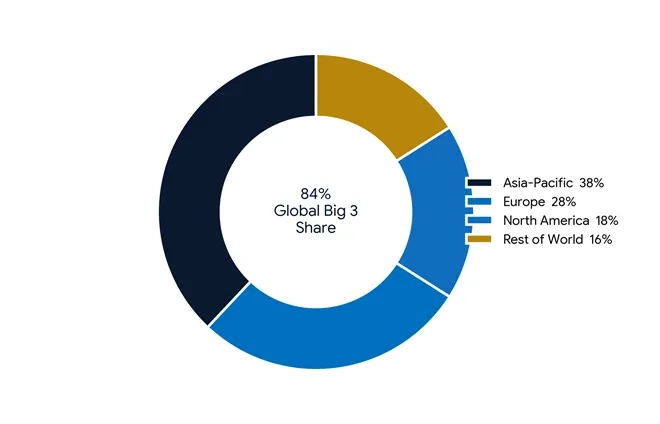
| Region | 2024 Share | CAGR | Demand and Service Position |
|---|---|---|---|
| Asia-Pacific | 38% | 7.2% | Largest volume growth hub; surging ADW penetration in urban China & India; high surfactant demand. |
| Europe | 28% | 4.5% | Leader in eco-label innovation, bio-enzymes, phosphate-free builders, and microplastic-free polymers. |
| North America | 18% | 5.1% | High unit-dose pod adoption; demand for premium multi-action enzymes and eco-friendly surfactants. |
| Latin America | 9% | 6.0% | Dominated by manual dish liquids; gradual shift toward compact concentrates and regional builder blending. |
| Rest of World | 7% | 4.2% | Middle East & Africa market led by traditional manual liquid/bar formulations; price-sensitive segment. |
| Application / Format | 2024 | 2031 | CAGR | Key Ingredient Drivers |
|---|---|---|---|---|
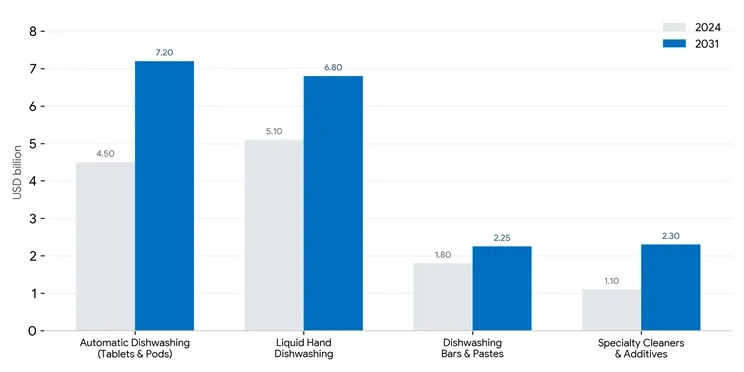
| Automatic Dishwashing (Tablets/Pods) | $4.50B | $7.20B | 6.9% | Enzymes, MGDA/GLDA builders, PVA film, bleach activators. |
| Liquid Hand Dishwashing | $5.10B | $6.80B | 4.2% | Mild anionic/amphoteric surfactants, skin care additives, APGs. |
| Dishwashing Bars & Pastes | $1.80B | $2.25B | 3.2% | Cost-effective LAS surfactants, carbonate/silicate builders, mineral fillers. |
| Specialty Cleaners & Rinse Aids | $1.10B | $2.30B | 11.1% | Low-foaming non-ionic surfactants, citric acid, scale-inhibiting polymers. |
| Total Market | $12.50B | $18.55B | 5.8% | Multi-functional bio-ingredients and eco-labeled formulations. |
| Provider Group | Representative Participants | Primary Market Position |
|---|---|---|
| Tier-1 Chemical Giants | BASF, Dow Chemical, Clariant, Evonik, Solvay | Large-scale surfactant synthesis, green builders, global supply reliability. |
| Bio-Enzyme Specialists | Novonesis (Novozymes/Chr. Hansen), DuPont/IFF, AB Enzymes | Proprietary enzyme engineering, low-temp wash technology, bio-catalysis. |
| Oleochemical Suppliers | Wilmar International, Musim Mas, Emery Oleochemicals, KLK OLEO | Plant-based fatty alcohol feeds, APGs, bio-surfactant raw materials. |
| Specialty Additive & Fragrance Houses | Givaudan, Firmenich-DSM, Croda International, Nouryon | Fragrance encapsulation, anti-corrosion polymers, specialty rinse aids. |
Competitive advantage stems from bio-ingredient patents, scale efficiency, and formulation co-development capabilities with major FMCG brand owners (Unilever, Procter & Gamble, Reckitt, Henkel). Tier-1 chemical companies maintain dominance in high-volume surfactants, while biotechnology pioneers capture high margins in performance enzymes and biosurfactants.
| Segmentation Criteria | Coverage / Categories |
|---|---|
| By Ingredient Type | Surfactants (Anionic, Non-ionic, Amphoteric, Biosurfactants); Builders & Co-builders (Citrates, MGDA, GLDA, Zeolites); Enzymes (Amylase, Protease, Lipase); Bleaching Agents & Activators (PER, TAED); Polymers & Additives (Anti-encrustation, Dyes, Fragrances). |
| By Application / Format | Automatic Dishwashing (Tablets, Unit-Dose Pods, Powders, Gels); Liquid Hand Dishwashing; Dishwashing Bars & Pastes; Specialty Cleaners & Rinse Aids. |
| By End User | Consumer / Household Dishwashing; Commercial Foodservice & Hospitality; Institutional & Industrial Cleaning. |
| By Origin / Source | Synthetic / Petrochemical-based; Bio-based / Oleochemical-based; Fermentation-derived / Natural. |
| By Geography | Asia-Pacific (China, India, Japan, Southeast Asia); Europe (Germany, UK, France, RoE); North America (US, Canada); Latin America (Brazil, Mexico); Rest of World (Middle East, Africa). |
The market estimate utilizes a comprehensive bottom-up chemical demand model. Ingredient categories are mapped across consumer liquid, bar, powder, and ADW tablet formulation recipes. Total ingredient consumption volume is calculated based on global detergent production volumes, regional household appliance penetration, and industrial dishwashing output. Average selling prices (ASPs) per metric ton are applied across surfactant, builder, enzyme, and polymer lines.
Regional allocations integrate dishwashing format distribution (e.g., manual soap vs. ADW pod market share), chemical import/export statistics, regional environmental legislation, and local manufacturing presence. Strategic supply contract values are derived from financial disclosures of publicly traded chemical producers and FMCG enterprise filings.
The global dishwashing ingredients market is transitioning rapidly from traditional synthetic chemistry toward high-efficacy, bio-based, and eco-compliant functional solutions. While Asia-Pacific represents the largest volume expansion market, Western Europe and North America remain the primary centers for high-value bio-enzyme and biosurfactant innovation. Winning ingredient suppliers will combine sustainable raw material sourcing, regulatory agility, and strong co-formulation partnerships with leading FMCG brand owners.
| Sr No | Topic |
|---|---|
| 1 | Market Segmentation |
| 2 | Scope of the report |
| 3 | Research Methodology |
| 4 | Executive summary |
| 5 | Key Predictions of Dishwashing Ingredients Market |
| 6 | Avg B2B price of Dishwashing Ingredients Market |
| 7 | Major Drivers For Dishwashing Ingredients Market |
| 8 | Global Dishwashing Ingredients Market Production Footprint - 2025 |
| 9 | Technology Developments In Dishwashing Ingredients Market |
| 10 | New Product Development In Dishwashing Ingredients Market |
| 11 | Research focuses on new Dishwashing Ingredients |
| 12 | Key Trends in the Dishwashing Ingredients Market |
| 13 | Major changes expected in Dishwashing Ingredients Market |
| 14 | Incentives by the government for Dishwashing Ingredients Market |
| 15 | Private investments and their impact on Dishwashing Ingredients Market |
| 16 | Market Size, Dynamics, And Forecast, By Type, 2026-2032 |
| 17 | Market Size, Dynamics And Forecast, By Output, 2026-2032 |
| 18 | Market Size, Dynamics, And Forecast, By End User, 2026-2032 |
| 19 | Competitive Landscape Of Dishwashing Ingredients Market |
| 20 | Mergers and Acquisitions |
| 21 | Competitive Landscape |
| 22 | Growth strategy of leading players |
| 23 | Market share of vendors, 2025 |
| 24 | Company Profiles |
| 25 | Unmet needs and opportunities for new suppliers |
| 26 | Conclusion |
© 2017-2026 Mobility Foresights Pvt Ltd. All rights reserved.
Developed with by ClousTech