
- Get in Touch with Us

Last Updated: Aug 14, 2026 | Study Period: 2026-2032
Calibrated estimate. Scope covers flexible video endoscopes, rigid video endoscopes, single-use video endoscopes, visualization towers, video processors, light sources, and dedicated ENT diagnostic software. It excludes non-video optical specs, general surgical suites, hospital building utilities, and internal hospital administrative overhead.
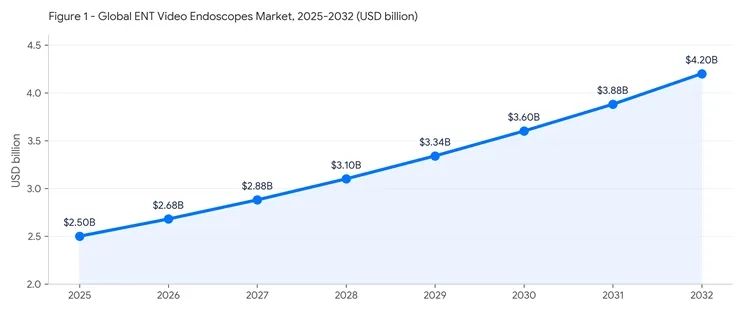
The 2025 baseline estimate of $2.50 billion is derived from an estimated global installed base of 115,000 to 130,000 active ENT video endoscopy towers and flexible scopes across acute care hospitals, ambulatory surgical centers (ASCs), and specialty ENT practices.
Growth through 2032 is driven by structural shifts in ENT care delivery rather than mere demographic expansion. The migration of diagnostic laryngoscopy, stroboscopy, and sinus endoscopy from inpatient operating rooms to office-based outpatient clinics increases the demand for compact, plug-and-play video endoscopy systems.
ENT video endoscopes are specialized electro-optical medical devices utilized by otolaryngologists to visualize, diagnose, and treat anatomical structures within the ear, nose, pharynx, and larynx. The market scope encompasses video rhinos laryngoscopes, otoscopes, video stroboscopes, flexible video nasopharyngoscopes, rigid sinus scopes.
The ENT video endoscopy market operates under distinct clinical and economic dynamics compared to general laparoscopy or gastrointestinal endoscopy. ENT procedures require exceptionally fine scope outer diameters (often under 3.0mm) to navigate narrow pediatric and adult nasal/laryngeal passages without compromising patient comfort.
By 2032, the ENT video endoscopy delivery model will become substantially more decentralized and software-enhanced. While North America and Western Europe maintain high absolute expenditure, infrastructure buildouts in China, India, Southeast Asia, and Brazil will account for the majority of new unit shipments. Regional warehousing of sterile disposable scopes and localized field-service centers will become mandatory contract prerequisites to meet 24-hour scope replacement targets.
Diagnostic content per procedure is expanding as visualization consoles incorporate artificial intelligence (AI) algorithms for real-time mucosal vascular pattern analysis and automated polyp identification.
| Product / Service | Adoption Rate | 2025–2032 Direction |
|---|---|---|
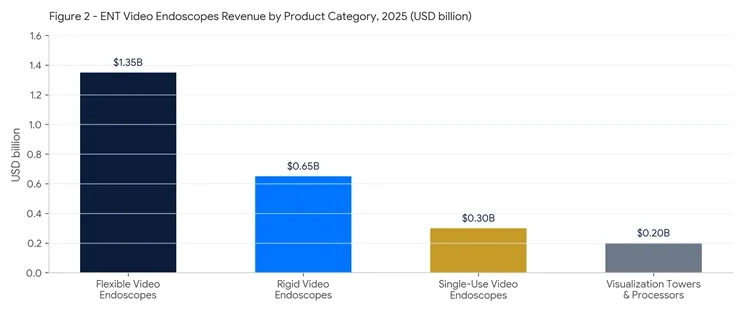
| Flexible Video Endoscopes | Very High | Mandatory for comprehensive office laryngoscopy, speech evaluation, and pediatric ENT. |
| Rigid Video Endoscopes | High | Dominant in surgical sinus procedures (FESS) and precision otologic skull-base surgery. |
| Single-Use Video Endoscopes | High Growth | Rapidly scaling in Emergency Departments, ICUs, and high-turnover outpatient clinics. |
| 4K / 3D Visualization Towers | High | Standard upgrade choice for acute care surgical suites and tertiary teaching hospitals. |
| AI Mucosal Analysis Software | Medium-High | Expanding for early detection of head & neck dysplasias and automated diagnostic reporting. |
| Third-Party Refurbishment | Medium | Cost-effective option for community hospitals, but restricted by OEM scope sealing tech. |
| Region | 2025 Share | CAGR | Demand Position & Ecosystem Drivers |
|---|---|---|---|
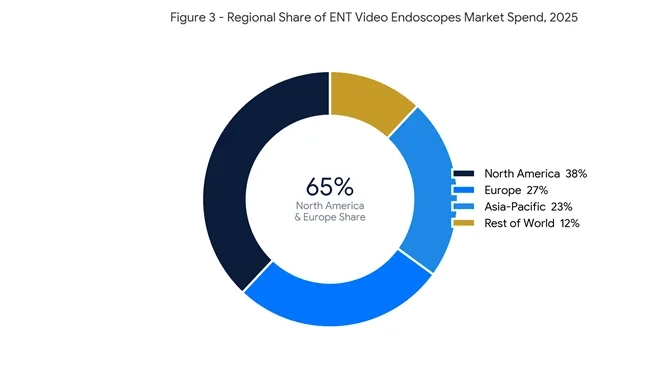
| North America | 38% | 6.5% | Largest revenue market; high ASC adoption of office-based video laryngoscopy and strong reimbursement. |
| Europe | 27% | 6.2% | Mature clinical market; stringent EU-MDR regulations driving preference for certified single-use scopes. |
| Asia-Pacific | 23% | 9.8% | Fastest-growing corridor; rapid expansion of private hospital chains and rising ENT disease awareness. |
| Rest of World | 5% | 7.5% | Gradual modernization of ENT clinics in GCC countries; high reliance on imported OEM equipment. |
| Application Family | 2025 | 2032 | CAGR | Clinical Service Demand |
|---|---|---|---|---|
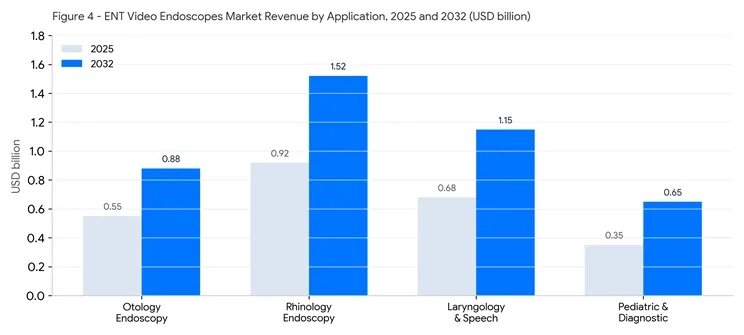
| Otology Endoscopy | $0.55B | $0.88B | 6.9% | Micro-rigid scopes for middle ear inspection and tympanoplasty. |
| Rhinology Endoscopy | $0.92B | $1.52B | 7.4% | Sinus surgery and diagnostic rhinoscopy; largest overall pool. |
| Pediatric & Diagnostic ENT | $0.35B | $0.65B | 9.2% | Ultra-thin flexible video scopes for non-sedated pediatric exams. |
| Provider Group | Representative Participants | Primary Market Positioning |
|---|---|---|
| Tier-1 Video Endoscopy OEMs | Olympus, KARL STORZ, Stryker, Fujifilm, Pentax Medical | Premium 4K/HD reusable systems, proprietary diagnostic modalities (NBI), global service networks. |
| Single-Use Specialists | Ambu A/S, Boston Scientific, Prosurg, Ecleris | Disruptive single-use flexible video scopes focusing on sterile convenience, zero downtime, and ICU/ER care. |
| Surgical & Visualization Tech | Smith & Nephew, Medtronic ENT, Richard Wolf | Integrated surgical endoscopy towers, powered ENT instruments, and image-guided sinus surgery software. |
| Independent Repair & Service | IMS (Steris), Agiliti, Specialized Regional Labs | Multi-brand scope repair, preventative maintenance contracts, and cost-effective component replacement. |
| Segmentation Paradigm | Coverage Scope |
|---|---|
| By Product Type | Flexible Video Endoscopes, Rigid Video Endoscopes, Single-Use Video Endoscopes, Visualization Towers & Processors. |
| By Application | Rhinology Endoscopy, Laryngology & Speech, Otology Endoscopy, Pediatric & Diagnostic ENT. |
| By Diagnostic Technology | Standard HD Video, 4K Ultra-HD, 3D Endoscopy, Narrow-Band / Optical Chromoendoscopy. |
| By End User | Hospitals, Ambulatory Surgical Centers (ASCs), Specialty ENT Clinics, Academic & Research Institutes. |
| By Geography | North America, Europe, Asia-Pacific, Latin America, Middle East & Africa. |
Olympus launched its next-generation flexible video rhinos laryngoscope featuring enhanced ergonomics and high-resolution digital image processing to facilitate delicate vocal cord evaluations.
Ambu A/S expanded its single-use endoscopy portfolio with FDA clearance for a dedicated pediatric single-use video laryngoscope, catering to emergency airway management.
KARL STORZ announced integration of artificial intelligence image-enhancement tools into its modular video tower platform, assisting clinicians in tissue differentiation during endoscopic sinus surgery.
Increased hospital capital allocation across Asia-Pacific resulted in over 1,200 new ENT endoscopy tower installations across regional medical centers during 2025.
The market size estimate employs a rigorous bottom-up and top-down triangulation methodology. Primary research involved structured interviews with practicing otolaryngologists, hospital procurement directors, clinical engineers, and medical device executive leaders. Secondary research analyzed public regulatory filings (FDA 510k, CE Mark approvals), corporate capex disclosures, national health statistic databases, and medical trade associations. Market value forecasts account for replacement cycles, single-use growth rates, regional healthcare spend, and macroeconomic indicators.
The global ENT video endoscopes market is undergoing a transformative evolution driven by digital sensor miniaturization, single-use sterilization advantages, and decentralized care delivery. While North America and Europe remain high-value strongholds, Asia-Pacific offers unparalleled unit volume expansion. Equipment manufacturers and healthcare providers that prioritize optical innovation, clinical ergonomics, and rapid service delivery will capture commanding positions in this dynamic market.
| Sr No | Topic |
|---|---|
| 1 | Market Segmentation |
| 2 | Scope of the report |
| 3 | Research Methodology |
| 4 | Executive summary |
| 5 | Key Predictions of ENT Video Endoscopes Market |
| 6 | Avg B2B price of ENT Video Endoscopes Market |
| 7 | Major Drivers For ENT Video Endoscopes Market |
| 8 | Global ENT Video Endoscopes Market Production Footprint - 2025 |
| 9 | Technology Developments In ENT Video Endoscopes Market |
| 10 | New Product Development In ENT Video Endoscopes Market |
| 11 | Research focuses on new ENT Video Endoscopes |
| 12 | Key Trends in the ENT Video Endoscopes Market |
| 13 | Major changes expected in ENT Video Endoscopes Market |
| 14 | Incentives by the government for ENT Video Endoscopes Market |
| 15 | Private investments and their impact on ENT Video Endoscopes Market |
| 16 | Market Size, Dynamics, And Forecast, By Type, 2026-2032 |
| 17 | Market Size, Dynamics And Forecast, By Output, 2026-2032 |
| 18 | Market Size, Dynamics, And Forecast, By End User, 2026-2032 |
| 19 | Competitive Landscape Of ENT Video Endoscopes Market |
| 20 | Mergers and Acquisitions |
| 21 | Competitive Landscape |
| 22 | Growth strategy of leading players |
| 23 | Market share of vendors, 2025 |
| 24 | Company Profiles |
| 25 | Unmet needs and opportunities for new suppliers |
| 26 | Conclusion |

© 2017-2026 Mobility Foresights Pvt Ltd. All rights reserved.
Developed with by ClousTech