
- Get in Touch with Us

Last Updated: Aug 14, 2026 | Study Period: 2026-2032
Calibrated estimate. Scope covers external equipment manufacturing, digital flexible ureteroscopes (single-use disposable and reusable digital/fiberoptic), video processing units, specialized access sheaths, suction-assisted ureteroscopy (sURS) attachments, software visualization modules, and maintenance/refurbishment services across urology clinics, hospitals, and ambulatory surgical centers. It excludes rigid ureteroscopes, nephroscopes, cystoscopes, general laparoscopes, laser generators, and in-house hospital sterilizer labor.
The 2025 baseline market value of $1.28 billion is derived from an estimated 1.85 million flexible ureteroscopy procedures performed globally across hospitals, academic medical centers, and ambulatory surgical centers. Factor calibration applies average scope selling prices across reusable capital systems, annual maintenance service contracts, and single-use disposable scope volume consumption. This yields a base-year calibrated valuation range of $1.15 to $1.40 billion.
Growth through 2032 to $2.22 billion is fueled by demographic trends, including an increasing global prevalence of nephrolithiasis (kidney stones), metabolic syndrome, and dietary shifts. High-resolution CMOS digital sensors, ultra-slim scope diameters (<7.5 Fr), automated deflection mechanics, and suction-assisted stone evacuation raise procedural success rates.
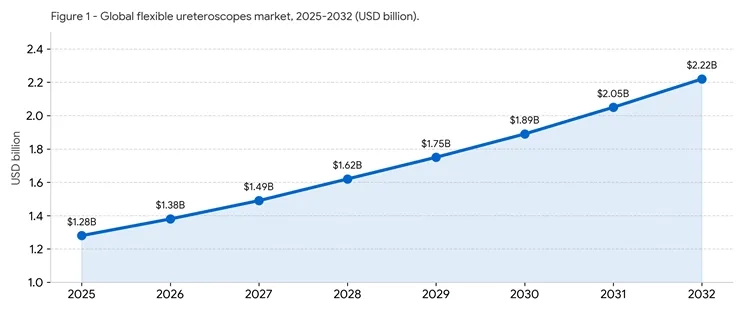
Flexible ureteroscopes are indispensable diagnostic and therapeutic endoscopes utilized by urologists to navigate the intricate upper urinary tract, renal pelvis, and kidney calyces. Primarily employed in retrograde intrarenal surgery (RIRS) for laser lithotripsy of kidney stones and diagnostic evaluation of upper tract urothelial carcinoma (UTUC), flexible ureteroscopes allow precise, minimally invasive intervention without external incisions.
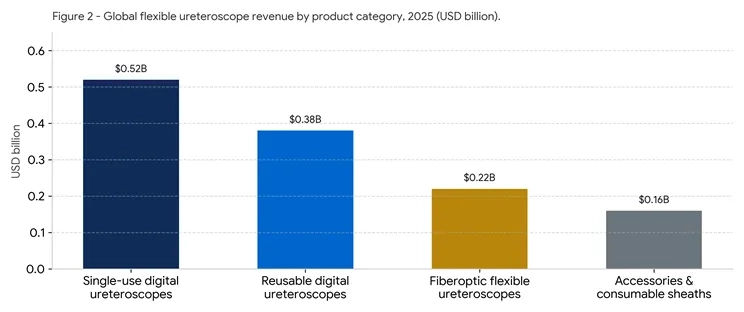
The market is undergoing a structural paradigm shift from traditional fiberoptic and reusable digital scopes toward single-use disposable flexible ureteroscopes. Reusable scopes, while delivering exceptional optic clarity, suffer from delicate fiber bundles, frequent deflection mechanism fatigue, high repair costs ($3,000-$8,000 per repair event), and complex reprocessing requirements.
By 2032, the global flexible ureteroscope market will be predominantly driven by single-use digital platforms integrated with artificial intelligence (AI) and intelligent fluid management. North America and Western Europe will see single-use adoption exceed 70% of total procedure volume, while emerging economies across Asia-Pacific and Latin America experience rapid adoption as unit costs decrease.
Technological convergence will focus on suction-assisted ureteroscopy (sURS), micro-CMOS image sensors delivering native 4K resolution, dual-LED lighting, and robotic-assisted ureteroscopy platforms (e.g., Avicenna Roboflex).
| Technology / Category | Adoption Level | 2025-2032 Direction |
|---|---|---|
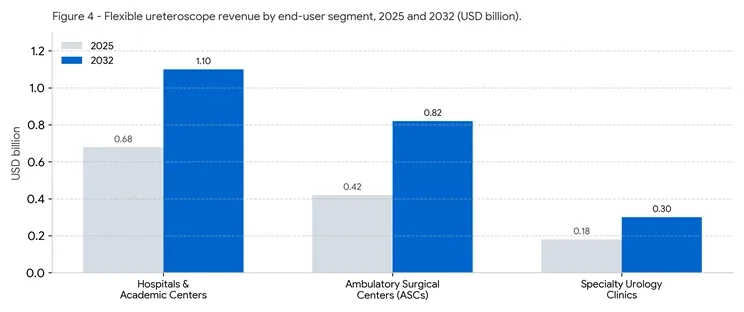
| Single-Use Digital Ureteroscopes | Very High | Rapid growth; becoming standard of care in ASCs and high-volume hospitals. |
| Reusable Digital Ureteroscopes | High | Stabilizing in top academic centers; selective use for complex anatomical cases. |
| Suction-Assisted Ureteroscopy (sURS) | High | Accelerating adoption; lowers intrarenal pressure and improves stone-free rates. |
| Fiberoptic Flexible Ureteroscopes | Medium-Low | Phase-out stage; replaced by digital CMOS chips offering superior optics. |
| AI-Assisted Image Enhancement | Medium | Emerging fast; real-time stone boundary detection and automatic fragmentation monitoring. |
| Robotic Ureteroscopy Systems | Low-Medium | Gradual expansion in specialized centers; enhances ergonomic surgeon comfort. |
| Region | 2025 Share | CAGR | Demand and Ecosystem Position |
|---|---|---|---|
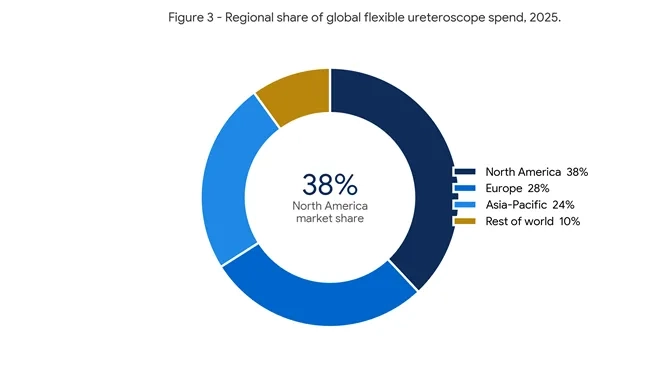
| North America | 38% | 7.8% | Largest market; early adoption of single-use scopes, high stone incidence, and robust ASC network. |
| Europe | 28% | 6.9% | Strong clinical guidelines emphasizing single-use hygiene; prominent hospital purchasing groups. |
| Asia-Pacific | 24% | 10.5% | Fastest-growing corridor; massive patient pool in China/India, expanding urological capacity. |
| Rest of World | 4% | 6.5% | Middle East medical infrastructure modernization drive; selective high-end hospital demand. |
| Segment / Product Family | 2025 | 2032 | CAGR | Key Demand Drivers |
|---|---|---|---|---|
| Single-Use Digital Flexible Scopes | $0.52B | $1.12B | 11.6% | Sterility assurance, zero repair costs, high ASC adoption. |
| Reusable Digital Flexible Scopes | $0.38B | $0.52B | 4.6% | Academic hospital preference, high optical fidelity. |
| Fiberoptic Flexible Scopes | $0.22B | $0.18B | -2.8% | Declining spend; technological obsolescence vs CMOS. |
| Access Sheaths & Suction Attachments | $0.11B | $0.26B | 13.1% | Suction-assisted clearance protocols (sURS). |
| Provider Group | Representative Participants | Primary Market Positioning |
|---|---|---|
| Multinational OEMs | Boston Scientific, Olympus, Karl Storz, Richard Wolf | Full portfolio (reusable + disposable), strong hospital contracts, high-end digital towers. |
| Single-Use Specialists | Pusen Medical, Ambu A/S, Clinico, YouCare, Mindray | Focused disposable digital scopes, aggressive cost structures, fast ASC penetration. |
| Laser & Systems Integrators | Lumenis (Boston Scientific), Quanta System, Dornier | Bundled laser lithotripsy platforms, suction systems, integrated urology OR suites. |
| Regional Repair & Distributors | AOHUA, Huger, Independent Service Organizations | Refurbishment of reusable optical bundles, local logistics, replacement accessories. |
The analysis utilizes a calibrated bottom-up installed-base and procedure-volume modeling methodology. Global procedure estimates across kidney stone lithotripsy and UTUC diagnostics are cross-referenced with public financial filings, hospital procurement databases, FDA 510(k) registration records, and primary interviews with urologists and hospital supply-chain directors. Market figures are adjusted for single-use consumption rates, reusable repair cycle costs, and regional pricing tiers.
The global flexible ureteroscope market is undergoing a fundamental transformation driven by single-use digital technology, suction-assisted stone evacuation, and outpatient care expansion. Manufacturers that combine high optical resolution, slim scope profiles, affordable single-use pricing, and suction capabilities will secure dominant market positions through 2032.
| Sr No | Topic |
|---|---|
| 1 | Market Segmentation |
| 2 | Scope of the report |
| 3 | Research Methodology |
| 4 | Executive summary |
| 5 | Key Predictions of Flexible Ureteroscopes Market |
| 6 | Avg B2B price of Flexible Ureteroscopes Market |
| 7 | Major Drivers For Flexible Ureteroscopes Market |
| 8 | Global Flexible Ureteroscopes Market Production Footprint - 2025 |
| 9 | Technology Developments In Flexible Ureteroscopes Market |
| 10 | New Product Development In Flexible Ureteroscopes Market |
| 11 | Research focuses on new Flexible Ureteroscopes |
| 12 | Key Trends in the Flexible Ureteroscopes Market |
| 13 | Major changes expected in Flexible Ureteroscopes Market |
| 14 | Incentives by the government for Flexible Ureteroscopes Market |
| 15 | Private investments and their impact on Flexible Ureteroscopes Market |
| 16 | Market Size, Dynamics, And Forecast, By Type, 2026-2032 |
| 17 | Market Size, Dynamics And Forecast, By Output, 2026-2032 |
| 18 | Market Size, Dynamics, And Forecast, By End User, 2026-2032 |
| 19 | Competitive Landscape Of Flexible Ureteroscopes Market |
| 20 | Mergers and Acquisitions |
| 21 | Competitive Landscape |
| 22 | Growth strategy of leading players |
| 23 | Market share of vendors, 2025 |
| 24 | Company Profiles |
| 25 | Unmet needs and opportunities for new suppliers |
| 26 | Conclusion |

© 2017-2026 Mobility Foresights Pvt Ltd. All rights reserved.
Developed with by ClousTech