- Get in Touch with Us

Last Updated: Aug 13, 2026 | Study Period: 2026-2032
Built from accelerated hyperscale AI server cluster deployment models, public capital-expenditure disclosures from cloud service providers (CSPs), server OEM platform roadmaps, and high-speed connector component teardowns. The analysis addresses three enterprise decisions: which connector architectures to standardize for next-generation GPU platforms, where signal-integrity and thermal tolerances require custom interconnect designs, and which supply chain regions offer resilient multi-sourcing.
Calibrated estimate. Scope covers high-speed board-to-board, mezzanine, PCIe Gen 5/6/7, NVLink/CXL interconnects, high-current power connectors, busbar connectors, and cable assemblies used specifically in AI GPU server nodes, NVL racks, and modular accelerator sleds. It excludes general-purpose enterprise CPU server sockets, standard network RJ45/SFP accessories, internal commodity wire harnesses, and building power infrastructure.
The 2025 midpoint value of $4.80 billion is derived from an estimated $42-$48 billion addressable GPU server hardware budget across hyperscale data centers, Tier-2 cloud providers, and enterprise AI supercomputing clusters. A specialized connector bill-of-materials (BOM) multiplier of 10.0%-11.4% is applied across server motherboard, GPU daughtercard, power distribution board, and high-speed backplane architectures. Adjustments are incorporated for bulk volume discounting, bundled backplane assemblies, and custom ASIC accelerator tray configurations.
Growth to 2032 is powered by structural shifts in AI cluster architecture rather than mere unit volume expansion. As GPU node densities scale from 8-GPU to 72-GPU monolithic rack structures (such as NVL72 architectures), internal copper and high-speed optical connector content per node multiplies by 3.2x. Transitioning from PCIe Gen 5 to Gen 6/7 protocols and 224G PAM4 SerDes architectures forces tight physical tolerances, driving higher average selling prices (ASPs) for premium connector solutions.
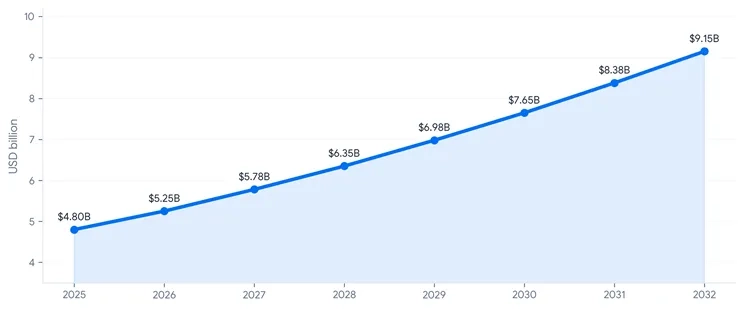
GPU server connectors establish critical electrical, thermal, and mechanical interfaces within high-performance AI computing nodes. Covered hardware families include multi-gigabit mezzanine connectors, GPU-to-GPU interconnect sockets, high-current power blind-mate connectors, backplane busbar clips, high-density PCIe Gen 5/6 CEM connectors, and external high-speed direct-attach copper (DAC) or optical transceiver cages. These components operate in harsh thermal environments, maintaining continuous high-frequency data pathways under heavy thermal cycling.
The GPU server connector ecosystem is structurally distinct from standard enterprise server interconnect markets. High-power accelerator boards draw 700W to 1200W per GPU, necessitating specialized power pin alloys, gold-plating thicknesses, and direct liquid-cooling compatible shroud designs. Signal-integrity degradation at 112G and 224G transmission speeds leaves zero margin for mechanical insertion misalignment, requiring micro-pitch accuracy and advanced electromagnetic shielding (EMI) across every pin pair.
By 2032, GPU server connector architectures will transition heavily toward co-packaged optics (CPO) sockets, direct-drive optical interconnects, and integrated liquid-cooled busbar distribution. While North America and East Asia retain research and primary system design, manufacturing and secondary assembly lines are expanding rapidly into Southeast Asia and Mexico to guarantee supply chain resilience against geopolitical disruptions.
Interconnect density per rack unit will reach historic levels. Major connector manufacturers are co-developing near-chip socket connectors that eliminate PCB traces entirely, bringing high-speed signaling directly from the accelerator package to backplane cables. Commercial adoption will hinge on automated robotic insertion capabilities, standardized multi-source pinouts, and thermal tolerance up to 125°C operating temperatures.
| Service / Interconnect Type | Adoption Rate | 2025-2032 Direction |
|---|---|---|
| High-Speed Mezzanine Connectors | Very High | Mandatory for direct GPU-to-board high-density interconnects and accelerator modules. |
| High-Current Busbar & Power Clips | Very High | Essential for 100kW+ AI rack configurations and direct liquid-cooled power delivery. |
| PCIe Gen 6 / CXL Connectors | High | Accelerating rapidly as host CPU-to-GPU cache coherent memory architectures scale. |
| Direct-Attach Optical Sockets (CPO) | High | Growing exponentially for ultra-low latency rack-to-rack network backbones. |
| Automated Blind-Mate Backplanes | Medium-High | Scaling across modular liquid-cooled server sleds to simplify field servicing. |
| Custom Micro-Pitch I/O Assemblies | Medium | Adopted in specialized ASIC proprietary supercomputing clusters and research labs. |
| Region | 2025 Share | CAGR | Demand and Service Position |
|---|---|---|---|
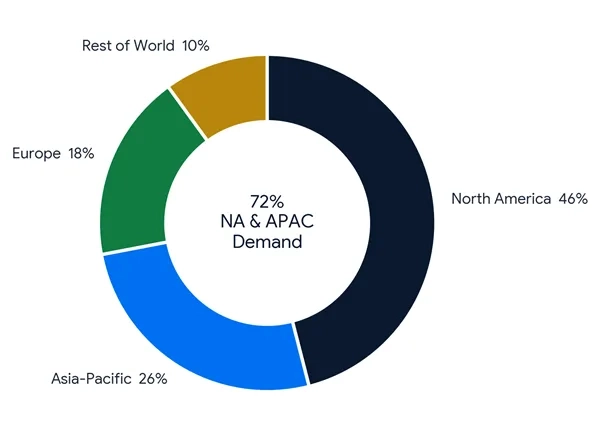
| North America | 46% | 8.8% | Dominant demand hub driven by hyperscale CSP capex (Microsoft, Meta, Google, AWS) and AI cluster installations. |
| Asia-Pacific | 26% | 11.8% | Fastest growing region; led by Taiwan ODM server manufacturing and expanding EMS assembly in Vietnam & India. |
| Europe | 18% | 7.2% | Focus on sovereign AI infrastructure, enterprise cloud nodes, and automotive supercomputing clusters. |
| Rest of World | 10% | 6.5% | Emerging data center hubs in Middle East (UAE, Saudi Arabia) and Latin America scaling localized compute capability. |
| Connector Family | 2025 | 2032 | CAGR | Key Market Demand Driver |
|---|---|---|---|---|
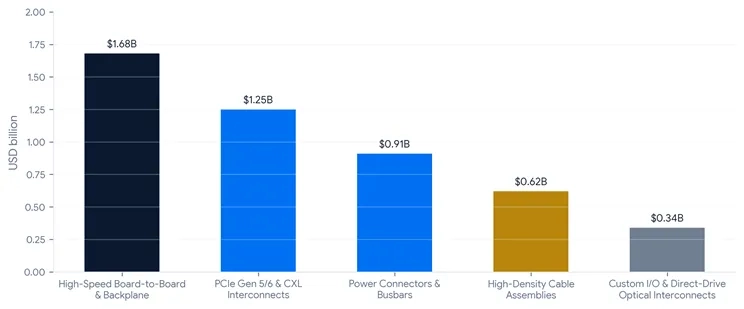
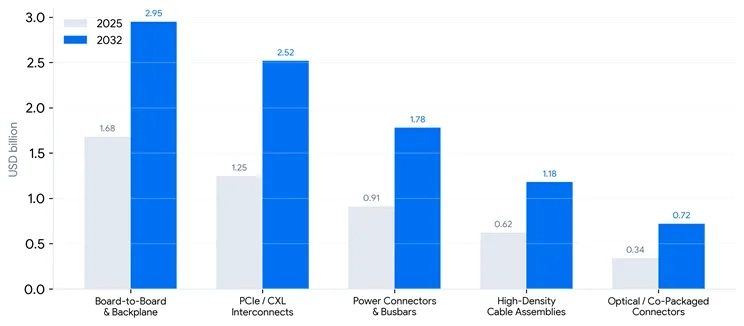
| Board-to-Board & Backplane | $1.68B | $2.95B | 8.38% | Largest market share; high pin-density GPU mezzanine sockets and primary backplanes. |
| PCIe / CXL Interconnects | $1.25B | $2.52B | 10.53% | PCIe 6.0/7.0 upgrade cycles driving replacement of standard slot connectors. |
| Power Connectors & Busbars | $0.91B | $1.78B | 10.05% | Transition to 100kW+ racks pushing demand for 120A+ busbar clips and liquid power feeds. |
| High-Density Cable Assemblies | $0.62B | $1.18B | 9.62% | Internal twinax cabling substituting lossy PCB traces for long-reach intra-rack routing. |
| Optical & Co-Packaged Sockets | $0.34B | $0.72B | 11.31% | Fastest-growing category powered by 1.6T co-packaged optical engine integration. |
| Provider Group | Representative Participants | Primary Market Position |
|---|---|---|
| Global Interconnect OEMs | TE Connectivity, Amphenol, Molex, Foxconn Interconnect (FIT) | Patented micro-pitch high-speed sockets, primary GPU mezzanine interfaces, and high-power busbars. |
| High-Speed Cable Specialists | Luxshare Precision, Samtec, BizLink, ACES Electronics | Internal twinax flyover cables, custom direct-attach high-speed harness assemblies, and backplane jumpers. |
| Optical & CPO Innovators | Broadcom, Corning, Coherent, Senko Advanced Components | Co-packaged optics (CPO) socket interfaces, optical transceiver cages, and ultra-low-loss fiber connectors. |
| Regional Value Distributors | Arrow Electronics, Avnet, TTI Inc., Heilind Electronics | Global inventory buffering, customized cable assembly kitting, and rapid regional supply support. |
Competitive advantage in the GPU server connector market hinges on patent ownership of high-density pin layouts, low-insertion-loss alloy selection, and joint design validation with GPU silicon manufacturers. Tier-1 players capture high-margin early node releases, while secondary suppliers win volume market share during secondary platform lifecycle scaling.
| Segmentation Axis | Detailed Coverage |
|---|---|
| By Product Type | Board-to-Board & Mezzanine; PCIe Gen 5/6/7 & CXL; Power Connectors & Busbars; High-Density Cable Assemblies; Optical & Co-Packaged Sockets. |
| By Data Rate | Below 56G PAM4; 112G PAM4; 224G PAM4; 448G Next-Gen Optical Interconnects. |
| By Server Architecture | Monolithic GPU Nodes; Modular Liquid-Cooled Server Sleds; NVL Rack-Scale Systems; Enterprise Edge AI Nodes. |
| By End User | Hyperscale Cloud Service Providers (CSPs); Tier-2/3 Cloud Hosting; Sovereign & Academic Supercomputing Centers; Enterprise Data Centers. |
| By Geography | North America (US, Canada); Asia-Pacific (Taiwan, China, Japan, South Korea, Vietnam, India); Europe (Germany, UK, France, Nordics); Rest of World. |
The market valuation uses a bottom-up component bill-of-materials (BOM) aggregation methodology. High-performance GPU server production volumes are mapped across server form factors (4U, 8U, and rack-scale NVL platforms). Component teardown data is utilized to establish the average quantity, pin count, and ASP of board-to-board, power, and PCIe interconnects per node. Market values are calibrated using public financial disclosures from leading interconnect suppliers, cloud capex reports, and primary interviews with server ODM hardware engineers.
The global GPU server connectors market is undergoing a fundamental transformation driven by ultra-high-density AI compute requirements. Success for connector suppliers depends on securing early co-design status with primary GPU vendors, mastering 224G signal integrity engineering, and delivering reliable liquid-cooling power interfaces. System integrators and CSP buyers must balance single-source performance advantages against multi-source supply chain resilience.
| Sr No | Topic |
|---|---|
| 1 | Market Segmentation |
| 2 | Scope of the report |
| 3 | Research Methodology |
| 4 | Executive summary |
| 5 | Key Predictions of GPU Server Connectors Market |
| 6 | Avg B2B price of GPU Server Connectors Market |
| 7 | Major Drivers For GPU Server Connectors Market |
| 8 | Global GPU Server Connectors Market Production Footprint - 2025 |
| 9 | Technology Developments In GPU Server Connectors Market |
| 10 | New Product Development In GPU Server Connectors Market |
| 11 | Research focuses on new GPU Server Connectors |
| 12 | Key Trends in the GPU Server Connectors Market |
| 13 | Major changes expected in GPU Server Connectors Market |
| 14 | Incentives by the government for GPU Server Connectors Market |
| 15 | Private investments and their impact on GPU Server Connectors Market |
| 16 | Market Size, Dynamics, And Forecast, By Type, 2026-2032 |
| 17 | Market Size, Dynamics And Forecast, By Output, 2026-2032 |
| 18 | Market Size, Dynamics, And Forecast, By End User, 2026-2032 |
| 19 | Competitive Landscape Of GPU Server Connectors Market |
| 20 | Mergers and Acquisitions |
| 21 | Competitive Landscape |
| 22 | Growth strategy of leading players |
| 23 | Market share of vendors, 2025 |
| 24 | Company Profiles |
| 25 | Unmet needs and opportunities for new suppliers |
| 26 | Conclusion |
© 2017-2026 Mobility Foresights Pvt Ltd. All rights reserved.
Developed with by ClousTech