
- Get in Touch with Us

Last Updated: Aug 14, 2026 | Study Period: 2026-2032
Built from installed-equipment replacement-value modelling across clinical gynecology centers, public healthcare capital-expenditure disclosures, surgical volume data and medical imaging OEM service documentation. The analysis addresses three buyer decisions: which visualization systems should remain under OEM contract, where third-party integrated service can lower cost and which hospital locations require new high-definition diagnostic coverage.
Calibrated estimate. Scope covers 3D/HD endoscopic towers, hysteroscopes, digital colposcopes, integrated GYN surgical suites, diagnostic software licenses, OEM maintenance contracts, calibration, optical alignment, parts, and retrofit services. It excludes general surgical tables, hospital building utilities, basic disposable consumables, and internal clinical payroll costs.
The 2025 base year midpoint of $3.30 billion is derived from an estimated $66-$74 billion replacement value of installed clinical gynecological imaging, hysteroscopic towers, digital colposcopes, and diagnostic laparoscopic systems worldwide. A specialized service and replacement calibration factor of 4.3%-5.0% is applied across system classes, adjusted for bundled OEM warranties, in-house clinical engineering coverage, and multi-specialty OR utilization. This produces a base-year valuation range of $3.0-$3.7 billion.
Market expansion to 2032 is not driven solely by diagnostic procedure volume. The geographic decentralization of ambulatory surgical centers (ASCs) expands the installed system footprint. High-definition 4K resolution, 3D stereoscopic imaging, narrow-band imaging (NBI) optical filters, and AI-assisted cervical neoplasia detection increase calibration and software maintenance intensity.
Remote video diagnostics and digital image management shift hospital spend from reactive break-fix service toward guaranteed contract uptime. Medical inflation and advanced sensor replacements support long-term valuation, while mature hospital utilization in mainland China limits extreme upside.
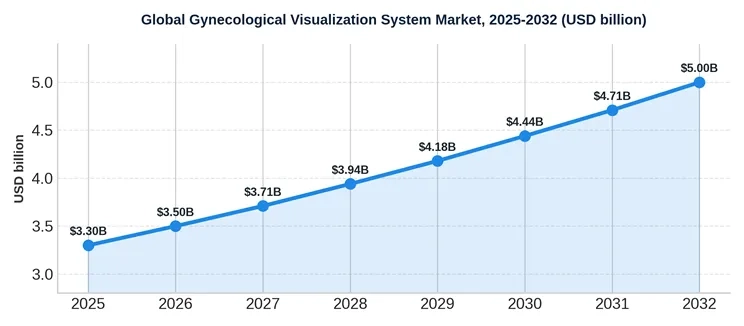
Gynecological visualization systems—comprising hysteroscopes, laparoscopes, digital colposcopes, light sources, video processors, and integrated suite software—are critical assets in modern women's healthcare. These systems ensure high precision in diagnostic exams, outpatient biopsies, and complex minimally invasive surgical procedures. Market coverage spans routine preventative care, optical alignment, sensor calibration, emergency component replacement, software upgrades, remote telemetry, and staff training.
This market is structurally distinct from generic medical capital equipment. Gynecological visualization tools demand extreme optical clarity, rapid sterilization resilience, precise color differentiation, and ultra-low latency video pipelines. Interventions must restore surgical clarity without jeopardizing steam autoclave integrity, digital signal encryption, or leak-tight sealing.
By 2032, gynecological visualization system deployment will be substantially more decentralized and software-centric. While high-tier regional hospitals in Eastern China and North America maintain large consolidated revenue pools, new system installations are surging across outpatient centers in India, Vietnam, and Latin America. Local parts stocking, rapid scope replacement programs, and localized technical field support are becoming essential criteria in hospital vendor selection.
System service density is rising as imaging platforms integrate real-time video streaming, AI-based tissue classification, and automated scope diagnostic logs. Major OEMs are embedding auto-calibration cycles, camera head moisture sensors, and cloud-linked usage logging into operating room towers.
| Service Segment | Adoption Rate | 2025–2032 Direction |
|---|---|---|
| Preventive Maintenance & Calibration | Very High | Mandatory for camera sensors, LED light engines, and fluid insufflation interfaces. |
| Remote Diagnostics & Telemetry | High | Accelerates troubleshooting and error code resolution; subject to hospital firewall controls. |
| Predictive Maintenance | Medium-High | Scaling rapidly in connected OR towers tracking usage hours and thermal cycles. |
| Third-Party Scope Refurbishment | Medium | Cost-effective for legacy optical scopes, but limited by proprietary software and sealing specs. |
| Region | 2025 Share | CAGR | Demand and Service Position |
|---|---|---|---|
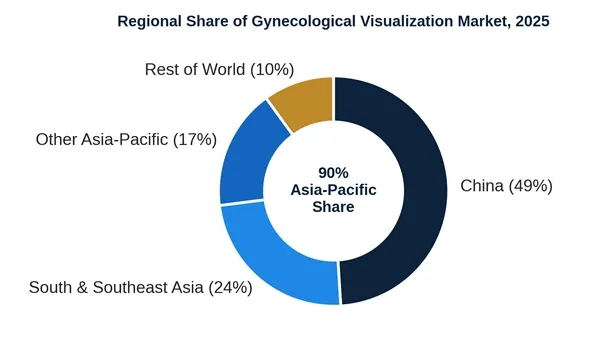
| China | 49% | 3%-4% | Largest installed system base; rapid expansion of grade-A tertiary hospitals and high OEM coverage. |
| India | 10% | 11%-13% | Surging private hospital networks and specialized GYN clinics; rapid adoption of digital colposcopy. |
| Southeast Asia | 14% | 9%-11% | Export-oriented medical tourism in Thailand/Vietnam; demand for rapid loaner scope networks. |
| Other Asia-Pacific | 17% | 5%-7% | Mature advanced markets (Japan, South Korea, Australia) focused on 3D 4K visualization and AI integrations. |
| Rest of World | 10% | 2%-4% | Selective hospital upgrades in Europe and Americas; higher preference for bundled multi-year contracts. |
| Equipment Family | 2025 | 2032 | CAGR | Service & Technology Demand |
|---|---|---|---|---|
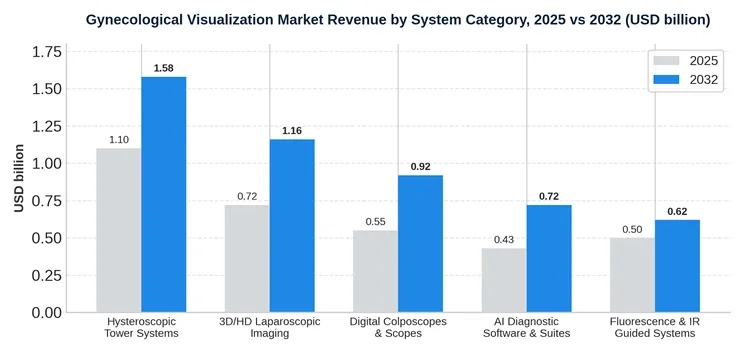
| Hysteroscopic Tower Systems | $1.10B | $1.58B | 5.3% | Largest segment; fluid management, light sources, camera heads, and scope repair. |
| 3D/HD Laparoscopic Imaging | $0.72B | $1.16B | 7.1% | High growth; 4K sensors, stereo alignment, optical fiber, and video processors. |
| Digital Colposcopes & Scopes | $0.55B | $0.92B | 7.6% | Outpatient expansion; high-magnification optics, digital capture, and LED engines. |
| AI Diagnostic Software & Suites | $0.43B | $0.72B | 7.7% | Rapid software evolution; algorithmic cancer screening, cloud storage, and PACS integration. |
| Fluorescence & IR Guided Systems | $0.50B | $0.62B | 3.1% | Specialized intraoperative tissue perfusion, lymphatic mapping, and light engine calibration. |
| Provider Group | Representative Participants | Primary Service Position |
|---|---|---|
| Endoscopic OEM Ecosystems | Olympus, Karl Storz, Stryker, Richard Wolf | Proprietary optical alignment, high-end 3D/4K towers, factory scope repair, guaranteed uptime contracts. |
| Colposcopy & Diagnostic Imaging | LGMEDICALCONNECT, CooperSurgical, MobileODT, DYSIS | Digital colposcopy, AI-guided neoplasia assessment, outpatient cloud imaging, specialized optics. |
| Integrated OR & Surgical Suites | Barco, EIZO, Sony Healthcare, Brainlab | Medical-grade displays, uncompressed video routing, OR integration software, calibration standards. |
| Independent Clinical Engineering | Agiliti, TRIMEDX, Regional ISO Refurbishers | Multi-vendor hospital asset management, cost-effective scope repair, standard preventive maintenance. |
| Segmentation Category | Detailed Coverage |
|---|---|
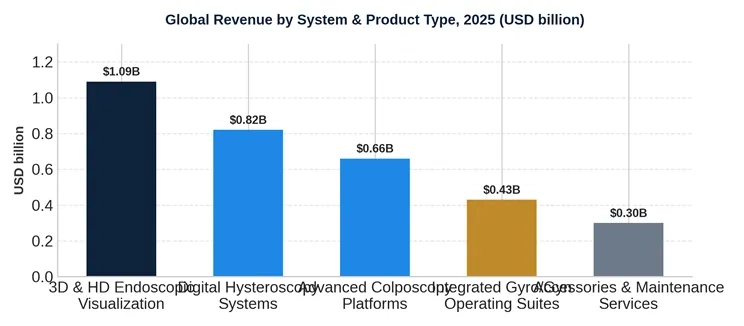
| By Service & Product Type | 3D & HD Endoscopic Systems; Digital Hysteroscopy Systems; Advanced Colposcopy Platforms; Integrated OR Suites; Software, Retrofit & Maintenance Services. |
| By System Component | Optical Endoscopes (Rigid/Flexible); Camera Heads & Video Processors; LED/Xenon Light Engines; Fluid Management Insufflators; Diagnostic Software & AI Modules. |
| By Provider Channel | Medical Equipment OEMs; Authorized Healthcare Distributors; Independent Clinical Engineering (ISO); Specialist Imaging Software Vendors. |
| By Contract Model | OEM Comprehensive Warranty; Annual Maintenance Contracts (AMC); Comprehensive Maintenance Contracts (CMC); Time & Material (T&M); Software Subscriptions. |
| By End User | Hospitals & Surgical Centers; Specialty Women's Health Clinics; Ambulatory Surgical Centers (ASCs); Academic & Research Institutes. |
This market valuation utilizes a bottom-up installed-base modeling approach. Gynecological visualization equipment families—including hysteroscopic towers, 3D laparoscopic systems, digital colposcopes, and integrated suites—are mapped across healthcare facility tiers globally. System replacement values are derived from public hospital procurement data, medical device OEM financial disclosures, and clinical surgical volume statistics.
Annual service factor intensity coefficients are applied based on component failure rates, sterilization wear-and-tear, optical calibration needs, and software licensing. Internal hospital technician salaries and basic disposable consumables are excluded to ensure true market service valuation. Regional allocations incorporate hospital bed density, healthcare capital expenditure, and regional service network maturity.
The global gynecological visualization system market is undergoing a structural shift from basic equipment maintenance toward comprehensive procedural availability and high-definition diagnostic performance. China continues to represent the largest installed system opportunity, while India and Southeast Asia drive the fastest growth in regional network expansion. Winning equipment and service vendors will be those capable of delivering flawless optical clarity, rapid loaner scope replacement, robust AI integration, and flexible contract structures tailored to evolving hospital requirements.
| Sr No | Topic |
|---|---|
| 1 | Market Segmentation |
| 2 | Scope of the report |
| 3 | Research Methodology |
| 4 | Executive summary |
| 5 | Key Predictions of Gynecological Visualization System Market |
| 6 | Avg B2B price of Gynecological Visualization System Market |
| 7 | Major Drivers For Gynecological Visualization System Market |
| 8 | Global Gynecological Visualization System Market Production Footprint - 2025 |
| 9 | Technology Developments In Gynecological Visualization System Market |
| 10 | New Product Development In Gynecological Visualization System Market |
| 11 | Research focuses on new Gynecological Visualization System |
| 12 | Key Trends in the Gynecological Visualization System Market |
| 13 | Major changes expected in Gynecological Visualization System Market |
| 14 | Incentives by the government for Gynecological Visualization System Market |
| 15 | Private investments and their impact on Gynecological Visualization System Market |
| 16 | Market Size, Dynamics, And Forecast, By Type, 2026-2032 |
| 17 | Market Size, Dynamics And Forecast, By Output, 2026-2032 |
| 18 | Market Size, Dynamics, And Forecast, By End User, 2026-2032 |
| 19 | Competitive Landscape Of Gynecological Visualization System Market |
| 20 | Mergers and Acquisitions |
| 21 | Competitive Landscape |
| 22 | Growth strategy of leading players |
| 23 | Market share of vendors, 2025 |
| 24 | Company Profiles |
| 25 | Unmet needs and opportunities for new suppliers |
| 26 | Conclusion |

© 2017-2026 Mobility Foresights Pvt Ltd. All rights reserved.
Developed with by ClousTech