- Get in Touch with Us

Last Updated: Aug 03, 2026 | Study Period: 2026-2032
Built from chemical production process modelling, polymer synthesis plant disclosures, global organometallic precursor trade flow analysis, and key catalyst manufacturer capacity tracking.
Calibrated estimate. Scope covers organometallic complexes and catalysts used in polyolefin synthesis, fine chemicals, pharmaceutical asymmetric synthesis, agrochemical intermediates, electronics precursors (ALD/CVD), and specialty chemical transformations. It excludes bulk heterogeneous inorganic catalysts, precious metal refining catalysts without organic ligands, and captive in-house non-commercial organometallic formulations.
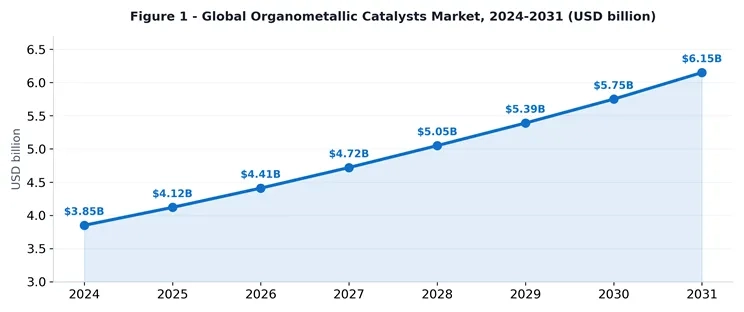
The 2024 midpoint value of $3.85 billion is derived from an estimated $58–$65 billion annual polymer and fine chemical yield produced via organometallic catalytic processes. An organometallic catalyst intensity factor of roughly 5.8%–6.6% is applied across catalytic reaction classes, then adjusted for catalyst recovery rates, recycling loop efficiency, and precious metal metal-lease structures. This produces a base-year valuation range of $3.50–$4.20 billion.
Growth to 2031 is driven by transition toward high-performance materials rather than simple volume expansion. Tightening environmental standards demand higher catalytic efficiency and ultra-low metal residue in end-use polymers and active pharmaceutical ingredients (APIs).
Organometallic catalysts feature direct metal-carbon bonds or metal-ligand coordination spheres that enable highly selective chemical transformations. Scope includes organoaluminum compounds (e.g., MAO, TEAL), metallocenes, half-sandwich complexes, organozinc, organolithium, and transition metal complexes with phosphine, N-heterocyclic carbene (NHC), or cyclopentadienyl ligands used across polymerization, cross-coupling, metathesis, and asymmetric hydrogenation.
The market is structurally distinct from traditional heterogeneous catalyst sectors. Organometallic synthesis requires rigorous pyrophoric handling, inert atmosphere processing (Schlenk lines and glovebox manufacturing), specialized logistics for hazardous transport, and high-purity ligand customization. End-users evaluate performance based on TON (turnover number), TOF, enantiomeric excess (% ee), and ease of catalyst removal from reaction mixtures.
By 2031, organometallic catalyst manufacturing and supply chains will be significantly more regionalized and digitally optimized. While East Asia remains the largest volume consumer, production and custom formulation nodes are expanding across South Asia, the Middle East, and North America to secure critical supply chains. Local air-sensitive chemical logistics depots and specialized isotank fleets are becoming strategic necessities.
Catalyst development is rapidly incorporating computational chemistry, density functional theory (DFT) screening, and automated high-throughput experimentation. Leading catalyst suppliers market tailored ligand libraries that optimize polymerization kinetics and enantiomeric yield, allowing polymer producers and pharmaceutical manufacturers to achieve targeted material architectures with reduced catalyst loading.
| Catalyst Class | Adoption Level | 2024–2031 Direction |
|---|---|---|
| Metallocene & Single-Site | Very High | Mandatory for high-density polyethylene (HDPE), mLLDPE, and elastomers. |
| Organoaluminum Co-catalysts | Very High | Essential alkylating/activating agents (MAO, TMA, TEAL) across polyolefin reactors. |
| Transition Metal Cross-Coupling | High | Accelerating growth in pharmaceutical API synthesis and OLED material synthesis. |
| Rare Earth Organometallics | Medium-High | Scaling in stereospecific synthetic rubber (polybutadiene) and biodegradable polymers. |
| Region | 2024 Share | CAGR | Demand and Supply Position |
|---|---|---|---|
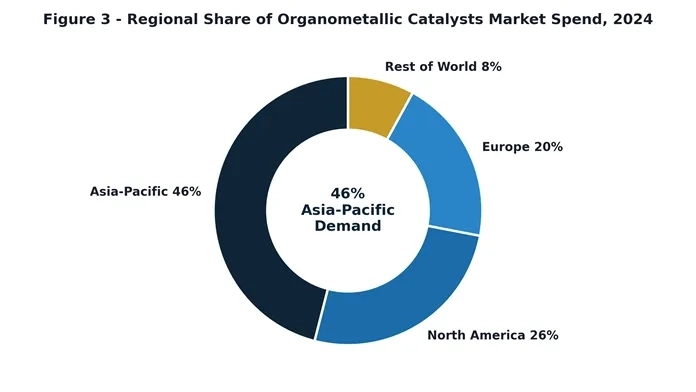
| China | 28% | 6.5% | Largest polyolefin manufacturing base; expanding local metallocene and organoaluminum production. |
| India | 10% | 10.2% | Rapid expansion in polymer manufacturing and active pharmaceutical ingredient (API) synthesis. |
| Southeast Asia | 8% | 8.8% | Growing petrochemical export hubs in Vietnam, Thailand, and Malaysia driving catalyst imports. |
| North America | 26% | 6.1% | Advanced R&D hub; heavy shale gas feedstock reliance boosting metallocene polyethylene lines. |
| Europe & ROW | 28% | 5.2% | Focus on specialty fine chemical synthesis, circular polymer catalysts, and bio-based transformations. |
| Catalyst Family | 2024 | 2031 | CAGR | Key Application Focus |
|---|---|---|---|---|
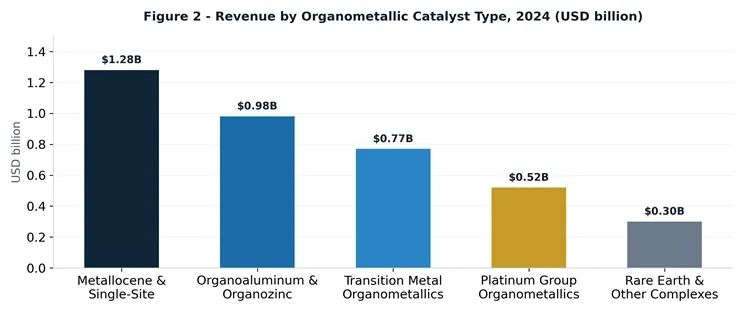
| Metallocene & Single-Site | $1.28B | $2.08B | 7.15% | LLDPE, HDPE, polypropylene, polyolefin elastomers. |
| Organoaluminum Compounds | $0.98B | $1.52B | 6.47% | Co-catalysts, activators (MAO, TEAL) for polymerization. |
| Transition Metal Organometallics | $0.77B | $1.24B | 7.04% | Cross-coupling (Pd/Ni), C-H activation, fine chemical synthesis. |
| Platinum Group Organometallics | $0.52B | $0.85B | 7.27% | Hydrosilylation, asymmetric hydrogenation, olefin metathesis. |
| Rare Earth & Other Complexes | $0.30B | $0.46B | 6.29% | Neodymium synthetic rubber polymerization, ALD electronic precursor films. |
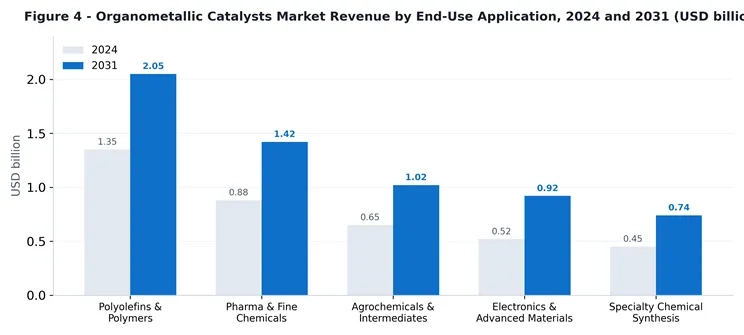
Competitive advantage stems from proprietary ligand design, low-cost metal recycling, specialized air-sensitive logistics, and responsive technical support for reactor optimization. Polyolefin producers increasingly demand customized single-site catalyst packages tailored to specific loop or gas-phase reactor conditions.
| Provider Group | Representative Participants | Primary Market Position |
|---|---|---|
| Polyolefin Catalyst Leaders | W.R. Grace, LyondellBasell, Univation Technologies, Mitsui Chemicals | Proprietary metallocene, Ziegler-Natta, and activator technologies for polymer producers. |
| Precious Metal Organometallics | Umicore, Johnson Matthey, Heraeus, Evonik | Homogeneous cross-coupling, asymmetric hydrogenation, and metathesis complexes. |
| Organoaluminum Specialists | Albemarle, Nouryon, LANXESS, Tosoh Finechem | Pyrophoric alkyls, MAO (methylaluminoxane), and co-catalyst distribution infrastructure. |
| Custom Synthesis & Precursors | Merck KGaA (Sigma-Aldrich/Strem), EMD Performance Materials, Tokyo Chemical Industry | High-purity electronic precursors, specialty ligand libraries, and laboratory-to-pilot synthesis. |
| Segmentation Axis | Coverage & Breakdown |
|---|---|
| By Catalyst Type | Metallocenes, Organoaluminum (MAO/TEAL/TMA), Organozinc, Transition Metal Complexes (Pd, Ni, Ru, Rh), Rare Earth Organometallics. |
| By Application | Polyolefin Synthesis (PE/PP), Pharmaceuticals & Fine Chemicals, Agrochemical Intermediates, Semiconductor CVD/ALD Precursors, Specialty Polymers. |
| By Metal Base | Transition Metals (Pd, Ni, Ti, Zr, Ru), Main Group Metals (Al, Zn, Li), Precious Metals (Pt, Rh, Ir), Rare Earths (Nd, Sm, La). |
| By Geography | China, India, Southeast Asia, Japan & South Korea, North America, Europe, Middle East, Rest of the World. |
The market estimate employs a combined top-down petrochemical yield analysis and bottom-up chemical process mapping methodology. Key polymer synthesis plants (polyethylene, polypropylene, synthetic rubber) and active pharmaceutical ingredient synthesis facilities worldwide are audited for catalytic requirements. Catalyst consumption factors (grams of catalyst per ton of polymer or fine chemical output) are established per catalytic reaction class. Catalyst recycling loops and precious metal metal-lease values are factored in to isolate net commercial catalyst market value.
Regional allocations are calibrated using chemical plant capacity databases, trade export data for organometallic compounds, and regional investment announcements. Projections integrate macroeconomic polymer growth, pharmaceutical R&D pipeline expansion, and technological substitution trends toward single-site organometallic catalysts.
The global organometallic catalysts market is transitioning toward higher selectivity, lower catalyst loading, and enhanced environmental sustainability. While China and North America continue to represent major consumption nodes, India and Southeast Asia are emerging as vital growth corridors. The most competitive catalyst suppliers will be those offering integrated ligand customization, robust air-sensitive logistics, efficient precious metal recycling, and strong technical process support.
| Sr No | Topic |
|---|---|
| 1 | Market Segmentation |
| 2 | Scope of the report |
| 3 | Research Methodology |
| 4 | Executive summary |
| 5 | Key Predictions of Organometallic Catalysts Market |
| 6 | Avg B2B price of Organometallic Catalysts Market |
| 7 | Major Drivers For Organometallic Catalysts Market |
| 8 | Global Organometallic Catalysts Market Production Footprint - 2025 |
| 9 | Technology Developments In Organometallic Catalysts Market |
| 10 | New Product Development In Organometallic Catalysts Market |
| 11 | Research focuses on new Organometallic Catalysts |
| 12 | Key Trends in the Organometallic Catalysts Market |
| 13 | Major changes expected in Organometallic Catalysts Market |
| 14 | Incentives by the government for Organometallic Catalysts Market |
| 15 | Private investments and their impact on Organometallic Catalysts Market |
| 16 | Market Size, Dynamics, And Forecast, By Type, 2026-2032 |
| 17 | Market Size, Dynamics And Forecast, By Output, 2026-2032 |
| 18 | Market Size, Dynamics, And Forecast, By End User, 2026-2032 |
| 19 | Competitive Landscape Of Organometallic Catalysts Market |
| 20 | Mergers and Acquisitions |
| 21 | Competitive Landscape |
| 22 | Growth strategy of leading players |
| 23 | Market share of vendors, 2025 |
| 24 | Company Profiles |
| 25 | Unmet needs and opportunities for new suppliers |
| 26 | Conclusion |
© 2017-2026 Mobility Foresights Pvt Ltd. All rights reserved.
Developed with by ClousTech