- Get in Touch with Us

Last Updated: Aug 03, 2026 | Study Period: 2026-2032
Calibrated estimate. Scope covers synthetic zeolites (Li-X, 13X, 5A, 4A) and carbon molecular sieves used in Pressure Swing Adsorption (PSA) and Vacuum Pressure Swing Adsorption (VPSA) systems across medical oxygen concentrators, industrial oxygen generation (steel, glass, chemicals, water treatment), aerospace, and portable oxygen units. It excludes non-adsorptive cryogenic air separation units (ASU) hardware and unrefined natural zeolites.
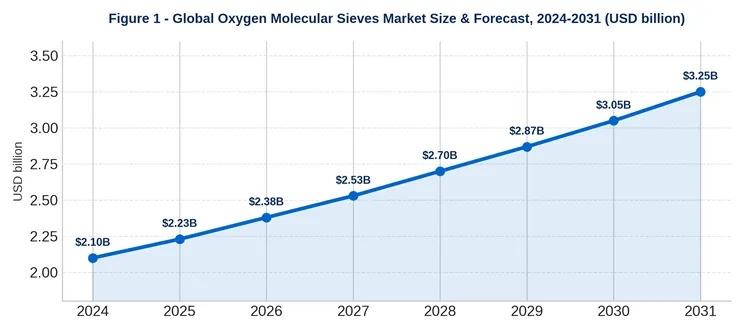
The 2024 baseline model is derived from an estimated 115,000–135,000 metric tons of global synthetic zeolite and carbon adsorbent production dedicated to oxygen concentration. Applying an average weighted market price of $15.50–$18.20 per kg across medical and industrial grades yields the base-year market valuation of $2.10 billion.
Growth through 2031 is driven by dual catalysts: expanding medical access in emerging markets and aggressive decarbonization in heavy industry. Oxy-fuel combustion in steelmaking and glass manufacturing requires low-cost oxygen, making energetic VPSA adsorbents like Li-X essential. Furthermore, replacing aging 13X beds in existing PSA units provides steady replacement revenue.
Oxygen molecular sieves are highly porous crystalline aluminosilicates (zeolites) or synthetic carbon structures engineered to selectively adsorb nitrogen, carbon dioxide, and moisture from ambient air under pressure, yielding high-purity oxygen (typically 90% to 95% O2). Key product variants include 13X, 5A, Lithium-X (Li-X), and specialized Carbon Molecular Sieves (CMS). Covered application hardware spans portable oxygen concentrators (POCs), clinical hospital PSA plants, industrial VPSA generators, wastewater aeration units, and aerospace life-support systems.
The market operates under strict physical and chemical parameters. Oxygen generation via Pressure Swing Adsorption relies on precise nitrogen separation dynamics, structural bead strength to prevent dusting, low heat of adsorption, and rapid regeneration capability. Buyers rigorously segment purchasing based on adsorption capacity (N2 capacity mmol/g), N2/O2 selectivity ratio, crush strength, and attrition rate.
By 2031, oxygen molecular sieve production will be significantly more performance-driven and ecologically optimized. While Asia-Pacific will remain the largest manufacturing and consumption hub, capacity expansions in Europe and North America will emphasize ultra-high-density Lithium zeolites and micro-bead formulations tailored for medical miniaturization.
Technical evolution will focus on nano-engineered pore structures and binderless molecular sieves. Binderless Li-X sieves offer up to 20%–30% higher active zeolite content per unit volume, enabling smaller, lighter portable oxygen concentrators and reduced power consumption in heavy industrial VPSA oxygen plants.
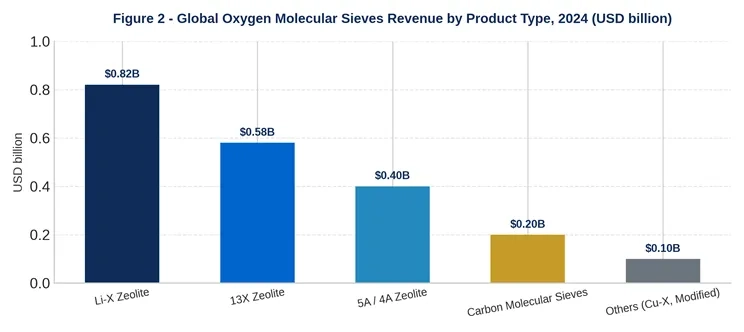
| Product Type / Adsorbent | Adoption Level | 2024–2031 Direction |
|---|---|---|
| Li-X Low-Silica Zeolite | Very High | Mandatory for portable oxygen concentrators and high-efficiency industrial VPSA systems. |
| 13X Standard Zeolite | High | Widespread in baseline industrial PSA plants; gradual replacement by Li-X in energy-critical plants. |
| 5A & 4A Calcium/Sodium Zeolites | Medium-High | Utilized in dual-bed desiccant/separation systems and regional industrial gas generation. |
| Binderless Zeolite Beads | High Growth | Rapid adoption in compact medical units requiring maximum oxygen output per gram. |
| Carbon Molecular Sieves (CMS) | Medium | Specialized deployment in high-purity nitrogen/oxygen dual swing adsorption systems. |
| Modified Cu-X / Rare-Earth Sieves | Emerging | Niche deployment in high-temperature or continuous aerospace life-support environments. |
| Region | 2024 Share | CAGR | Demand and Ecosystem Position |
|---|---|---|---|
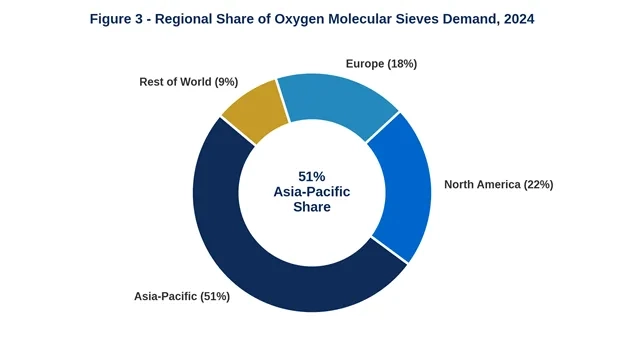
| China | 32% | 5.8% | Largest manufacturing base and end-user market. Strong government push for hospital PSA capacity. |
| India | 11% | 9.2% | Fastest-growing market; post-COVID hospital infrastructure mandates drive massive PSA installation. |
| Southeast Asia | 8% | 7.5% | Expanding industrial gas hub (Vietnam, Indonesia); rising demand in aquaculture and medical gas. |
| North America | 22% | 5.2% | High concentration of medical POC manufacturing (Inogen, ResMed) and heavy industrial oxygen use. |
| Europe & RoW | 27% | 4.8% | Focus on high-purity Li-X sieves for industrial decarbonization and medical device exports. |
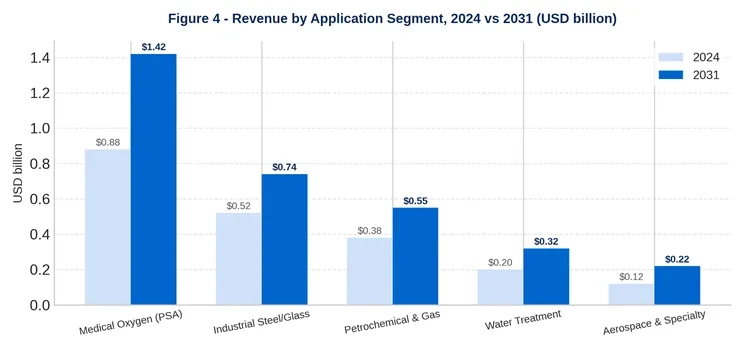
| Application Family | 2024 | 2031 | CAGR | Adsorbent Demand Drivers |
|---|---|---|---|---|
| Medical Oxygen Concentrators | $0.88B | $1.42B | 7.1% | Portable oxygen concentrators and clinical hospital PSA generator expansion. |
| Industrial Steel & Metallurgy | $0.52B | $0.74B | 5.2% | Transition to oxy-fuel combustion and electric arc furnace enrichment. |
| Petrochemical & Gas Processing | $0.38B | $0.55B | 5.4% | Claus sulfur recovery units and partial oxidation synthesis gas production. |
| Water & Wastewater Treatment | $0.20B | $0.32B | 7.0% | Ozone generation feed gas for industrial effluent and municipal purification. |
| Aerospace & Defense | $0.12B | $0.22B | 9.0% | On-Board Oxygen Generation Systems (OBOGS) for military aircraft and defense. |
| Provider Group | Representative Participants | Primary Market Position |
|---|---|---|
| Global Zeolite Leaders | Arkema (Siliporite), Honeywell UOP, Tosoh Corporation | Dominates high-performance Li-X and 13X supply; strong global IP and distribution. |
| Specialized Asian Manufacturers | Luoyang Jianlong Micro-zeolite, Shanghai Zeochem, Fulong Synthetic Zeolite | Leading bulk capacity growth; cost-competitive supply for medical concentrators. |
| Industrial Gas Integrators | Linde plc, Air Liquide, Air Products, Taiyo Nippon Sanso | Integrates molecular sieves into proprietary VPSA/PSA industrial gas plants. |
| Medical Equipment Supply Chain | Inogen, CAIRE Inc., Drive DeVilbiss, Yuwell | Consumes specialized micro-bead and pre-packed sieve canisters for POC lines. |
| Segmentation Axis | Coverage & Categories |
|---|---|
| By Product Type | Li-X Zeolite, 13X Zeolite, 5A Zeolite, 4A Zeolite, Carbon Molecular Sieves (CMS), Others |
| By Technology | Pressure Swing Adsorption (PSA), Vacuum Pressure Swing Adsorption (VPSA), Vacuum Swing Adsorption (VSA) |
| By Application | Medical Oxygen Concentrators (POC, Clinical PSA), Industrial Oxygen Generation, Water Treatment, Petrochemical, Aerospace |
| By Form Factor | Beads/Spheres (0.4–0.8mm, 1.6–2.5mm, 3.0–5.0mm), Pellets/Extrudates, Powder/Formulated Columns |
| By Geography | China, India, Japan, South Korea, Southeast Asia, North America, Europe, Rest of World |
The market size is derived through a rigorous bottom-up installed-capacity and adsorbent mass-balance model. Production capacities across major synthetic zeolite synthesis plants were mapped against annual global shipments of medical PSA concentrators and industrial VPSA oxygen generators. Unit pricing across Li-X, 13X, 5A, and CMS was modeled through direct industry interviews and customs export/import trade data. Growth projections integrate macroeconomic industrial production indices, healthcare infrastructure spending, and energetic efficiency trends.
The Global Oxygen Molecular Sieves market is entering a steady growth phase propelled by medical healthcare expansion and industrial decarbonization. Lithium-X zeolites will continue to capture market share due to superior energy efficiency and separation capacity. Suppliers capable of offering consistent quality, high attrition resistance, and localized technical bed-re-bedding support will achieve sustainable competitive advantages.
| Sr No | Topic |
|---|---|
| 1 | Market Segmentation |
| 2 | Scope of the report |
| 3 | Research Methodology |
| 4 | Executive summary |
| 5 | Key Predictions of Oxygen Molecular Sieves Market |
| 6 | Avg B2B price of Oxygen Molecular Sieves Market |
| 7 | Major Drivers For Oxygen Molecular Sieves Market |
| 8 | Global Oxygen Molecular Sieves Market Production Footprint - 2025 |
| 9 | Technology Developments In Oxygen Molecular Sieves Market |
| 10 | New Product Development In Oxygen Molecular Sieves Market |
| 11 | Research focuses on new Oxygen Molecular Sieves |
| 12 | Key Trends in the Oxygen Molecular Sieves Market |
| 13 | Major changes expected in Oxygen Molecular Sieves Market |
| 14 | Incentives by the government for Oxygen Molecular Sieves Market |
| 15 | Private investments and their impact on Oxygen Molecular Sieves Market |
| 16 | Market Size, Dynamics, And Forecast, By Type, 2026-2032 |
| 17 | Market Size, Dynamics And Forecast, By Output, 2026-2032 |
| 18 | Market Size, Dynamics, And Forecast, By End User, 2026-2032 |
| 19 | Competitive Landscape Of Oxygen Molecular Sieves Market |
| 20 | Mergers and Acquisitions |
| 21 | Competitive Landscape |
| 22 | Growth strategy of leading players |
| 23 | Market share of vendors, 2025 |
| 24 | Company Profiles |
| 25 | Unmet needs and opportunities for new suppliers |
| 26 | Conclusion |
© 2017-2026 Mobility Foresights Pvt Ltd. All rights reserved.
Developed with by ClousTech