- Get in Touch with Us

Last Updated: Aug 03, 2026 | Study Period: 2026-2032
Built from chemical synthesis capacity modeling, polymer additive demand dynamics, regulatory compliance databases, and capital expenditure disclosures across polyurethanes, epoxy resins, and engineering plastics. Scope covers chemically bonded (reactive) flame retardant additives across building construction, electronics, automotive, and industrial polymers. It excludes additive-type non-bonded flame retardants, physical fillers like aluminum trihydroxide (ATH), and coating surface treatments.
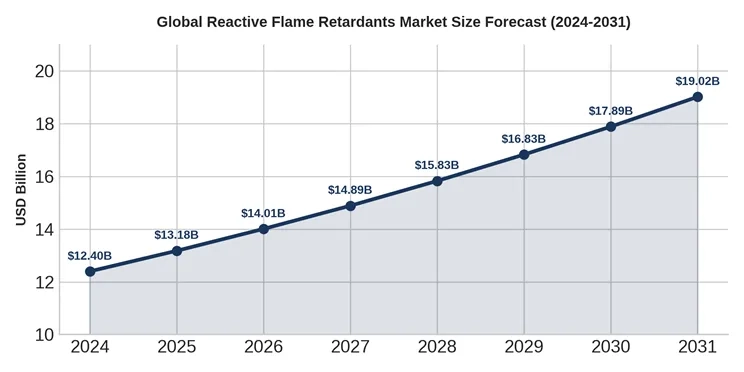
The 2024 market value of $12.40 billion reflects total global consumption across polyurethane, epoxy, unsaturated polyester, and polycarbonate systems. The external demand factor is calculated based on polymer blend ratios (typically 3%–12% reactive loading) combined with regional resin output volumes.
Growth through 2031 is driven by expanding industrial applications, tight fire performance mandates, and the permanent chemical incorporation advantage. Because reactive flame retardants become copolymerized into the matrix, they offer superior permanence, minimal mechanical weakening, and non-migration properties critical for high-reliability applications like EV battery enclosures and 5G printed circuit boards.
Reactive flame retardants are chemical compounds containing flame-retarding elements (such as phosphorus, bromine, or chlorine) along with functional reactive groups (hydroxy, epoxy, vinyl, or carboxylic groups). Unlike traditional additive flame retardants, which are physically mixed into polymers and subject to leaching or volatilization over time, reactive flame retardants covalently bond into the polymer chain during polymerization.
This fundamental chemical differentiation provides permanent flame retardancy, superior heat resistance, zero additive migration, and preserved polymer optical and mechanical properties. Major end-use sectors including automotive, aerospace, construction, electronics, and textiles increasingly mandate reactive solutions to satisfy demanding fire, health, and environmental compliance frameworks.
By 2031, the reactive flame retardant landscape will be heavily shaped by halogen-free chemistries, bio-based reactive monomers, and specialized formulations for electric vehicle (EV) battery systems. While Asia-Pacific retains its central role in manufacturing and consumption, regulatory pressure in North America and Western Europe is accelerating adoption of non-halogenated organophosphorus reactive systems.
Chemical producers are heavily investing in custom reactive intermediates like 9,10-dihydro-9-oxa-10-phosphaphenanthrene-10-oxide (DOPO) derivatives and polyols that allow tailored crosslinking densities without increasing resin viscosity during formulation.
The table below details current adoption levels and future direction across key reactive flame retardant product categories:
| Product Category | Adoption Level | 2024-2031 Strategic Direction |
|---|---|---|
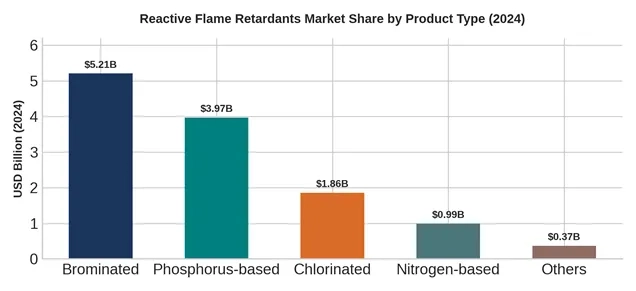
| Brominated Reactives (e.g., TBBA) | Very High | Maintains strong share in PCBs and epoxies; facing regulatory scrutiny in Europe. |
| Phosphorus-Based Reactives | High / Fast Growing | Rapidly expanding across PU foams and engineering plastics due to halogen-free demand. |
| Chlorinated Reactives | Medium | Steady demand in cost-sensitive polyester resin and rigid foam construction applications. |
| Nitrogen-Based Reactives | Medium | Increasingly blended with phosphorus reactives for synergistic flame-retardant performance. |
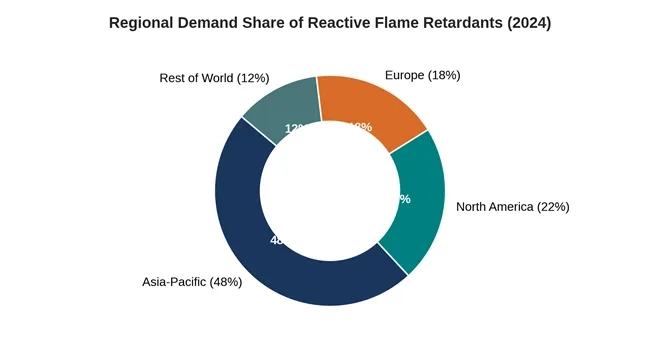
Market expansion varies significantly across regions based on local manufacturing hubs, raw material access, and environmental safety regulations:
| Region | 2024 Share | CAGR (2024-31) | Market and Ecosystem Position |
|---|---|---|---|
| Asia-Pacific | 48% | 7.1% | Dominates global electronics and PU foam production; China and India lead raw material volume. |
| North America | 22% | 5.8% | Driven by strict building code standards, aerospace composites, and EV battery innovations. |
| Europe | 18% | 4.9% | Pioneer in eco-friendly halogen-free transitions and REACH compliance mandates. |
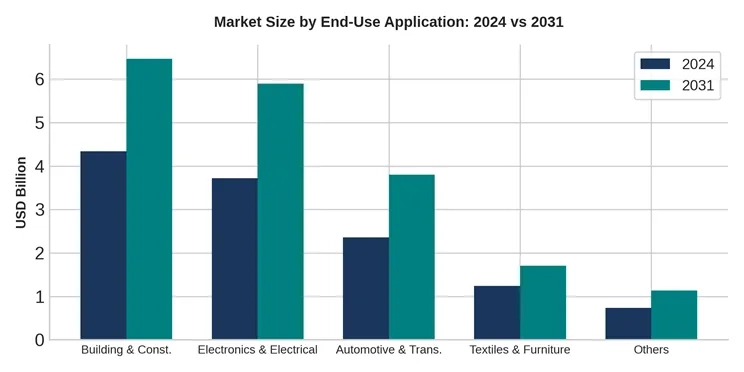
The integration of reactive flame retardants spans major industrial polymer platforms, each exhibiting distinct growth profiles:
| Application Sector | 2024 Value | 2031 Value | CAGR | Technology & Process Demands |
|---|---|---|---|---|
| Building & Construction | $4.34B | $6.47B | 5.9% | Rigid PU/PIR spray foam insulation, structural panels, and architectural coatings. |
| Electronics & Electrical | $3.72B | $5.90B | 6.8% | Epoxy laminates (FR-4 PCB), semiconductor packaging, and connector housings. |
| Automotive & Transport | $2.36B | $3.80B | 7.0% | EV battery pack enclosures, lightweight structural composites, and seating foams. |
The market is characterized by consolidated specialty chemical giants and dedicated niche synthesis firms:
| Provider Tier | Representative Participants | Primary Market Position & Focus |
|---|---|---|
| Global Specialty Chemical Leaders | LANXESS, ICL Group, Albemarle Corporation, Clariant | Integrated chemical synthesis, extensive patent portfolios, and global distribution. |
| Regional Synthetic Specialists | Sanko Chemical, Chemische Fabrik Budenheim, Daihachi Chemical | Specialized phosphorus and DOPO derivatives tailored for high-end electronic applications. |
| Resin & Polyol Formulators | BASF SE, Dow Chemical, Covestro AG | Integrating reactive intermediates into turn-key polyol systems for PU foam and coating clients. |
| Segmentation | Coverage |
|---|---|
| By Product Type | Brominated Reactive Flame Retardants (TBBPA, etc.), Phosphorus-based Reactive Flame Retardants (DOPO, reactive polyols), Chlorinated Reactives, Nitrogen-based Reactives, Others. |
| By Polymer Matrix | Polyurethane (Rigid & Flexible Foams), Epoxy Resins, Unsaturated Polyester Resins (UPR), Polycarbonate, Polyolefins & Engineering Plastics. |
| By Application | Building & Construction, Electronics & Electrical, Automotive & Transportation, Textiles & Upholstery, Industrial & Aerospace. |
| By Geography | North America, Europe, Asia-Pacific, ROW. |
The market estimates presented in this report utilize a rigorous bottom-up and top-down synthesis approach. Chemical production capabilities, raw material trade flows, and global resin production figures (PU, Epoxy, UPR) were analyzed to calculate the total addressable market.
Primary interviews were conducted with specialty chemical product managers, polymer formulators, and regulatory compliance experts. Secondary research included company financial filings, patent databases, trade association publications, and environmental agency reports.
The global reactive flame retardants market represents a vital, high-growth sector within specialty chemicals. Driven by the imperative for non-leaching, durable, and environmentally compliant fire safety solutions, chemically bound retardants are rapidly replacing legacy physical additives. Companies that focus on innovative phosphorus-based, bio-derived, and custom reactive monomers will be best positioned to capture market share through 2031.
| Sr No | Topic |
|---|---|
| 1 | Market Segmentation |
| 2 | Scope of the report |
| 3 | Research Methodology |
| 4 | Executive summary |
| 5 | Key Predictions of Reactive Flame Retardants Market |
| 6 | Avg B2B price of Reactive Flame Retardants Market |
| 7 | Major Drivers For Reactive Flame Retardants Market |
| 8 | Global Reactive Flame Retardants Market Production Footprint - 2025 |
| 9 | Technology Developments In Reactive Flame Retardants Market |
| 10 | New Product Development In Reactive Flame Retardants Market |
| 11 | Research focuses on new Reactive Flame Retardants |
| 12 | Key Trends in the Reactive Flame Retardants Market |
| 13 | Major changes expected in Reactive Flame Retardants Market |
| 14 | Incentives by the government for Reactive Flame Retardants Market |
| 15 | Private investments and their impact on Reactive Flame Retardants Market |
| 16 | Market Size, Dynamics, And Forecast, By Type, 2026-2032 |
| 17 | Market Size, Dynamics And Forecast, By Output, 2026-2032 |
| 18 | Market Size, Dynamics, And Forecast, By End User, 2026-2032 |
| 19 | Competitive Landscape Of Reactive Flame Retardants Market |
| 20 | Mergers and Acquisitions |
| 21 | Competitive Landscape |
| 22 | Growth strategy of leading players |
| 23 | Market share of vendors, 2025 |
| 24 | Company Profiles |
| 25 | Unmet needs and opportunities for new suppliers |
| 26 | Conclusion |
© 2017-2026 Mobility Foresights Pvt Ltd. All rights reserved.
Developed with by ClousTech