- Get in Touch with Us

Last Updated: Aug 13, 2026 | Study Period: 2026-2032
Built from vehicle-production statistics, supplier disclosures, safety-agency evidence, restraint-system product data and bottom-up fitment modelling. The analysis shows where pyrotechnic content is expanding and which technical, qualification and logistics barriers protect established suppliers.
Calibrated estimate. Scope includes complete micro gas generators used in retractor, buckle, anchor, lap-belt, end-fitting and dual pretensioner systems for passenger and commercial vehicles. Airbag inflators, reversible pretensioner motors and unrelated pyrotechnic actuators are excluded.
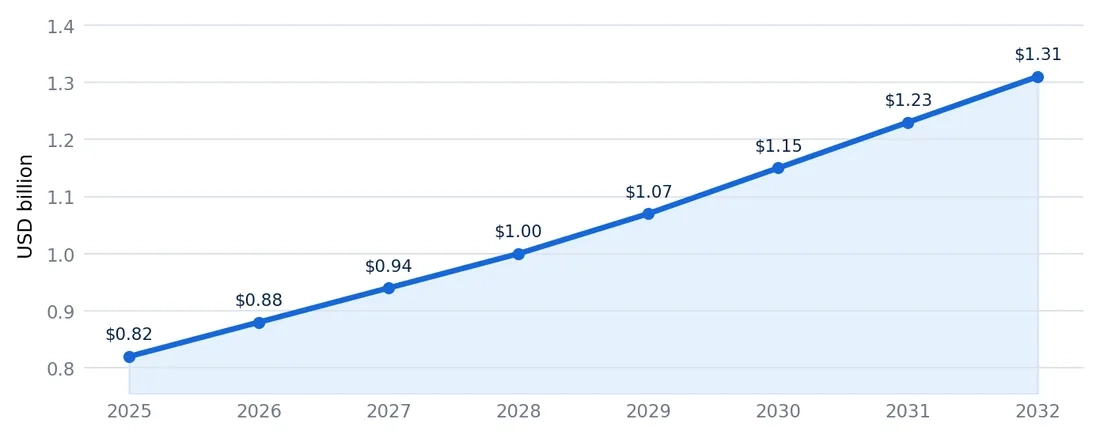
The global seat belt pretensioner gas generator market is estimated to increase from $0.82 billion in 2025 to $1.31 billion in 2032. The 2025 range is $0.74-0.91 billion and the 2032 range is $1.14-1.47 billion, with midpoint values used throughout the report.
The model has considered vehicle production reaching about 107-110 million units by 2032, while average PGG content increases from 2.45 to roughly 3.05-3.25 units per vehicle. Rear-seat, buckle, anchor and dual-pretensioner fitment provides most incremental demand. Average nominal value rises from about $3.47 to $3.78.
Autoliv's $3.513 billion of 2025 seat belt sales and stated 45% global seat belt share imply a complete seat belt system market near $7.8 billion. The modeled PGG value is therefore about 10-11% of the full system pool. This is a useful reasonableness check, not a disclosed PGG revenue ratio.
A seat belt pretensioner gas generator, or PGG, is a compact pyrotechnic device activated by the vehicle's crash-sensing system. Its squib ignites a gas-generating propellant and the resulting pressure moves a piston, cable, rotor or rack to remove slack from the belt.
The deployment sequence takes about 0.05 seconds according to Nippon Kayaku. The pretensioner positions the occupant relative to the airbag, while a force limiter controls the belt load. Product performance depends on the complete restraint architecture, not gas output alone.
Growth will shift from mature front-seat retractor fitment toward rear outboard, buckle, anchor and dual systems. Premium vehicles, larger SUVs and pickups will adopt first, while entry-level platforms retain simpler configurations. Electrification has limited direct effect on PGG technology, but heavier vehicles, battery packaging and new seating concepts require carefully tuned restraints. Active control retractors should expand in higher-value vehicles without removing the crash-stage pyrotechnic function.
| Application | 2025 adoption | Outlook to 2032 |
|---|---|---|
| Front retractor pretensioners | Very High | Mature recurring production base |
| Front buckle pretensioners | High | Additional content in premium and highly rated vehicles |
| Anchor and lap pretensioners | Moderate-High | Growth from pelvis control and submarining reduction |
| Rear outboard pretensioners | Moderate | Largest incremental unit opportunity |
| Dual pretensioner systems | Moderate | Two pyrotechnic activation points per seating position |
| Commercial vehicles | Low-Moderate | Safety-content gap gradually narrows |
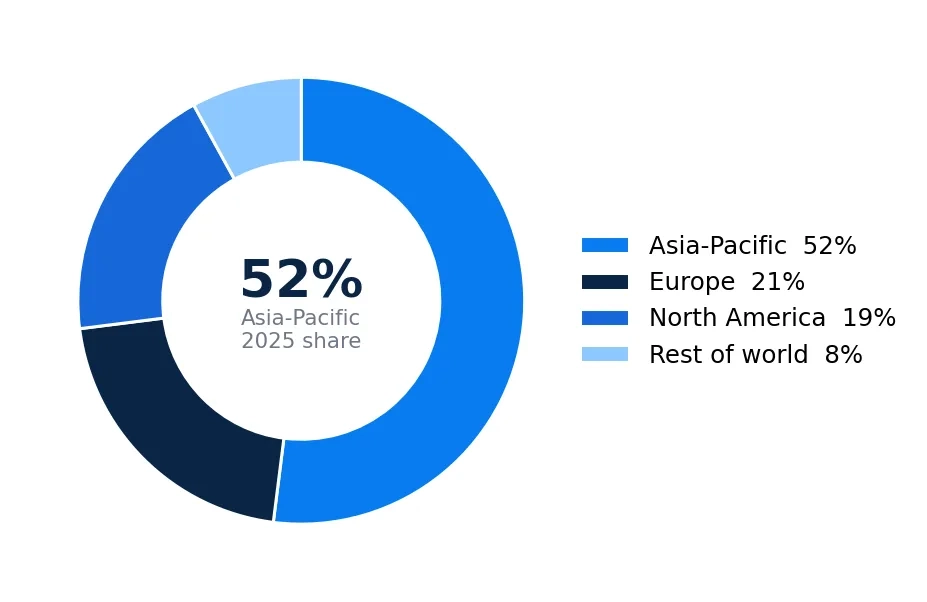
Retractor applications remain the largest value pool, but buckle and anchor systems grow faster because they improve lap-belt positioning and can create a second activation point. Public pricing is limited. The model uses an average transfer value of about $3.47 per PGG in 2025, adjusted by interface, housing, output, production region and qualification requirements. Rear-centre positions remain constrained by packaging and cost.
| Region | 2025 | 2032 | CAGR | Market position |
|---|---|---|---|---|
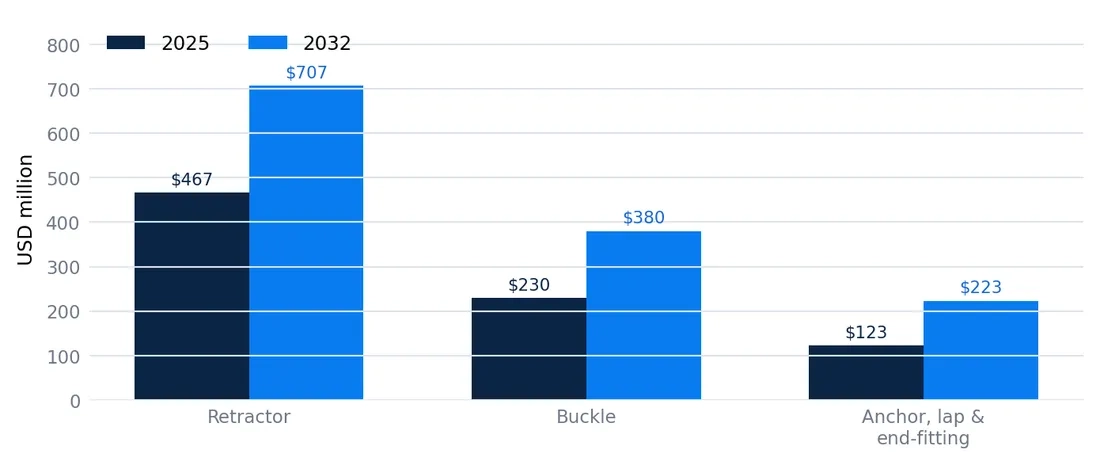
| Asia-Pacific | $426M | $707M | 7.5% | Largest production base; 59.2 million vehicles in 2025. |
| Europe | $172M | $262M | 6.2% | High safety content and stronger rear-seat requirements. |
| North America | $156M | $236M | 6.1% | SUV and pickup mix; rear-occupant testing supports content. |
| Rest of world | $66M | $105M | 6.9% | Rising safety-component penetration from a smaller base. |
Regional values follow vehicle production location rather than supplier headquarters. Asia-Pacific's 52% value share is below its 61% production share because average safety content differs by income level. Autoliv estimates passive-safety content near $350 per vehicle in high-income markets versus about $210 in medium- and low-income markets. Europe and North America therefore generate higher PGG value per vehicle through rear-seat, dual and premium systems.
| Product platform | 2025 | 2032 | CAGR | Commercial position |
|---|---|---|---|---|
| Retractor PGG | $467M | $707M | 6.1% | Largest installed base and recurring production volume. |
| Buckle PGG | $230M | $380M | 7.4% | Premium and higher-rated vehicle content. |
| Anchor, lap and end-fitting PGG | $123M | $223M | 8.9% | Fastest growth from pelvis control and dual systems. |
| Pin-type interface | 64% share | 68% share | - | Compact packaging and automated module assembly. |
Pin-type products gain modest share because they simplify packaging and direct integration into retractor, buckle or anchor modules. Lead-wire designs remain relevant where vehicle architecture requires flexible routing. ASTOTEC also offers lateral pin orientations. Pressure profile, connector position, sealing, propellant ageing and module dimensions prevent full standardisation, keeping customer-specific engineering important.
| Supplier | Position | Verified evidence |
|---|---|---|
| Nippon Kayaku | Leading merchant supplier | Claims top share in externally sold MGGs and squibs. |
| Autoliv | Integrated captive supplier | 45% seat belt share; $3.513B seat belt sales in 2025. |
| Daicel | Independent pyrotechnic supplier | PGG production in Japan, United States and Thailand. |
| ASTOTEC | European specialist | Pin- and lead-wire MGGs for multiple pretensioners. |
| Joyson Safety | Integrated seat belt supplier | Retractor, anchor, buckle and electric systems. |
| ZF LIFETEC | Integrated active-restraint supplier | Combines electric and pyrotechnic pretensioning. |
Public information does not support an additive company-share table because several suppliers combine PGG revenue with inflators, squibs or complete restraints. Nippon Kayaku identifies itself as the leading externally sold MGG and squib supplier, while Autoliv's 45% seat belt share cannot be treated as an identical PGG share. Competitive position should be judged through verified leadership, customer qualifications, regional production and captive versus merchant supply.
| Segmentation | Coverage |
|---|---|
| By interface | Pin-type; lead-wire-type |
| By application | Retractor; buckle; anchor; lap-belt; end-fitting; dual system |
| By vehicle | Passenger; light commercial; heavy commercial; buses |
| By seat position | Driver; front passenger; rear outboard; rear centre; additional rows |
| By value segment | Entry-level; mass market; premium; luxury |
| By supply model | Captive production; merchant supply |
| By propulsion | ICE; hybrid; battery electric; fuel-cell vehicle |
| By geography | North America; Europe; Asia-Pacific; and Rest of the world |
The model uses vehicle production, seat-position fitment, pretensioner architecture and average OEM transfer value. Volume equals vehicle output multiplied by equipped seating positions, fitment by position and gas generators per architecture. Value equals estimated PGG demand multiplied by transfer value by type and region.
Validation uses Autoliv's disclosed seat belt revenue and market share, named rear-seat system changes, supplier manufacturing footprints and sensitivity testing for vehicle output, PGG content and unit value. Exact manufacturer shares require primary interviews with purchasing and restraint-engineering teams.
Primary research should distinguish externally purchased generators from captive production and should test fitment by vehicle class, price segment and seat position. The forecast is most sensitive to rear-seat adoption, global vehicle output and realised unit value, while electrical-interface mix has a smaller effect on total revenue.
| Measure | 2025 base case |
|---|---|
| Global vehicle production | 96.4 million vehicles |
| Average PGG content | About 2.45 units per vehicle |
| Estimated PGG demand | About 236 million units |
| Average transfer value | About $3.47 per unit |
| Estimated market value | $0.82 billion |
| Market range | $0.74-0.91 billion |
| Claim | Confidence | Basis |
|---|---|---|
| Vehicle production | High | Direct OICA reporting |
| PGG technology | High | Multiple verified supplier disclosures |
| Rear-seat trend | High | Supplier strategy and named vehicle changes |
| 2025 unit demand | Medium | Bottom-up fitment model |
| 2025 and 2032 values | Medium | Unit model and seat belt cross-check |
| Company shares | Medium | Comparable PGG revenue is not isolated |
The market is expanding faster than vehicle production because safety content per vehicle is rising. Front retractor PGGs remain the volume base, while rear, buckle and anchor systems create the stronger incremental opportunity.
Suppliers with proven initiator, propellant, sealing, automated inspection and regional pyrotechnic logistics capability will be best positioned to convert fitment growth into durable revenue through 2032.
The commercial priority is therefore not a generic low-cost generator. It is a qualified platform that can be tuned across several pretensioner locations, produced near the restraint-system customer and supported with complete batch traceability.
| Sr No | Topic |
|---|---|
| 1 | Market Segmentation |
| 2 | Scope of the report |
| 3 | Research Methodology |
| 4 | Executive summary |
| 5 | Key Predictions of Seat Belt Pretensioner Gas Generators Market |
| 6 | Avg B2B price of Seat Belt Pretensioner Gas Generators Market |
| 7 | Major Drivers For Seat Belt Pretensioner Gas Generators Market |
| 8 | Global Seat Belt Pretensioner Gas Generators Market Production Footprint - 2025 |
| 9 | Technology Developments In Seat Belt Pretensioner Gas Generators Market |
| 10 | New Product Development In Seat Belt Pretensioner Gas Generators Market |
| 11 | Research focuses on new Seat Belt Pretensioner Gas Generators |
| 12 | Key Trends in the Seat Belt Pretensioner Gas Generators Market |
| 13 | Major changes expected in Seat Belt Pretensioner Gas Generators Market |
| 14 | Incentives by the government for Seat Belt Pretensioner Gas Generators Market |
| 15 | Private investments and their impact on Seat Belt Pretensioner Gas Generators Market |
| 16 | Market Size, Dynamics, And Forecast, By Type, 2026-2032 |
| 17 | Market Size, Dynamics And Forecast, By Output, 2026-2032 |
| 18 | Market Size, Dynamics, And Forecast, By End User, 2026-2032 |
| 19 | Competitive Landscape Of Seat Belt Pretensioner Gas Generators Market |
| 20 | Mergers and Acquisitions |
| 21 | Competitive Landscape |
| 22 | Growth strategy of leading players |
| 23 | Market share of vendors, 2025 |
| 24 | Company Profiles |
| 25 | Unmet needs and opportunities for new suppliers |
| 26 | Conclusion |
© 2017-2026 Mobility Foresights Pvt Ltd. All rights reserved.
Developed with by ClousTech



