- Get in Touch with Us

Last Updated: Aug 14, 2026 | Study Period: 2026-2032
Built from installed-equipment replacement-value modelling across hospital networks, surgical centers and home-care fleets, public healthcare capex disclosures, official clinical technology data and medical equipment-OEM service documentation. The analysis addresses three buyer decisions: which compression system families should remain under OEM contract, where multivendor biomedical service can lower cost, and which regional healthcare markets require expanded technical field coverage.
Calibrated estimate. Scope covers external maintenance, repair, overhaul, pressure calibration, garment/sleeve supply management, remote tele-monitoring software support and system retrofits for sequential compression devices (SCD) utilized in inpatient surgical wards, intensive care units (ICUs), outpatient centers and post-operative home rehabilitation. It excludes raw textile manufacturing, general hospital infrastructure utilities, and the internal payroll costs of hospital-employed biomedical engineering teams.
The 2025 midpoint calculation is established from an estimated $66-$74 billion replacement value for active sequential compression device controllers, portable prophylaxis pumps, and associated multi-chamber compression garments across global healthcare facilities. An external maintenance and service factor of 4.3%-5.0% is applied by equipment class, adjusted for bundled warranty periods, in-house biomedical engineering maintenance, and cross-departmental device utilization. This establishes the 2025 baseline range of $3.0-$3.7 billion.
Growth to 2032 is driven by factors beyond rising surgical volume. Expanding clinical protocols mandating mechanical DVT and Pulmonary Embolism (PE) prophylaxis across non-surgical bed days increase device run-hours. Transition to smart, battery-powered portable units enables continuous therapy during patient transport and home recovery, requiring decentralized service networks. Furthermore, integration with electronic health records (EHR) and wireless compliance monitoring shifts spend from reactive pump repairs toward proactive uptime contracts.
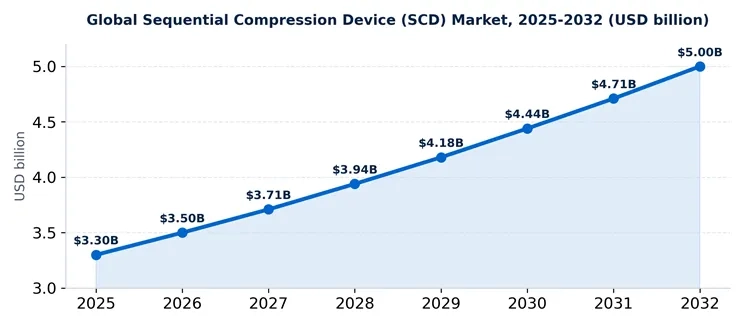
Sequential Compression Device (SCD) MRO services ensure pneumatic compression systems, pressure controllers, and multi-chambered garments remain precise, hygienic, and compliant with medical standards. The scope covers routine pressure sensor calibration, cycle timing validation, pump overhaul, sleeve and hose replacement, battery health checks, wireless connectivity maintenance, remote diagnostic monitoring, and healthcare personnel operational training.
Medical SCD MRO differs significantly from generic pneumatic device maintenance. SCD systems operate directly on patient limbs to prevent venous stasis and thromboembolism, requiring tight inflation/deflation pressure tolerances (typically 30-60 mmHg) and strict alarm safety systems.
By 2032, SCD service delivery will become highly decentralized and data-driven. While major hospital networks remain the primary revenue pool, rapid growth in outpatient surgical care and home recovery requires mobile field service units and localized depot maintenance. Rapid turnaround times and automated hygiene/sterilization verification will become standard contractual requirements.
Service content per unit is expanding as devices incorporate telemetry, Bluetooth tracking, and patient compliance logging. Modern SCD controllers transmit real-time compression cycle data to hospital nursing dashboards.
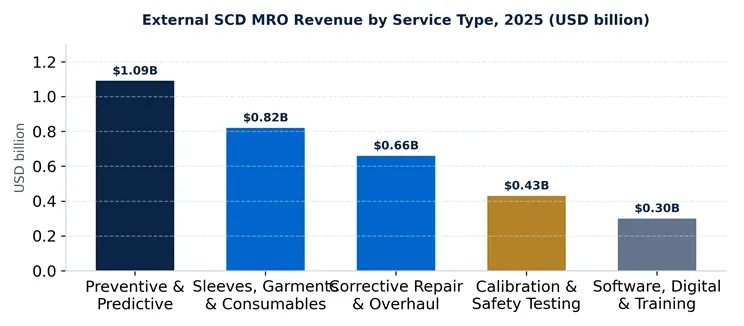
| Service | Adoption | 2025–2032 Direction |
|---|---|---|
| Preventive maintenance | Very High | Mandatory testing for pneumatic valves, internal pumps, and pressure sensors. |
| Remote tele-compliance diagnostics | High | Accelerating in home-use models; reduces physical service calls and tracks usage. |
| Predictive pump maintenance | Medium-High | Scaling in smart hospital systems via internal usage-hour and pressure telemetry. |
| Independent depot overhaul | Medium | Cost-effective for legacy fleets; limited by proprietary firmware and OEM valves. |
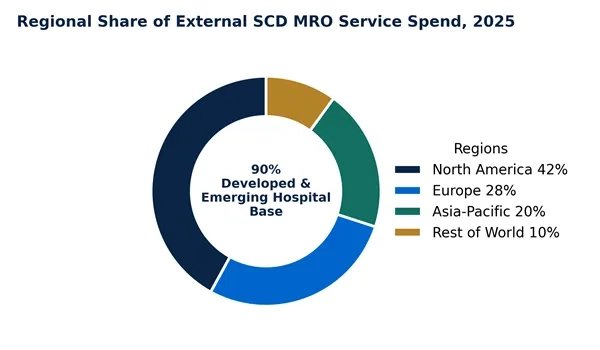
| Region | 2025 Share | CAGR | Demand and Service Position |
|---|---|---|---|
| North America | 42% | 5.2% | Largest installed base; strict surgical compliance standards (SCIP) and high adoption of smart, connected SCD units. |
| Europe | 28% | 4.8% | Strong public healthcare mandates for venous thromboembolism prophylaxis; focus on eco-friendly garment reconditioning. |
| Asia-Pacific | 20% | 9.5% | Fastest-growing region; rapid expansion of private hospital infrastructure and rising surgical volume drive equipment demand. |
| ROW | 4% | 5.8% | Investment in modern medical cities; reliance on regional distributor networks and OEM service agreements. |
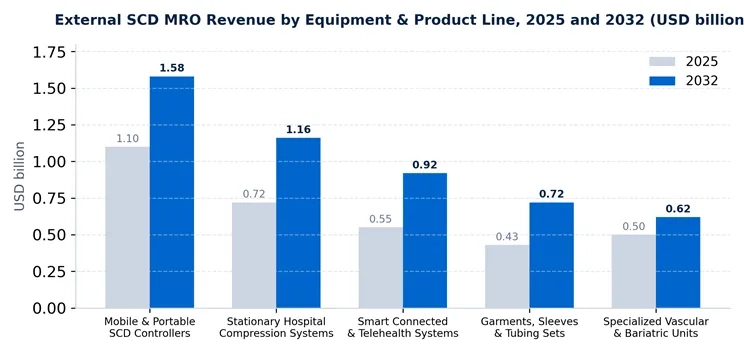
| Equipment Family | 2025 | 2032 | CAGR | Service Demand |
|---|---|---|---|---|
| Mobile & Portable SCD Controllers | $1.10B | $1.58B | 5.3% | Battery testing, ruggedized casing maintenance, drop repair, and pressure recalibration. |
| Stationary Hospital Compression Systems | $0.72B | $1.16B | 7.1% | Pneumatic manifold servicing, internal compressor overhaul, and multi-bed telemetry support. |
| Smart Connected & Telehealth Systems | $0.55B | $0.92B | 7.6% | Data integration, cybersecurity patching, cloud compliance dashboarding, and sensor tuning. |
| Garments, Sleeves & Tubing Sets | $0.43B | $0.72B | 7.7% | Quality inspection, connector integrity testing, anti-microbial sleeve distribution, and recycling. |
| Specialized Vascular & Bariatric Units | $0.50B | $0.62B | 3.1% | High-pressure pump servicing, specialized garment custom fitting, and custom calibration. |
| Provider Group | Representative Participants | Primary Service Position |
|---|---|---|
| Medical Device OEMs | Cardinal Health (Kendall), Arjo, Zimmer Biomet, Bio Compression Systems | Proprietary diagnostics, certified parts, full compliance guarantees, and direct software updates. |
| Biomedical ISOs & Integrators | Trimedx, TRIMEDX, Agiliti, Crothall Healthcare, BC Group | Multi-brand hospital asset management, cost-effective maintenance, and rapid field support. |
| Specialized Calibration & Compliance | Fluke Biomedical, Datrend Systems, Netech | Precision pressure calibration tools, safety testing equipment, and regulatory compliance software. |
| Regional Healthcare Distributors | Medline Industries, Owens & Minor, local medical suppliers | Garment inventory management, rapid delivery, basic pump repair, and loaner fleet logistics. |
Competitive advantage depends on rapid loaner deployment, pressure calibration precision, and digital telemetry support. OEMs maintain dominance in critical hospital ICUs and surgical wards, while ISOs gain traction in broader health system fleet management where cost efficiency is paramount.
| Segmentation | Coverage |
|---|---|
| By service type | Preventive & predictive maintenance; corrective pneumatic repair; pressure calibration & validation; garment & tubing management; tele-compliance software & retrofits. |
| By equipment | Mobile & portable controllers; stationary hospital compression systems; smart connected systems; specialized vascular/bariatric units; garments & accessories. |
| By provider | Medical device OEMs; authorized healthcare distributors; independent service organizations (ISOs); specialized software & calibration vendors. |
| By contract | Full-risk annual maintenance contracts (AMC); time and material (T&M); loaner fleet agreements; garment management programs; software subscription. |
| By geography | North America; Europe; Asia-Pacific; Latin America; Middle East & Africa. |
The market evaluation utilizes a bottom-up installed-base modeling technique. Active SCD units across global hospital beds, operating rooms, ASCs, and home care fleets were cataloged and categorized by device generation and mobility. Annual replacement values were computed from medical equipment pricing databases and healthcare provider capital expenditure reports.
External service spend was modeled by applying equipment-specific MRO factors based on duty cycles, pneumatic calibration requirements, valve wear rates, and software telemetry subscription costs. Deductions were made for internal hospital biomedical engineering labor and initial equipment warranty coverage to derive net external service market figures.
The global Sequential Compression Device MRO market is evolving from basic reactive repair into a technology-driven, compliance-focused service model. Growth will be led by smart connected compression systems, portable home-use prophylaxis fleets, and stringent clinical compliance requirements. Healthcare organizations that align with agile service providers capable of delivering rapid calibration, telemetry management, and guaranteed device availability will achieve superior patient outcomes and operational efficiency.
| Sr No | Topic |
|---|---|
| 1 | Market Segmentation |
| 2 | Scope of the report |
| 3 | Research Methodology |
| 4 | Executive summary |
| 5 | Key Predictions of Sequential Compression Device (SCD) Market |
| 6 | Avg B2B price of Sequential Compression Device (SCD) Market |
| 7 | Major Drivers For Sequential Compression Device (SCD) Market |
| 8 | Global Sequential Compression Device (SCD) Market Production Footprint - 2025 |
| 9 | Technology Developments In Sequential Compression Device (SCD) Market |
| 10 | New Product Development In Sequential Compression Device (SCD) Market |
| 11 | Research focuses on new Sequential Compression Device (SCD) |
| 12 | Key Trends in the Sequential Compression Device (SCD) Market |
| 13 | Major changes expected in Sequential Compression Device (SCD) Market |
| 14 | Incentives by the government for Sequential Compression Device (SCD) Market |
| 15 | Private investments and their impact on Sequential Compression Device (SCD) Market |
| 16 | Market Size, Dynamics, And Forecast, By Type, 2026-2032 |
| 17 | Market Size, Dynamics And Forecast, By Output, 2026-2032 |
| 18 | Market Size, Dynamics, And Forecast, By End User, 2026-2032 |
| 19 | Competitive Landscape Of Sequential Compression Device (SCD) Market |
| 20 | Mergers and Acquisitions |
| 21 | Competitive Landscape |
| 22 | Growth strategy of leading players |
| 23 | Market share of vendors, 2025 |
| 24 | Company Profiles |
| 25 | Unmet needs and opportunities for new suppliers |
| 26 | Conclusion |
© 2017-2026 Mobility Foresights Pvt Ltd. All rights reserved.
Developed with by ClousTech