- Get in Touch with Us

Last Updated: Aug 05, 2026 | Study Period: 2026-2032
Scope note. These market estimates reflect primary surfactant formulations (isethionates, taurates, sulfosuccinates, alkyl polyglucosides, and glutamate/glycinate amino acid surfactants) excluding legacy SLS/SLES components. All underlying volume assumptions are detailed in Section 18 and graded in the Confidence Dashboard.
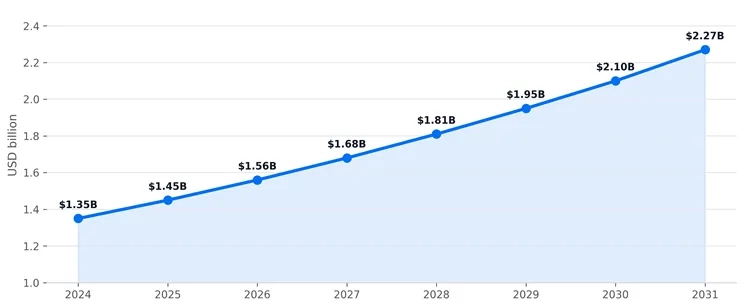
The 2024 midpoint is derived from an estimated $1.35 billion revenue pool across global personal care, cosmetics, and specialty cleaning surfactant applications. A calibrated formulation intensity factor of roughly 3.5%–4.8% is applied across end-use product categories, then adjusted for bio-feedstock availability, blend ratios, and regional manufacturing economics. This produces a base-year range of $1.20–$1.48 billion.
Growth to 2031 is propelled by consumer migration away from harsh sulfates toward gentle, eco-friendly formulations. Solid waterless formats, dermatological cleansers, color-protection shampoos, and tear-free baby products significantly boost sulfate-free surfactant consumption. Bio-based carbon mandates and RSPO certification requirements support value growth, while raw material price volatility presents moderate headwinds.
Sulfate-free surfactants maintain product efficacy, cleansing performance, and foam aesthetic without utilizing traditional alkyl sulfates such as Sodium Lauryl Sulfate (SLS) or Sodium Laureth Sulfate (SLES). The product scope encompasses mild anionic surfactants (isethionates, sulfosuccinates, sarcosinates, taurates, glutamates), non-ionic surfactants (alkyl polyglucosides), and amphoteric surfactants (betaines, amphoacetates).
The market is structurally distinct from commodity industrial surfactants. Sulfate-free formulations require precise co-surfactant balancing to achieve desirable foam viscosity, flash lather, and rinseability without compromising dermatological mildness. Chemical suppliers must deliver high-purity, low-salt, and eco-certified ingredients to meet stringent clean beauty standards.
By 2031, sulfate-free surfactant production will be significantly more regionalized and 100% bio-based focused. North America and Europe remain high-value innovation hubs, but new manufacturing plants concentrate in China, India, and Southeast Asia to optimize feedstock logistics (palm kernel and coconut oil derivatives).
Surfactant blends offering multifunctional benefits — such as simultaneous cleansing, conditioning, and scalp barrier protection — will command higher market share. Commercial growth centers on standardized, easy-to-handle liquid concentrate blends that reduce formulation complexity for mid-tier beauty brand owners.
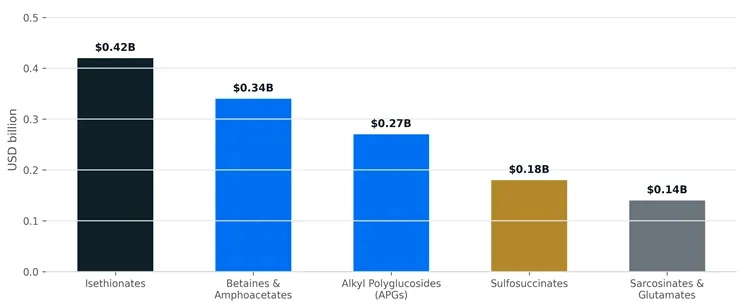
| Product / Category | Adoption | 2024–2031 Direction |
|---|---|---|
| Sodium Cocoyl Isethionates | Very High | Mandatory for solid shampoo bars, facial bars, and mild liquid cleansers. |
| Cocamidopropyl Betaine | Very High | Ubiquitous secondary surfactant providing foam stability and viscosity enhancement. |
| Alkyl Polyglucosides (APGs) | High | Rapidly expanding bio-based non-ionic category favored for extreme mildness. |
| Disodium Sulfosuccinates | High | Crucial for tear-free baby shampoos, facial washes, and ultra-sensitive skin lines. |
| Sodium Lauroyl Sarcosinate | Medium-High | Growing in color-safe premium hair care and fluoride-free natural toothpastes. |
| Sodium Cocoyl Glutamate | Medium | Premium amino acid surfactant gaining traction in eco-certified luxury skincare. |
| Region | 2024 Share | CAGR | Demand and Market Position |
|---|---|---|---|
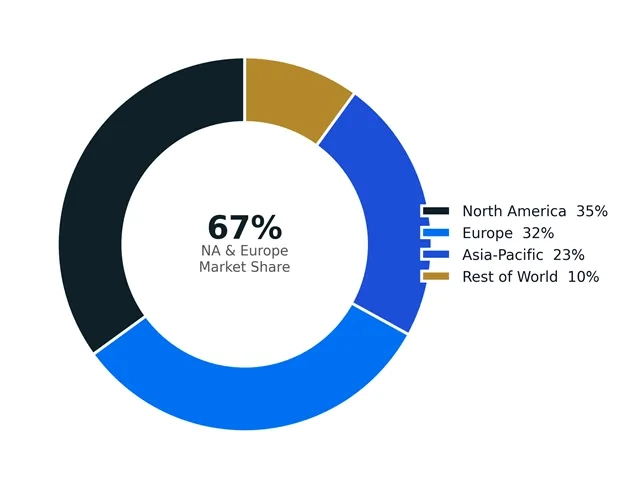
| North America | 35% | 6.8%–7.5% | Largest market by value; driven by clean beauty trends and high premium product penetration. |
| Europe | 32% | 6.2%–7.0% | Strict eco-labeling standards (Ecolabel, COSMOS); high demand for bio-based APGs and amino acids. |
| Asia-Pacific | 23% | 9.5%–11.0% | Fastest-growing region; expanding middle class and booming manufacturing hubs in China and India. |
| Latin America | 6% | 7.0%–8.2% | Growing personal care sector; Brazil leads regional adoption in premium hair care. |
| Rest of World | 4% | 5.5%–6.8% | Niche market expanding alongside urban retail growth and luxury hospitality developments. |
| Application Segment | 2024 | 2031 | CAGR | Key Demand & Formulation Drivers |
|---|---|---|---|---|
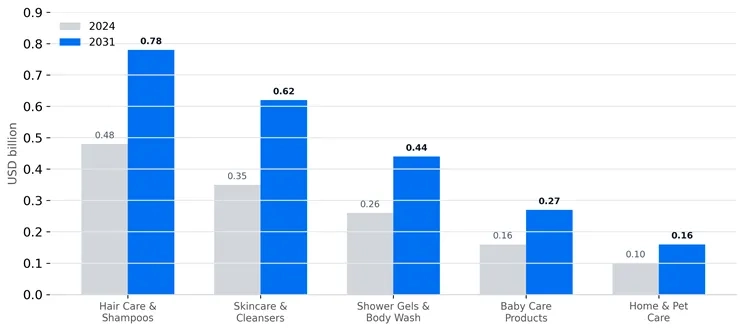
| Hair Care & Shampoos | $0.48B | $0.78B | 7.2% | Core market pool; high demand for color-safe, anti-frizz, and gentle cleansing shampoos. |
| Skincare & Cleansers | $0.35B | $0.62B | 8.5% | Fastest-growing segment; micellar waters, dermatological facial washes, and acne cleansers. |
| Shower Gels & Body Wash | $0.26B | $0.44B | 7.8% | Consumer shift from soap bars and SLS gels to sulfate-free body washes. |
| Baby Care Products | $0.16B | $0.27B | 7.8% | High sensitivity segment requiring tear-free, hypo-allergenic, and ultra-mild blends. |
| Home & Pet Care | $0.10B | $0.16B | 7.0% | Emerging category; eco-friendly dish soaps and sensitive-skin pet grooming shampoos. |
| Supplier Group | Representative Participants | Primary Market & Product Position |
|---|---|---|
| Global Multinationals | BASF, Evonik, Clariant, Solvay | Broad product portfolios, high-volume production, global distribution, REACH compliance. |
| Specialty Surfactant Leaders | Innospec, Croda, Stepan Company | Market leaders in SCI, amino acid surfactants, custom formulation technical support. |
| Oleochemical Specialists | Emery Oleochemicals, Kao Corp, Lion Corp | Sustainable palm/coconut derivatives, APG production, strong Asia-Pacific market presence. |
| Regional Distributors & Blenders | Azelis, Univar Solutions, Brenntag | Localized formulation labs, small-batch blending, rapid delivery to indie brands. |
| Segmentation | Coverage |
|---|---|
| By Product Type | Isethionates (SCI), Sulfosuccinates, Alkyl Polyglucosides (APGs), Betaines & Amphoacetates, Sarcosinates, Glutamates, Taurates. |
| By Application | Hair Care & Shampoos, Skincare & Facial Cleansers, Body Wash & Shower Gels, Baby Care Products, Oral Care, Home & Pet Care. |
| By Form | Liquid, Powder, Flakes/Prills, Paste. |
| By Origin | Bio-based (100% plant-derived), Synthetic/Petroleum-derived, Hybrid. |
| By Geography | North America (US, Canada), Europe (Germany, UK, France, Italy), Asia-Pacific (China, India, Japan, ASEAN), Latin America, Rest of World. |
The market estimate utilizes a bottom-up formulation modeling approach. Surfactant demand is mapped across personal care, cosmetics, baby care, and specialty cleaning manufacturing lines globally. Replacement value is estimated from public chemical supplier filings, brand owner capex disclosures, and trade statistics. Each surfactant category receives a specific demand weighting factor based on active concentration, formulation compatibility, and market adoption rates.
The global sulfate-free surfactants market is transitioning from a niche premium sector into a core ingredient standard across personal care. North America and Europe lead in consumption volume, while Asia-Pacific presents the most dynamic manufacturing expansion opportunity. Winning chemical suppliers will offer pre-blended cold-processable concentrates, reliable bio-based supply chains, and robust formulation application support.
| Sr No | Topic |
|---|---|
| 1 | Market Segmentation |
| 2 | Scope of the report |
| 3 | Research Methodology |
| 4 | Executive summary |
| 5 | Key Predictions of Sulfate-Free Surfactants Market |
| 6 | Avg B2B price of Sulfate-Free Surfactants Market |
| 7 | Major Drivers For Sulfate-Free Surfactants Market |
| 8 | Global Sulfate-Free Surfactants Market Production Footprint - 2025 |
| 9 | Technology Developments In Sulfate-Free Surfactants Market |
| 10 | New Product Development In Sulfate-Free Surfactants Market |
| 11 | Research focuses on new Sulfate-Free Surfactants |
| 12 | Key Trends in the Sulfate-Free Surfactants Market |
| 13 | Major changes expected in Sulfate-Free Surfactants Market |
| 14 | Incentives by the government for Sulfate-Free Surfactants Market |
| 15 | Private investments and their impact on Sulfate-Free Surfactants Market |
| 16 | Market Size, Dynamics, And Forecast, By Type, 2026-2032 |
| 17 | Market Size, Dynamics And Forecast, By Output, 2026-2032 |
| 18 | Market Size, Dynamics, And Forecast, By End User, 2026-2032 |
| 19 | Competitive Landscape Of Sulfate-Free Surfactants Market |
| 20 | Mergers and Acquisitions |
| 21 | Competitive Landscape |
| 22 | Growth strategy of leading players |
| 23 | Market share of vendors, 2025 |
| 24 | Company Profiles |
| 25 | Unmet needs and opportunities for new suppliers |
| 26 | Conclusion |
© 2017-2026 Mobility Foresights Pvt Ltd. All rights reserved.
Developed with by ClousTech