
- Get in Touch with Us

Last Updated: Apr 26, 2025 | Study Period: 2024-2030
One times magnification of autoclavable camera heads with 1080 effective scan lines, one touch zoom, and remote control capabilities.
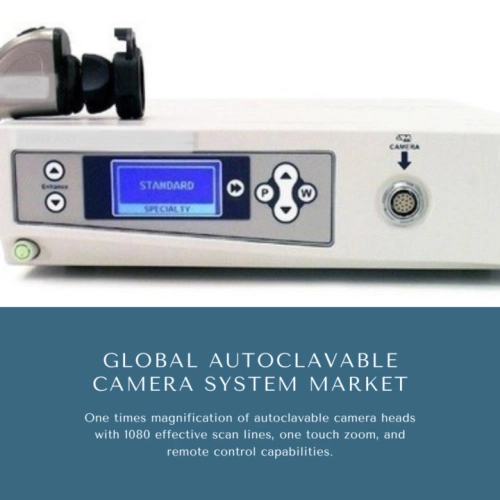
The image can be zoomed in to its original size without losing any HD image quality.Medical device operation time and maintenance costs are decreased by autoclave sterilization.
High-quality photographs can be saved unchanged with little loss of quality since both still and moving images can be captured and output digitally.
Due to the system's ability to add images to patients' electronic medical records, share medical data among institutions, and send image data to distant locations, the digitization of medical information is supported.
The global autoclavable camera system market accounted for $XX Billion in 2023 and is anticipated to reach $XX Billion by 2030, registering a CAGR of XX% from 2024 to 2030.
The HD autoclavable camera heads from Olympus, model OTV-S7PROH-HD-10E/Q, have 1080 effective scan lines, one-touch zoom, and remote control capabilities. The image can be zoomed in on and enlarged up to 1.5 times its original size while still maintaining HD image quality.
There are three switches that can be configured with frequently used functions on the camera head control portion. The camera heads are compatible with a wide range of autoclavable telescopes and are offered with an eye-piece or quick-lock connection.
A subsidiary of Smith & Nephew plc, Smith & Nephew, Inc., Endoscopy Division announced the release of the Dyonics Vision 337 Autoclavable Camera System.
The device, which comprises a detachable coupler and an autoclavable 3-chip endoscopic camera, was created to survive the rigors of steam autoclaving, one of the most effective yet toughest means of sterilization.
The system offers the medical community an autoclavable camera head so that surgeons can benefit from autoclaving without sacrificing overall camera performance or image quality.
| Sl no | Topic |
| 1 | Market Segmentation |
| 2 | Scope of the report |
| 3 | Abbreviations |
| 4 | Research Methodology |
| 5 | Executive Summary |
| 6 | Introduction |
| 7 | Insights from Industry stakeholders |
| 8 | Cost breakdown of Product by sub-components and average profit margin |
| 9 | Disruptive innovation in the Industry |
| 10 | Technology trends in the Industry |
| 11 | Consumer trends in the industry |
| 12 | Recent Production Milestones |
| 13 | Component Manufacturing in US, EU and China |
| 14 | COVID-19 impact on overall market |
| 15 | COVID-19 impact on Production of components |
| 16 | COVID-19 impact on Point of sale |
| 17 | Market Segmentation, Dynamics and Forecast by Geography, 2024-2030 |
| 18 | Market Segmentation, Dynamics and Forecast by Product Type, 2024-2030 |
| 19 | Market Segmentation, Dynamics and Forecast by Application, 2024-2030 |
| 20 | Market Segmentation, Dynamics and Forecast by End use, 2024-2030 |
| 21 | Product installation rate by OEM, 2023 |
| 22 | Incline/Decline in Average B-2-B selling price in past 5 years |
| 23 | Competition from substitute products |
| 24 | Gross margin and average profitability of suppliers |
| 25 | New product development in past 12 months |
| 26 | M&A in past 12 months |
| 27 | Growth strategy of leading players |
| 28 | Market share of vendors, 2023 |
| 29 | Company Profiles |
| 30 | Unmet needs and opportunity for new suppliers |
| 31 | Conclusion |
| 32 | Appendix |




© 2017-2026 Mobility Foresights Pvt Ltd. All rights reserved.
Developed with by ClousTech