
- Get in Touch with Us

Last Updated: Apr 25, 2025 | Study Period: 2024-2030
The global market for automotive powder metallurgy components is growing exponentially with the increasing demand from the automotive sector for lightweight, high-energy-efficient components to minimize fuel consumption and enhance overall performance in line with prescribed safety standards.
Betterments in engine components, such as connecting rods and camshafts, are offering better stability and efficiency that meet more stringent performance criteria in high-performance as well as regular vehicles. Similarly, innovations in transmission gear alloy and processing techniques improve the wear resistance, thereby reducing noise to quieter and stronger drivetrains that will improve market competitiveness and customer satisfaction.
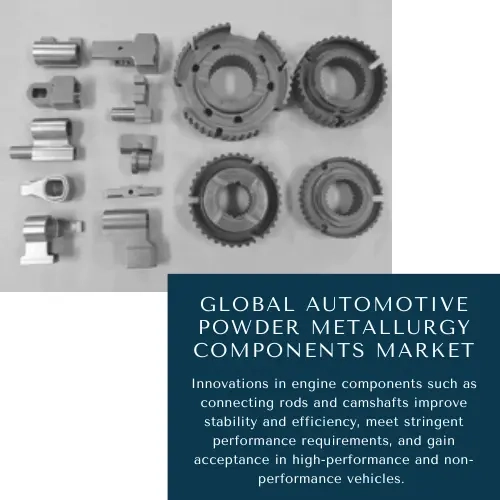
Moreover, it is very preferred by automotive manufacturers, who have to balance cost, quality, and performance since powder metallurgy produces complex shapes with less material waste adding to cost efficiencies. Furthermore, the focus on sustainability and legislation related to environmental protection heightens the incentive for automotive industries to make use of powder metallurgy in their production to reduce vehicle weight and promote better recyclability.
Research and development investments keep innovating powder metallurgy materials and manufacturing processes. On a regional basis,The Asia-Pacific region holds the largest share of the global automotive powder metallurgy components market, driven mainly by countries such as China, Japan, and South Korea, through their robust production levels in the automotive sector.
Automotive powder metallurgy components represent a pivotal innovation in the automotive manufacturing sector because of their high performance. The technology for compacting fine metal powders into complex shapes by processes of pressing and sintering offers considerable advantages in high strength-to-weight ratio, reduced loss of material, and lowered production costs for complicated geometries.
These components, with wide application in almost all automotive systems from engines and transmissions to chassis, give importance to lightweight and durability, very much contributing to fuel efficiency, performance, and longevity. In this direction, automotive manufacturers are increasingly turning to powder metallurgy to meet stringent regulatory requirements for emissions and safety while satisfying consumer requirements for a reliable and efficient vehicle.
The automotive powder metallurgy components market is witnessing strong growth with the automotive industry constantly demanding lightweight, high-performance solutions. Key developments in powder metallurgy materials and processing methods make it demonstrate high-performance characteristics in components such as motor parts, gears, and electric vehicle parts.
New developments in alloy compositions and processing techniques improve wear resistance, reduce noise, and are part of the industry's drive for sustainable mobility. Heavy investments in research and development further push these technologies, the market is poised to expand in regions such as Asia-Pacific, with automotive production and the increasing adoption of electric vehicles under stringent emissions regulations.

The automotive powder metallurgy components market accounted for $XX Billion in 2023 and is anticipated to reach $XX Billion by 2030, registering a CAGR of XX% from 2024 to 2030.
Materials development:Continued innovation in powder metallurgy materials, including new alloy structures and nanostructured powders, to enhance mechanical properties such as strength, corrosion resistance, thermal stability, etc. These developments provide lightweight yet robust products to support automaker goals of improving fuel economy and performance.
Digitalization and Automation:Integration of digital technologies for AI-driven process optimization, IoT-enabled manufacturing, and automated quality assurance systems. These technologies streamline the production processes, reduce the production cost, and make manufacturing more efficient for a consistent quality of product with stringent performance standards.
Sustainability and environmental responsibility:This involves the setting of more demand for sustainable production processes in the powder metallurgy segment, such as reduction of energy consumption by reducing the wastage of raw material through recycling and developing eco-friendly production techniques. Manufacturers utilize powder metallurgy as a cleaner tool than traditional machining methods, reflecting current trends in the automotive industry worldwide.
Additive Manufacturing (3D Printing): Powder metallurgy adopts additive manufacturing techniques that allow for very complex geometries and customized parts with less loss of raw materials. It provides the ability to prototype rapidly, enabling parts impossible or very hard to execute using conventional methods.
Advanced Sintering Techniques:Innovations in sintering processes, such as pressureless sintering, hot isostatic pressing (HIP), and spark plasma sintering (SPS) increase the density, mechanical properties, and dimensional accuracy of powder metallurgy components. Such processes optimize the microstructure for improved strength, toughness, and wear resistance in these materials.
Nanostructuring of powders:The use of nanostructured powders in powder metallurgy processes improves the performance of automotive parts by providing better mechanical properties and surface properties. Nanostructures meet the complex needs of modern automotive applications, enabling part fabrication lightweight and durable with improved fatigue resistance, heat transfer, and corrosion resistance.
| Sr.No | Topic |
| 1 | Market Segmentation |
| 2 | Scope of the report |
| 3 | Research Methodology |
| 4 | Executive Summary |
| 5 | Average B2B by price |
| 6 | Introduction |
| 7 | Insights from Industry stakeholders |
| 8 | Key Drivers for automotive powder metallurgy components Market |
| 9 | Disruptive Innovation in the Industry |
| 10 | Overview of automotive powder metallurgy components Market |
| 11 | Consumer trends in the industry |
| 12 | Recent technological Trends in automotive powder metallurgy components Market |
| 13 | SWOT Analysis of Key Market Players |
| 14 | New product development in the past 12 months |
| 15 | Market Size, Dynamics, and Forecast by Geography, 2024-2030 |
| 16 | Market Size, Dynamics, and Forecast by Application, 2024-2030 |
| 17 | Market Size, Dynamics, and Forecast by Material Type, 2024-2030 |
| 18 | Market Size, Dynamics, and Forecast by Component Type, 2024-2030 |
| 19 | Competitive landscape |
| 20 | Gross margin and average profitability of suppliers |
| 21 | Merger and Acquisition in the past 12 months |
| 22 | Growth strategy of leading players |
| 23 | Market share of vendors, 2023 |
| 24 | Market Company Profiles |
| 25 | Unmet needs and opportunities for new suppliers |
| 26 | Conclusion |


© 2017-2026 Mobility Foresights Pvt Ltd. All rights reserved.
Developed with by ClousTech