
- Get in Touch with Us

Last Updated: Apr 26, 2025 | Study Period: 2024-2030
The display that satisfies the strict requirements of medical imaging in mammography and radiology is called a diagnostic monitor. Radiologists use it to view diagnostic pictures, including X-rays, MRIs, CT scans, and others.
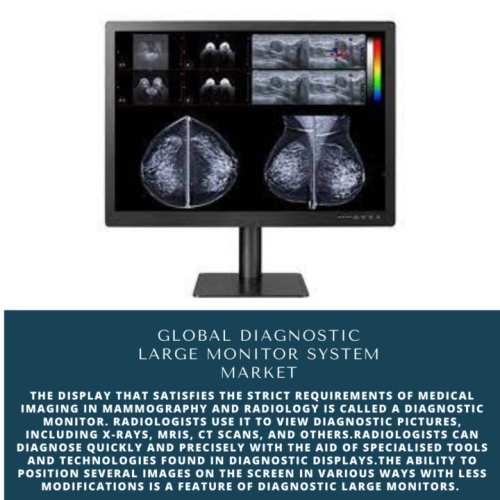
Radiologists can diagnose quickly and precisely with the aid of specialised tools and technologies found in diagnostic displays.The ability to position several images on the screen in various ways with less modifications is a feature of Diagnostic large monitors.
Faster identification of minute details is made possible by well calibrated lighting and image-enhancing elements. In a perfect screen, a diagnostic display would enable the simultaneous viewing of various modalities in both colour and grayscale.
The global diagnostic large monitor system market accounted for $XX Billion in 2023 and is anticipated to reach $XX Billion by 2030, registering a CAGR of XX% from 2024 to 2030.
A 32-inch 4K Ultra HD monitor with a very brilliant LCD panel (850 nits) stuffed with high-performance controllers has been released by Canvys - Visual Technology Solutions. These displays are perfect for the healthcare sector since they are made of lightweight plastic, weigh less than 30 pounds, and have a glass front screen with a flat surface that is simple to clean and disinfect.
LG's new 3MP Diagnostic Monitor (model 21HK512D) and a 1.3MP Clinical Review Monitor (model 19HK312C).
The 21HK512D completes LG's portfolio of medical imaging devices and is the company's first item in the diagnosis
ategory. The LG 21HK512D is a 21.3-inch, 3MP (1536 x 2048) Diagnostic Monitor with remarkable brightness level.
Its built-in calibrator determines which colours require adjusting and corrects the erroneous colours to ensure that MRI and CT scans are clearly displayed. The 19-inch, 5:4 ratio IPS screen of LG's new 1.3MP (1280 x 1024) Clinical Review Monitor is compatible with current hospital technology.
| Sl no | Topic |
| 1 | Market Segmentation |
| 2 | Scope of the report |
| 3 | Abbreviations |
| 4 | Research Methodology |
| 5 | Executive Summary |
| 6 | Introduction |
| 7 | Insights from Industry stakeholders |
| 8 | Cost breakdown of Product by sub-components and average profit margin |
| 9 | Disruptive innovation in the Industry |
| 10 | Technology trends in the Industry |
| 11 | Consumer trends in the industry |
| 12 | Recent Production Milestones |
| 13 | Component Manufacturing in US, EU and China |
| 14 | COVID-19 impact on overall market |
| 15 | COVID-19 impact on Production of components |
| 16 | COVID-19 impact on Point of sale |
| 17 | Market Segmentation, Dynamics and Forecast by Geography, 2024-2030 |
| 18 | Market Segmentation, Dynamics and Forecast by Product Type, 2024-2030 |
| 19 | Market Segmentation, Dynamics and Forecast by Application, 2024-2030 |
| 20 | Market Segmentation, Dynamics and Forecast by End use, 2024-2030 |
| 21 | Product installation rate by OEM, 2023 |
| 22 | Incline/Decline in Average B-2-B selling price in past 5 years |
| 23 | Competition from substitute products |
| 24 | Gross margin and average profitability of suppliers |
| 25 | New product development in past 12 months |
| 26 | M&A in past 12 months |
| 27 | Growth strategy of leading players |
| 28 | Market share of vendors, 2023 |
| 29 | Company Profiles |
| 30 | Unmet needs and opportunity for new suppliers |
| 31 | Conclusion |
| 32 | Appendix |




© 2017-2026 Mobility Foresights Pvt Ltd. All rights reserved.
Developed with by ClousTech