
- Get in Touch with Us

Last Updated: Mar 17, 2026 | Study Period: 2026-2032
The India Data Center UPS Market is expanding steadily as data center infrastructure growth accelerates worldwide.
Increasing demand for reliable power backup systems to support critical IT infrastructure and minimise downtime is driving adoption.
Technological advancements in UPS systems — including modular, scalable, and lithium-ion based solutions — are improving efficiency and reliability.
Growth in cloud services, hyperscale facilities, and edge computing installations is reinforcing UPS procurement.
Rising enterprise focus on uptime, data integrity, and business continuity supports robust UPS integration.
Energy efficiency standards and green data center initiatives are promoting high-efficiency UPS offerings.
Strategic partnerships between UPS OEMs and data center design integrators are enhancing solution deployment.
Expansion of micro-grid and hybrid renewable integration is increasing need for intelligent UPS controls in India.
The India Data Center UPS Market is projected to grow from USD 12.8 billion in 2025 to USD 26.9 billion by 2032, registering a CAGR of 10.9% during the forecast period. Growth is primarily driven by increasing data traffic, expanding cloud infrastructure, and heightened expectations for zero downtime across critical services.
UPS systems provide seamless power continuity during outages, voltage fluctuations, and grid disturbances — ensuring protection for servers, networking gear, and storage systems. Adoption of high-efficiency and scalable UPS architectures supports reduced total cost of ownership and improved operational sustainability in India.
Data center UPS (Uninterruptible Power Supply) systems are critical components that deliver continuous, conditioned electrical power to IT loads during grid failures, brownouts, or transient disturbances. UPS solutions range from small modular systems for edge facilities to large double-conversion units for hyperscale deployments — all designed to protect sensitive computing infrastructure.
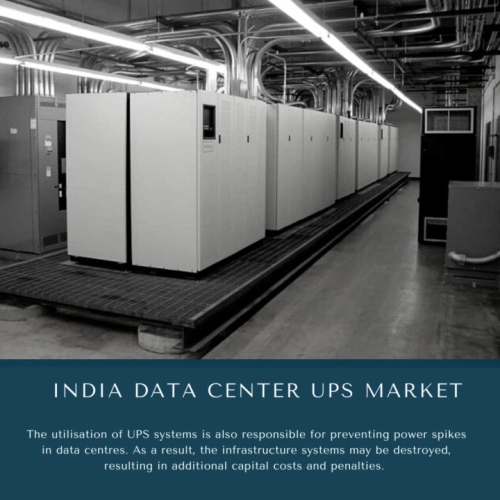
Modern UPS systems employ advanced battery technologies (such as VRLA, lithium-ion, and flow batteries), redundant architectures, smart controls, and remote diagnostics features. In India, rising investment in data centers — driven by cloud, IoT, AI, and digital services — necessitates dependable UPS solutions to avoid financial losses due to downtime or data corruption.
By 2032, the India Data Center UPS Market is expected to see continued expansion with increased integration of digital power controls, predictive maintenance analytics, and hybrid energy systems that combine UPS with renewable generation and micro-grid frameworks. Demand for UPS systems capable of supporting 5G network edge sites, colocation facilities, and mission-critical enterprise data centers will accelerate.
Technological advancements — such as modular UPS, containerised power solutions, and AI-driven energy optimisation — will improve serviceability and reduce operational costs. Sustainability mandates and stringent availability SLAs will further reinforce UPS penetration across all data center tiers in India.
Shift Toward Modular and Scalable UPS Architectures
Data centers in India are increasingly adopting modular UPS systems that allow capacity expansion, hot-swap maintenance, and redundancy improvements without full system shutdowns. Modular architectures deliver improved uptime by enabling parallel deployment and dynamic load sharing among UPS cabinets. Scalability supports phased infrastructure growth that aligns with evolving compute and load requirements. These solutions often integrate hot-plug components that reduce mean time to repair (MTTR) and support flexible power scaling. Cost efficiencies stem from right-sizing deployments based on current and projected demand.
Integration of Lithium-Ion Battery Technologies
Lithium-ion battery adoption in UPS systems is rising in India due to higher energy density, longer cycle life, faster recharge times, and reduced footprint compared with traditional valve-regulated lead-acid (VRLA) batteries. Lithium-ion UPS reduces cooling needs, improves storage longevity, and lowers total cost of ownership over lifecycle. Enhanced battery management systems ensure optimal performance and safety. As data centers prioritise sustainability and space efficiency, lithium-ion based UPS becomes a preferred choice — particularly in edge and hyperscale facilities.
Adoption of AI-Driven Power Management and Predictive Analytics
AI and machine learning are being integrated into UPS control systems in India to optimise load distribution, forecast battery health, and predict maintenance needs. Predictive analytics models evaluate environmental conditions, usage patterns, and failure indicators to schedule proactive servicing. Intelligent UPS platforms improve energy efficiency and reduce unplanned outages. Integration with DCIM (data center infrastructure management) tools enables better capacity planning and operational visibility. AI-enabled controls enhance reliability and service life of UPS assets.
Expansion of Hybrid Renewable and Micro-Grid Integrated UPS Systems
Data centers in India are increasingly deploying hybrid energy architectures that combine UPS systems with renewable generation (solar, wind) and micro-grid frameworks to enhance resilience and reduce dependence on grid power. UPS integrated with renewable sources supports uninterrupted power delivery during prolonged outages and reduces carbon emissions. Intelligent energy management coordinates between battery storage and generation assets. These hybrid setups improve energy autonomy for off-grid or remote data centers. Regulatory incentives for clean energy accelerate adoption.
Demand for High-Efficiency and Green UPS Solutions
Growing emphasis on sustainability and energy efficiency in India is encouraging adoption of UPS systems with high efficiency ratings, reduced harmonic distortion, and advanced power factor correction capabilities. Green UPS offerings reduce energy waste, operational costs, and environmental impact. Certification standards and efficiency benchmarks guide procurement choices. High-efficiency UPS systems support overall data center PUE (power usage effectiveness) improvements, reinforcing sustainability goals. Energy-aware UPS platforms align with corporate ESG commitments.
Expansion of Cloud and Hyperscale Data Centers
Rapid growth of cloud computing services and hyperscale facilities in India is driving substantial demand for UPS systems that ensure uninterrupted operations. Hyperscale providers require high-availability power architectures with redundancy and quick failover capabilities. UPS deployments are critical to prevent costly outages and preserve service availability. Colocation services also depend on robust UPS infrastructures to meet stringent client SLAs. Cloud expansion accelerates UPS consumption across diverse tiers.
Rising Expectations for Reliability and Zero Downtime
Enterprises and service providers in India face increasing expectations for continuous service availability, heightened by digital transformation and 24/7 online services. Even brief power interruptions can result in significant financial losses. UPS systems provide instantaneous backup power that bridges gaps until auxiliary generators or grid restoration occurs. Demand for high-performance UPS solutions grows with adoption of mission-critical workloads and real-time applications. Reliability requirements underpin procurement decisions.
Stringent Regulatory and Compliance Standards
Data centers in India must comply with stringent reliability, uptime, and safety standards — including standards from Uptime Institute, Tier classifications, and regional codes that mandate backup power provisions. Regulatory expectations for critical infrastructure resilience support robust UPS deployments. Compliance ensures data integrity and operational continuity across essential services. UPS systems are central to meeting audit and certification requirements. Standards compliance drives market growth.
Increasing Focus on Edge Data Center Deployments
The rise of edge computing in India — driven by 5G rollouts, IoT, and latency-sensitive applications — necessitates localized UPS solutions that protect distributed sites. Edge facilities often operate in space-constrained and remote environments where reliable power backup is crucial. Compact, high-efficiency UPS units support edge nodes and ensure continuity for real-time processing. Edge expansion broadens addressable UPS market segments beyond traditional core data centers.
Adoption of Advanced Monitoring and Remote Management Tools
Integration of UPS with remote monitoring, analytics, and control platforms in India allows operators to manage distributed power assets more efficiently. Remote diagnostics enable proactive servicing, firmware updates, and capacity planning. Centralised management reduces operational overhead and improves SLA adherence. Critical alerts and performance insights support rapid response to power anomalies. Intelligent monitoring enhances overall UPS service quality.
High Initial Procurement and Lifecycle Costs
Advanced UPS systems require significant upfront investment — particularly modular, lithium-ion, and hybrid solutions — in India. Capital intensity can constrain adoption among smaller enterprises and budget-focused data centers. Lifecycle costs include replacement batteries, scheduled maintenance, and periodic upgrades. Total cost of ownership remains a key consideration in procurement planning. Cost pressures may slow deployment in price-sensitive segments.
Technological Complexity and Integration Challenges
Integrating sophisticated UPS systems with existing data center infrastructure — including generators, PDUs, and DCIM tools — requires specialised expertise and careful planning in India. Ensuring seamless interoperability with legacy equipment and control systems may involve custom engineering and software adjustment. Compatibility concerns can extend deployment timelines. Technical complexity increases commissioning and testing overhead. Skilled technical resources are required for reliable integration and optimisation.
Battery Lifecycle and Disposal Issues
Battery components — particularly VRLA and lithium-ion units — present lifecycle management and environmental disposal challenges in India. Degradation over time affects performance, requiring proactive replacement planning. Safe disposal and recycling of spent batteries must adhere to regulatory requirements, adding operational complexity and costs. Battery thermal management and safety protocols influence design complexity. Improved recycling frameworks are needed to mitigate environmental impact.
Regulatory and Compliance Uncertainties
Evolving regulatory models and power reliability standards in India may affect UPS procurement strategies and certification timelines. Data centers must navigate regional codes, electrical grid regulations, and energy efficiency mandates that vary across jurisdictions. Uncertainties in compliance expectations can delay planning and deployment. Adapting to frequent standard revisions increases operational overhead. Regulatory alignment is essential to prevent disruptions but adds procedural complexity.
Supply Chain Constraints and Component Lead Times
Global supply chain disruptions — including semiconductor shortages, transformer delays, and specialised component lead-time challenges — impact UPS manufacturing and delivery timelines in India. Long lead times can delay project completion, affecting data center commissioning schedules. Inventory management and sourcing strategies become critical to maintain deployment plans. Geopolitical factors and logistics challenges add to supply uncertainty. Supply volatility influences cost forecasting.
Standby/Offline UPS
Line-Interactive UPS
Online/Double-Conversion UPS
Modular UPS
Rotary UPS Systems
<10 kVA
10–100 kVA
100–500 kVA
500 kVA–1 MW
1 MW
| S No | Overview of Development | Development Detailing | Region of Development | Possible Future Outcomes |
| 1 | Microsoft announces plans for firm's largest data centre in India | The announcement was made in the presence of Rajeev Chandrasekhar, Union Minister of State for Information Technology, and KT Rama Rao, Telangana's Information Technology Minister. | India | This would enhance better Technological Controls |
| 2 | Microsoft acquires 3 land parcels in Hyderabad, to establish largest data center region in India | Microsoft has paid roughly Rs 275 crore for three land plots in Hyderabad where it plans to build a data centre. | India | This would enhance better Technological Controls |
| 3 | New Sophos Central data center is now live in India | Sophos Central is a cloud-based administration tool for our powerful, next-generation security solutions. | India | This would enhance better Technological Controls |
| 4 | Data centres to enable India’s trillion-dollar digital economy growth | The data centre sector in India is set to develop for a long time, thanks to a variety of consumer and demographic factors. | India | This would enhance better Technological Controls |
| 5 | Numeric Launches Keor XPE, Three Phase UPS For Data Centers And Mission Critical Applications | Numeric, a renowned UPS producer and developer of voltage quality solutions, has unveiled the debut of the 'Keor XPE' three - phase power adaptable UPS. | India | This would enhance better Technological Controls |
The media and entertainment business is often involved in the generation, gathering, and delivery of material, news and information, advertising, and entertainment via a variety of media channels and platforms, which is critical for data centers, resulting in an increase in UPS consumption.In present times, millennials devote more time downloading material than watching traditional television, and streaming services are growing in popularity, with around 60% of customers utilising them on a monthly basis.
ABB is a leading mobiliser of the Mobility solutions involving UPS solutions requirements in the market. There's a single-phase and three-phase UPS for any purpose. You may be certain of the highest dependability and a constant supply of clean power with a modular, plug-in UPS architecture and pre-engineered frames that reduce cabling.
You can keep it under control from wherever, at whichever time, with physical and virtual real-time surveillance. The modular architecture of ABB, which is based on DPA technology, allows to add or replace components
Eaton is part of the component manufacturing trending companies in the current industry. For contemporary data centers, the Eaton 93PM UPS is the ideal three-phase white or grey space option. The 93PM is interoperable with lithium-ion Necessary requirements, which seem to be 40 percent on average lighter and also have double the lifespan of VRLA battery packs, resulting in lower battery replacement costs and more space in battery closets.The process of implementing front-to-back or front-to-top air increases implementation versatility while lowering cooling costs.
Schneider Electric introduced high-efficiency modular UPS solutions with advanced predictive analytics in India.
Eaton Corporation expanded its lithium-ion UPS portfolio targeted at edge computing sites in India.
Vertiv Holdings LLC launched AI-based UPS monitoring platforms for remote diagnostics in India.
Huawei Technologies Co., Ltd. strengthened localised UPS production and service networks in India.
Delta Electronics, Inc. unveiled hybrid UPS systems integrating renewable generation support in India.
What is the projected market size and growth rate of the India Data Center UPS Market by 2032?
Which UPS types and power ratings are gaining fastest adoption in India?
How are modular architectures and battery technologies shaping market dynamics?
What are the primary integration and regulatory challenges affecting data center UPS deployment?
Who are the leading players operating in the India Data Center UPS Market?
| Sr no | Topic |
| 1 | Market Segmentation |
| 2 | Scope of the report |
| 3 | Research Methodology |
| 4 | Executive summary |
| 5 | Key Predictions of India Data Center UPS Market |
| 6 | Avg B2B price of India Data Center UPS Market |
| 7 | Major Drivers For India Data Center UPS Market |
| 8 | India Data Center UPS Market Production Footprint - 2025 |
| 9 | Technology Developments In India Data Center UPS Market |
| 10 | New Product Development In India Data Center UPS Market |
| 11 | Research focus areas on new India Data Center UPS |
| 12 | Key Trends in the India Data Center UPS Market |
| 13 | Major changes expected in India Data Center UPS Market |
| 14 | Incentives by the government for India Data Center UPS Market |
| 15 | Private investments and their impact on India Data Center UPS Market |
| 16 | Market Size, Dynamics, And Forecast, By Type, 2026-2032 |
| 17 | Market Size, Dynamics, And Forecast, By Output, 2026-2032 |
| 18 | Market Size, Dynamics, And Forecast, By End User, 2026-2032 |
| 19 | Competitive Landscape Of India Data Center UPS Market |
| 20 | Mergers and Acquisitions |
| 21 | Competitive Landscape |
| 22 | Growth strategy of leading players |
| 23 | Market share of vendors, 2025 |
| 24 | Company Profiles |
| 25 | Unmet needs and opportunities for new suppliers |
| 26 | Conclusion |



© 2017-2026 Mobility Foresights Pvt Ltd. All rights reserved.
Developed with by ClousTech
