
- Get in Touch with Us

Last Updated: Jul 03, 2026 | Study Period: 2026-2032 | Base Year: 2025 | Pages: 90–110 | Currency: USD
This report answers the single question a market entrant needs resolved before committing capital: which vision-guidance workload, by application and by geography, offers a defensible beachhead now, before the leaders' installed-base and software-attach economics close the window.
The market-size trajectory is bottom-up modeled from disclosed vendor revenue growth rates applied against the IFR's disclosed industrial-robot hardware base, not an audited actual. Every sizing claim is flagged by confidence rather than asserted as false precision.
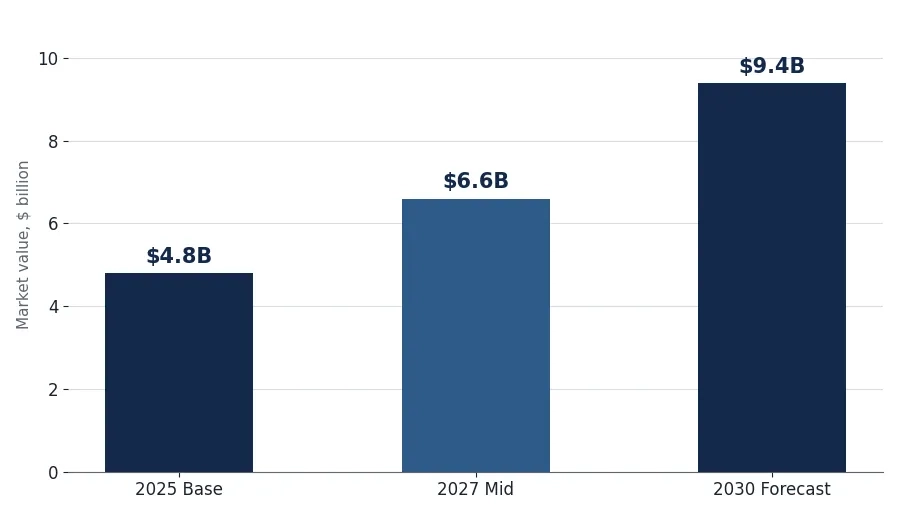
On a bottom-up modeled basis, the global robotics vision guidance systems market is estimated at approximately $4.8 billion in 2025, built from disclosed vendor growth rates against the IFR's stated $16.5 billion 2024 industrial robot hardware base, reaching roughly $6.6 billion by the 2027 mid-point and $9.4 billion by 2030 — an implied CAGR in the low-to-mid teens.
The curve is weighted from Cognex's double-digit 2025 quarterly growth, Keyence's 9.5% fiscal 2025 revenue growth, and Basler's 22% 2025 revenue growth with 23% order growth, offset against a broader base that still includes flatter legacy inspection-only segments.
The trajectory bends upward from 2026 to 2027 as China's humanoid perception-component targets and logistics-sector vision spend, both already visible in 2025 vendor order books, move from pilot to volume purchasing.
Robotics vision guidance systems combine cameras, 3D sensors, lighting, and image-processing software to let a robot locate, identify, and precisely position parts or itself in real time, closing the loop between what a robot sees and how it moves.
This differs from standalone machine vision inspection, which only judges pass or fail; guidance systems feed coordinates directly into robot motion control, enabling bin picking, random-part pick-and-place, in-line assembly verification with correction, and mobile robot navigation.
The category matters now because three forces — labor scarcity, the shift from fixed high-volume lines to high-mix low-volume production, and the extension of robotics into logistics, semiconductor, and humanoid form factors — all require a robot to handle variability that hard tooling cannot, which only vision can resolve.
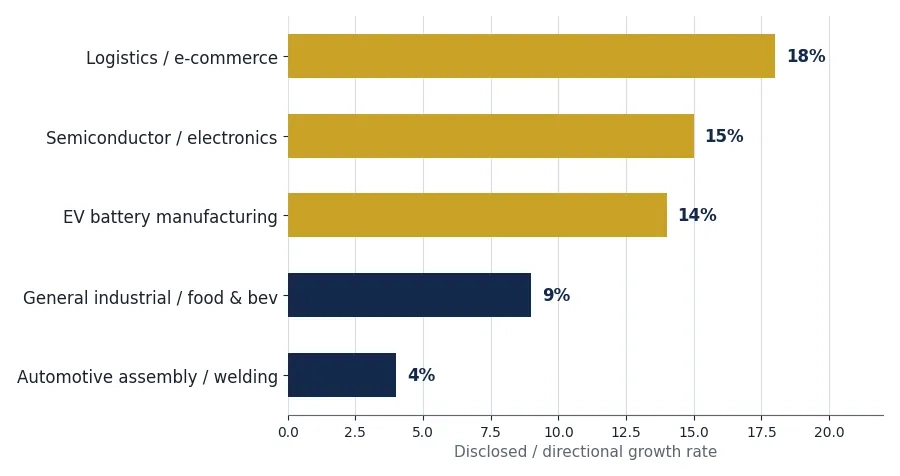
Robotics vision guidance is no longer riding a single industrial-robot installation cycle; it is riding two overlapping ones — a mature discrete-manufacturing base that is flat to declining in its historical anchor markets, and a fast-compounding logistics, semiconductor, and battery-manufacturing base pulling disclosed vendor growth into the high teens.
China is simultaneously the largest existing demand pool and the source of a new, policy-mandated perception-stack product category tied to humanoid deployment targets. The addressable opportunity is shifting away from camera-and-optics hardware sold against a robot unit and toward AI-enabled guidance software and application-specific solution stacks sold against a workload that a buyer can qualify quickly.
Entrants who design around a single legacy end market — automotive assembly — will be building for the segment where growth has already gone flat.
| Segment | Unmet Need |
|---|---|
| Logistics & e-commerce item handling | Very High — low-cost, fast-deploy 3D guidance for irregular, poly-bagged, mixed-SKU items |
| EV battery & cell manufacturing | High — high-precision guidance validated for cleanroom and thermal-sensitive handling |
| Semiconductor wafer & panel handling | High — sub-micron guidance accuracy integrated with existing inspection workflows |
| General industrial SME retrofit | Moderate — guidance that does not require a specialist integrator to commission |
| Humanoid & embodied-AI perception | Very High — perception stacks that generalize across tasks rather than being hand-tuned per cell |
The most immediately actionable whitespace is SME general-industrial retrofit. Roughly two-thirds of Cognex, Keyence, and Basler's collective disclosed revenue still concentrates in large accounts, where dedicated integrators absorb commissioning complexity. A guidance product built around self-calibrating cameras, pre-trained part libraries for common SME geometries, and a no-code teach interface removes the largest single cost line in an SME automation project — the integrator's commissioning hours — and converts a six-figure project into a configuration task.
| Region | 2024–25 Installs | Trend | Why it matters |
|---|---|---|---|
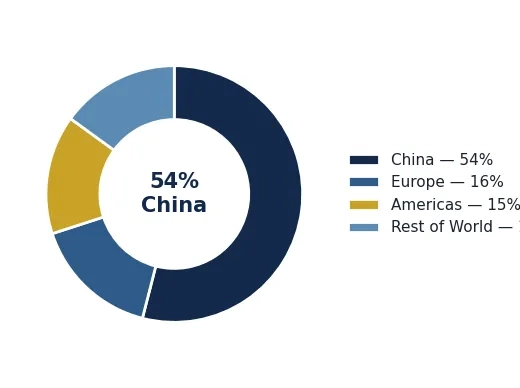
| China | 295,000 | ~54% share | MIIT Humanoid Robot Action Plan; deep domestic Machine Vision Union supplier base; operational stock >2M units |
| United States | 38,000 | +11% YoY | Growth led by food and non-manufacturing sectors; automotive installs roughly flat at 13,500 units |
| Europe | 85,000 | -8% YoY | Germany, the largest EU market, down 5% to ~26,982 units; pressure to grow via software attach and retrofit |
| Rest of World | ~124,000 | residual | Broader Asia ex-China and emerging markets; earlier-stage automation build-out |
Installation figures per International Federation of Robotics (IFR) World Robotics 2025 and regional press releases; regional revenue splits for vision guidance specifically are not independently disclosed.
| Technology | Representative Application | Note |
|---|---|---|
| 2D vision guidance | Bin picking / random pick | Cost-effective baseline for structured, low-mix parts; largest installed legacy base |
| 3D vision guidance | Pick-and-place / palletizing | Leading choice for irregular and mixed-SKU logistics items |
| AI-embedded / deep-learning guidance | Assembly verification with correction | Fastest-growing tier; core to semiconductor and electronics inspection-guided pick |
| Line scan / high-speed guidance | Welding & precision positioning | Core to EV battery cell handling and thermal-sensitive processes |
| Mobile robot navigation guidance | Autonomous mobile robots | General industrial and food & beverage; growing beyond fixed-cell deployment |
| Stage | Margin Band | Note |
|---|---|---|
| Optics, sensors & imaging components | Moderate | Swings materially with volume; Basler's 2025 EBT margin recovered to 7.2% from a negative prior year on volume alone |
| Guidance software & AI models | Very High | Software-heavy leaders such as Keyence sustain operating margins above 50% |
| System integration & commissioning | Low | Integrators absorb the highest labor cost per project; the cost line the SME whitespace targets for compression |
| Robot OEM controller & platform | High | Fanuc, ABB and Yaskawa increasingly bundle native vision guidance, capturing value that previously flowed to third-party suppliers |
Strategic implication: lock-in concentrates at the guidance-software layer, where application-specific calibration and part libraries are costly to rebuild on a different platform, and at the robot OEM controller layer, where native vision bundling raises the bar for independent suppliers to win new design slots.
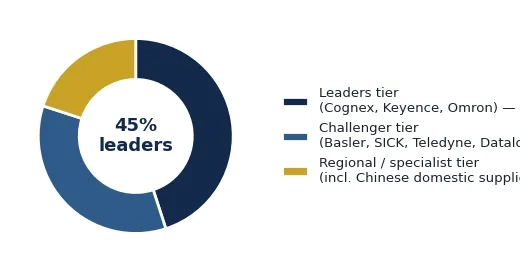
Concentration sits in the leaders tier on the strength of direct-sales reach and software depth, but the fastest-growing sub-segments — logistics and China-based semiconductor and battery accounts — are precisely where regional and specialist vendors such as Mech-Mind and Techman Robot are gaining share fastest, exposing the leaders tier's weakest flank in the geography carrying the most volume.
| Vendor group (2025, est.) | Share (est.) | Specific position |
|---|---|---|
| Leaders tier | ~45% | Cognex, Keyence, Omron — direct-sales reach and software depth |
| Challenger tier | ~35% | Basler, SICK AG, Teledyne (DALSA, FLIR), Datalogic |
| Regional / specialist tier | ~20% | Mech-Mind Robotics, Techman Robot and Chinese domestic suppliers — gaining share fastest |
| Segmentation Axis | Categories |
|---|---|
| By technology | 2D vision guidance; 3D vision guidance; AI-embedded / deep-learning guidance; line scan / high-speed guidance; mobile robot navigation |
| By application | Bin picking / random pick; pick-and-place / palletizing; assembly verification with correction; welding & precision positioning; mobile robot navigation |
| By end industry | Automotive; logistics & e-commerce; semiconductor & electronics; EV battery manufacturing; general industrial / food & beverage |
| By region | China; United States; Europe; Rest of World |
Figures in this report are triangulated from disclosed operating data of publicly listed vision-guidance and robotics vendors, statistics published by the International Federation of Robotics and national statistical bodies, standards documentation from ISO and IEC, and government and ministry policy publications, primarily China's MIIT.
The one modeled market-size trajectory is built bottom-up from named vendor revenue growth rates applied against the IFR's disclosed industrial robot hardware base, with each inflection point tied to a named driver. The evidence base also includes primary stakeholder consultations across the value chain, covering component and sensor suppliers, robot manufacturers and integrators, channel partners, and end customers in logistics, semiconductor, automotive and battery manufacturing.
| Scope Item | Assumption |
|---|---|
| Base Year | 2025 |
| Forecast Period | 2026–2032 |
| Currency | USD |
| Market Sizing Approach | Bottom-up, disclosed vendor growth rates applied against IFR's industrial robot hardware base |
| Primary Inputs | Component/sensor suppliers, robot manufacturers & integrators, channel partners, end customers in logistics, semiconductor, automotive, battery manufacturing |
| Secondary Inputs | IFR statistics, vendor SEC/earnings filings, ISO/IEC standards documentation, MIIT policy publications |
| Validation | Each trajectory inflection point tied to a named, disclosed driver rather than an unattributed assumption |
If you are evaluating a vision-guidance product entry, a channel partnership, or a competitive response tied to the logistics, semiconductor or humanoid-perception rotation, this report is engineered to give you the numbers, the names, and the nuance to make defensible decisions over the 2026–2032 horizon.
| Sl no | Topic |
| 1 | Market Segmentation |
| 2 | Scope of the report |
| 3 | Research Methodology |
| 4 | Executive summary |
| 5 | Key Predictions of Robotics Vision Guidance Systems Market |
| 6 | Avg B2B price of Robotics Vision Guidance Systems Market |
| 7 | Major Drivers For Robotics Vision Guidance Systems Market |
| 8 | Global Robotics Vision Guidance Systems Market Production Footprint - 2025 |
| 9 | Technology Developments In Robotics Vision Guidance Systems Market |
| 10 | New Product Development In Robotics Vision Guidance Systems Market |
| 11 | Research focus areas on new Robotics Vision Guidance Systems Market |
| 12 | Key Trends in the Robotics Vision Guidance Systems Market |
| 13 | Major changes expected in Robotics Vision Guidance Systems Market |
| 14 | Incentives by the government for Robotics Vision Guidance Systems Market |
| 15 | Private investements and their impact on Robotics Vision Guidance Systems Market |
| 16 | Market Size, Dynamics And Forecast, By Type, 2026-2032 |
| 17 | Market Size, Dynamics And Forecast, By Output, 2026-2032 |
| 18 | Market Size, Dynamics And Forecast, By End User, 2026-2032 |
| 19 | Competitive Landscape Of Robotics Vision Guidance Systems Market |
| 20 | Mergers and Acquisitions |
| 21 | Competitive Landscape |
| 22 | Growth strategy of leading players |
| 23 | Market share of vendors, 2025 |
| 24 | Company Profiles |
| 25 | Unmet needs and opportunity for new suppliers |
| 26 | Conclusion |


© 2017-2026 Mobility Foresights Pvt Ltd. All rights reserved.
Developed with by ClousTech

