- Get in Touch with Us

Last Updated: Apr 25, 2025 | Study Period: 2022-2030
The anion exchange resin has an amino functional group that enables the exchange of anions like the Cl- ion and the SO4-- ion. The basic strength of the amino functional group can be used to distinguish between strongly basic and weakly basic anion exchange resins.
The quaternary ammonium-containing ion exchange resin is highly alkaline and dissociates similarly to NaOH and KOH. Therefore it is called a strongly basic anion exchange resin.
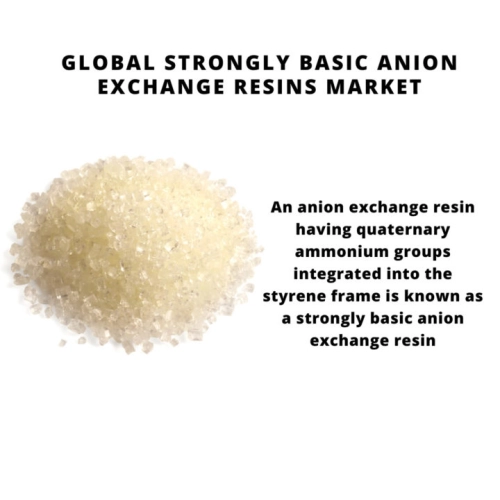
An anion exchange resin having quaternary ammonium groups integrated into the styrene frame is known as a strongly basic anion exchange resin. Type I with a trimethyl ammonium group and Type II with a dimethy lethanol ammonium group are two varieties with different levels of alkalinity.
The highly basic resin's capacity to strongly absorb anions is utilised to create demineralized water that is extremely pure.
The Global Strongly Basic Anion Exchange Resins market accounted for $XX Billion in 2021 and is anticipated to reach $XX Billion by 2030, registering a CAGR of XX% from 2022 to 2030.
The manufacturer of specialty chemicals LANXESS is expanding its line of consumer care products to include the new Lewatit PH 1074 HEP. It is especially well adapted to the purification and interim storage of heparin, in addition to the decolorization of fermentation broths and sugar.
As one of the industry's top producers of ion exchangers, LANXESS hopes to further solidify its position on the market by attracting new clients in the pharmaceutical and bioprocessing sectors with the help of this ground-breaking device.
Based on a cross-linked polyacrylate, the macroporous, strongly basic anion exchange resin satisfies food quality criteria. It contains a unique resin matrix and pore structure that were created specifically for the capture of very molecular substances.
Lewatit PH 1074 HEP facilitates the reliable capture and removal of organic compounds with a high molecular weight, making it suited for the treatment and purification of products made from biomass. This implies that complex process solutions, including fermentation broths, can be filtered and treated, as well as liquid sugar syrups.
| Sl no | Topic |
| 1 | Market Segmentation |
| 2 | Scope of the report |
| 3 | Abbreviations |
| 4 | Research Methodology |
| 5 | Executive Summary |
| 6 | Introduction |
| 7 | Insights from Industry stakeholders |
| 8 | Cost breakdown of Product by sub-components and average profit margin |
| 9 | Disruptive innovation in the Industry |
| 10 | Technology trends in the Industry |
| 11 | Consumer trends in the industry |
| 12 | Recent Production Milestones |
| 13 | Component Manufacturing in US, EU and China |
| 14 | COVID-19 impact on overall market |
| 15 | COVID-19 impact on Production of components |
| 16 | COVID-19 impact on Point of sale |
| 17 | Market Segmentation, Dynamics and Forecast by Geography, 2022-2030 |
| 18 | Market Segmentation, Dynamics and Forecast by Product Type, 2022-2030 |
| 19 | Market Segmentation, Dynamics and Forecast by Application, 2022-2030 |
| 20 | Market Segmentation, Dynamics and Forecast by End use, 2022-2030 |
| 21 | Product installation rate by OEM, 2022 |
| 22 | Incline/Decline in Average B-2-B selling price in past 5 years |
| 23 | Competition from substitute products |
| 24 | Gross margin and average profitability of suppliers |
| 25 | New product development in past 12 months |
| 26 | M&A in past 12 months |
| 27 | Growth strategy of leading players |
| 28 | Market share of vendors, 2022 |
| 29 | Company Profiles |
| 30 | Unmet needs and opportunity for new suppliers |
| 31 | Conclusion |
| 32 | Appendix |


© 2017-2026 Mobility Foresights Pvt Ltd. All rights reserved.
Developed with by ClousTech