
- Get in Touch with Us

Last Updated: Apr 25, 2025 | Study Period:
The cable industry has been used two-way splitters for years. These inexpensive passive devices are used in headends, hubs, the outside distribution network, subscriber drops, towers, and other locations.
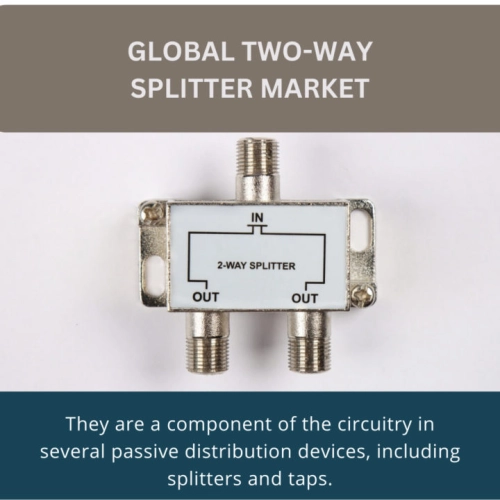
They are a component of the circuitry in several passive distribution devices, including splitters and taps. A four-way splitter, for instance, consists of a two-way splitter feeding two more two-way splitters.
If you have ever been curious about how a two-way splitter functions. The cable industry has been used two-way splitters for years.
These inexpensive passive devices are used in headends, hubs, the outside distribution network, subscriber drops, towers, and other locations.
They are a component of the circuitry in several passive distribution devices, including splitters and taps.
A four-way splitter, for instance, consists of a two-way splitter feeding two more two-way splitters.If you have ever been curious about how a two-way splitter functions.
A power combiner can also be a two-way splitter. The splitter's two former output ports are now input ports in this configuration, and the original input port is now the splitter's output port.
The single output port in this case will receive RF signals from two sources that have been applied to the two input ports. But when it comes to the combined power, there is a certain amount of "it depends.
The Global Two-Way Splitter market accounted for $XX Billion in 2023 and is anticipated to reach $XX Billion by 2030, registering a CAGR of XX% from 2024 to 2030.
The demand for increased electrical system efficiency and dependability is what drives the global market for power two-way splitters.
In the upcoming years, the market for power two-way splitters is anticipated to increase as a result of the rising demand for renewable energy sources and the requirement to lower carbon emission levels.
Power two-way splitters are used by the telecommunications sector to minimise battery size and weight as well as to reduce electrical expenses by reducing wasted power.
They are also utilised in chemical engineering to provide electricity on offshore rigs and ships, as well as in aviation engineering to reduce noise levels and improve passenger comfort. Due to the high price, the market's growth may encounter some bumps.
| Sl no | Topic |
| 1 | Market Segmentation |
| 2 | Scope of the report |
| 3 | Abbreviations |
| 4 | Research Methodology |
| 5 | Executive Summary |
| 6 | Introduction |
| 7 | Insights from Industry stakeholders |
| 8 | Cost breakdown of Product by sub-components and average profit margin |
| 9 | Disruptive innovation in the Industry |
| 10 | Technology trends in the Industry |
| 11 | Consumer trends in the industry |
| 12 | Recent Production Milestones |
| 13 | Component Manufacturing in US, EU and China |
| 14 | COVID-19 impact on overall market |
| 15 | COVID-19 impact on Production of components |
| 16 | COVID-19 impact on Point of sale |
| 17 | Market Segmentation, Dynamics and Forecast by Geography, 2024-2030 |
| 18 | Market Segmentation, Dynamics and Forecast by Product Type, 2024-2030 |
| 19 | Market Segmentation, Dynamics and Forecast by Application, 2024-2030 |
| 20 | Market Segmentation, Dynamics and Forecast by End use, 2024-2030 |
| 21 | Product installation rate by OEM, 2023 |
| 22 | Incline/Decline in Average B-2-B selling price in past 5 years |
| 23 | Competition from substitute products |
| 24 | Gross margin and average profitability of suppliers |
| 25 | New product development in past 12 months |
| 26 | M&A in past 12 months |
| 27 | Growth strategy of leading players |
| 28 | Market share of vendors, 2023 |
| 29 | Company Profiles |
| 30 | Unmet needs and opportunity for new suppliers |
| 31 | Conclusion |
| 32 | Appendix |



© 2017-2026 Mobility Foresights Pvt Ltd. All rights reserved.
Developed with by ClousTech
